In memoriam

Mum
Mary Teresa Ann Lyons

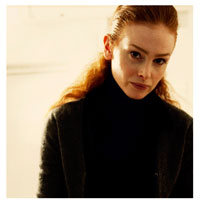
These cold frosty mornings, such as the one I awoke to today, always remind me of the days my mother spent in the Brook hospital in Shooters Hill, towards the end of her life. The poem below was written immediately after visiting her one day in the hospital when I, like all her children, had been stunned by her sudden decline. The accompanying photo was taken two years earlier, around the time of her seventieth birthday and that is how I like to remember her. She was born in Tralee, Co. Kerry in 1922, and her family emigrated to Welling in 1937, for reasons I never fully understood. From the photo it can be seen that even at her age then, she had lost none of the beauty that led my father to call her his Rose of Tralee throughout their life together. But the radiance of her physical beauty was nothing compared to the inner beauty that glowed within her and was manifest in her eternal smile. She was blessed with the tough genes of the Kerry people and she worked tirelessly throughout her life as a proud wife and a mother of six and as a teacher of primary school infants. In so many respects she was the life and soul of the family, and if I had to sum up in one word what drove her to embrace life with such inexhaustible energy, I would have to say love.


Your final resting

Half-moon over November night:
      snow on the ground and icy dusting
of snow in the boughs of trees
      in the ancient woodlands by your last bed.
A barn owl sits motionless in the darkness,
      in the half-light of the half-moon.
A lone cry in the woodlands,
      the lone cry of the November owl
under the half-moon. And then silence.
      And then peace. A final flurry of snow.

That you should love and be loved.
      nothing more. That you should love
and be lived by that love. The two-way gift,
      the life-gift and the love-gift,
and not the one without the other.
      All life is two-way just as all love
is all life
      in the giving and receiving.
And so Divina asks me where was she
      before she was born,
because living and loving cannot understand
      the state of non-being.
And I say to her:
      You were there in our love
where you will always be,
      there
            in our love.

And you, my mother—
      I gave birth to you
just as you brought me out of yourself
      and into the light,
barely a half-moon from now,
      barely three and forty years from here.
You born again in the moment of my birth
      into that deep love-gift of motherhood;
And I have loved you
      as the father of your motherhood of me,
son and father to you
      as the mother and daughter of my love.

And your dying — this two-way sadness
      which we call your death
is also a kind of lying in,
      is also a kind of new maternity,
a fresh maternity as you lie here now
      in peace and at peace,
nurturing us into that new life,
      that life with and without you,
that never-losing-you life of your death.
      Your six children
around your last bed,
      at the breast of your love.

November sun — and magpies soaring
      in the chill air,
seen through the window of your last resting
      A sadness yes, a grief
undeniably. And yet an overwhelming
      sense of love undying.
Not of ashes to ashes
      but of life to life
             through love.

23 November 1993
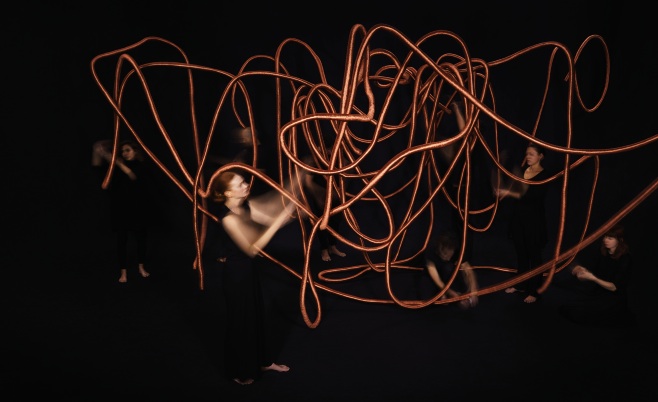
Alice Anderson – the Midas touch

The Midas touch of Alice Anderson

ropes
Alice Anderson “Ropes”

If you haven’t seen it already, there’s still time to catch the free exhibition of sculptures by Alice Anderson at the Wellcome Collection in Euston Road, (diagonally opposite Euston Station), before it closes on 18 October.

According to the publicity handout:

Alice Anderson asks you to take a journey into memory. Displayed together for the first time is a series of sculptures which prompt you to rediscover things you thought you already knew. A computer, a record-player, sketch-books, a bicycle, even a staircase have been transformed into luminous half-recognisable shapes through a process the artist refers to as “mummification”. This process actually involves the objects being bound with very fine copper thread so that they are, theoretically preserved for all time.

The exhibition experience is broken down into a series of themed rooms. In the first room, called Studio, you are invited to contribute to a sculpture by becoming part of Anderson’s studio. Here you can participate in the transformation of a ‘naked’ object by weaving copper thread around a 1967 Ford Mustang. The space where this occurs has minimal lighting to heighten the impact of the glowing copper thread and the effect is absolutely breathtaking.

Alice-Anderson-Turntable
Turntable

And as you move through the different spaces of the exhibition you are bombarded with a series of everyday objects similarly wrapped in the copper thread. The range of objects mummified includes a plasma tv screen, a guitar, a bicycle, keys, a telescope, a turntable, eye glasses, a smoking pipe, a telephone, coat hangers, a stethoscope, tools including screwdrivers and hammers, a basketball, a boomerang, a set of drums, ladders, shelves, geometrical shapes, and so on, and the cumulative effect is spectacular.

Two sculptures in particular caught my imagination: the first was a staircase wrapped in the luminous thread, and such was the scintillating play of light that it appeared to be a staircase to heaven. The second sculpture (illustrated at the top of the page) was a huge, twisting and turning cable of copper rope suspended from the ceiling in one room creating a beautiful abstract space that visitors are able to walk through and therefore observe the rope from every dimension.

alice_anderson_
Alice Anderson

Like with so much conceptual art, Alice Anderson is inviting us to take a fresh look at everyday objects we take for granted by reducing them to their essential shapes. However, the fact that they are bound in a glowing precious metal inevitably enhances their worth—especially given the market price of copper today—and the overall effect is as though Miss Anderson has transformed the objects into gold with her Midas touch. I would add incidentally, that it is probably no coincidence that the artist’s own hair is copper-coloured. Make of that what you will!

Alice Anderson lives and works in London. She studied at the École Nationale Supérieure des Beaux- Arts de Paris and at Goldsmiths College London. See http://www.alice-anderson.org/travfactory.html


Never been to the Wellcome Collection? If that’s the case, make a note. It’s a fabulous exhibition space, and the museum’s permanent collection is full of informative displays. The building itself is worth a drop-in visit, and on the day I was there the cafeteria and bookshop were buzzing. On top of all this, the venue has a broad programme of events embracing the arts and sciences, the majority of which are free. Details available from http://wellcomecollection.org/.


The Wind in the Willows

Hardwick_House_-_geograph.org.uk_-_635467
Hardwick House

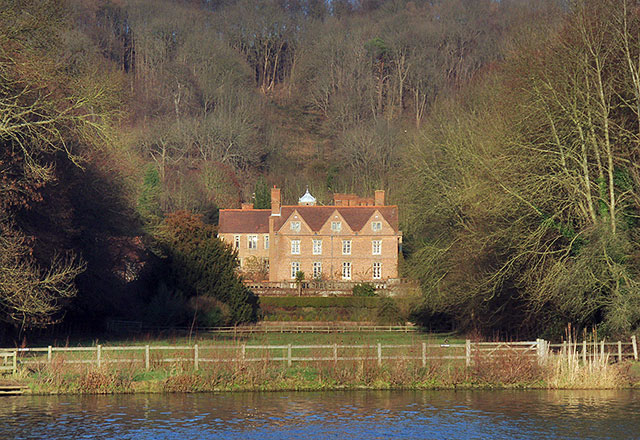
And so on a beautiful autumn afternoon, with Patsy and Allyson and Aidan to the Pumpkin Fair in the grounds of Hardwick House, a seven-bedroom Elizabethan manor house located on the Thames in South Oxfordshire, with a beautiful river view.

The sun shone and the children played, and pizza and pumpkin soup were consumed; and for those with a keen interest in horticulture, the head gardener gave an impressively informative tour of the 900-acre Estate’s market garden, the theme of which was “know and embrace your natural friends and allow them to thrive so that they keep the predators at bay”. Good advice at any time!

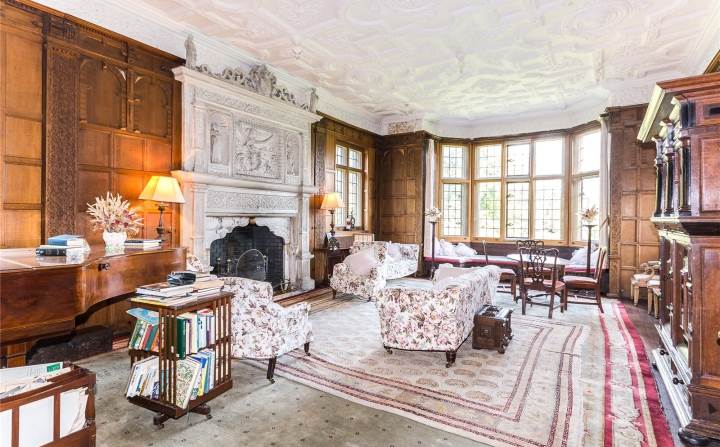
Following that, the delightful Miriam Rose, daughter of the present owner, gave a straggling group of followers a brief tour of the incredibly well-preserved house.

Hardwick_cieling
The drawing room

Turns out, Hardwick House was built on top of the remains of an ancient dwelling recorded in the Doomsday book, part of which remains in the flint and chalk cellar walls. The main house was constructed in the 16th Century by the Lybbe family – soldiers, courtiers and winetasters to the Plantagent Kings. In 1643 the royalist Lybbe family were forced to flee during the Civil War, when the house was bombarded by Cromwell’s forces. King Charles I, possibly a friend of the family, also played bowls on the green at Collins End Common on the Hardwick Estate before he was finally beheaded.

When the Lybbe-Powyses fell on hard times in the late 1800s, Sir Charles Rose – a banker, MP and larger-than-life public figure, bought the estate and house. He and his wife were well connected in the arts and literary world and Kenneth Graham visited the house regularly, basing his book The Wind in The Willows at Hardwick (with influences from other Thames-side houses), and the character of Mr Toad on Sir Charles himself. Henry James also set the first scene of Portrait of a Lady in the gardens at Hardwick, and a number of other books of the time make mention of the house.

Sir Charles was a tennis, motoring, yachting, flying and horse-racing enthusiast, and built two Real Tennis courts at Hardwick, one of which is still very actively used. His paintings and furnishings still adorn many of the rooms.

And the good news? The East Wing of this glorious house is currently available to rent at £5000 per month, which will give you 7 bedrooms, 3 reception rooms, 2 bathrooms, and an immersion in the history and joys of country life as it was in the good old days that should last you a lifetime.


Extract from Chapter seven of The Wind in the Willows, by Kenneth Grahame. Toad is in prison, having been caught by the police after he stole a car:

Now the gaoler had a daughter, a pleasant wench and good-hearted, who assisted her father in the lighter duties of his post. She was particularly fond of animals, and, besides her canary, whose cage hung on a nail in the massive wall of the keep by day, to the great annoyance of prisoners who relished an after-dinner nap, and was shrouded in an antimacassar on the parlour table at night, she kept several piebald mice and a restless revolving squirrel. This kind-hearted girl, pitying the misery of Toad, said to her father one day, ‘Father! I can’t bear to see that poor beast so unhappy, and getting so thin! You let me have the managing of him. You know how fond of animals I am. I’ll make him eat from my hand, and sit up, and do all sorts of things.’

Her father replied that she could do what she liked with him. He was tired of Toad, and his sulks and his airs and his meanness. So that day she went on her errand of mercy, and knocked at the door of Toad’s cell.

     ‘Now, cheer up, Toad,’ she said, coaxingly, on entering, ‘and sit up and dry your eyes and be a sensible animal. And do try and eat a bit of dinner. See, I’ve brought you some of mine, hot from the oven!’

It was bubble-and-squeak, between two plates, and its fragrance filled the narrow cell. The penetrating smell of cabbage reached the nose of Toad as he lay prostrate in his misery on the floor, and gave him the idea for a moment that perhaps life was not such a blank and desperate thing as he had imagined. But still he wailed, and kicked with his legs, and refused to be comforted. So the wise girl retired for the time, but, of course, a good deal of the smell of hot cabbage remained behind, as it will do, and Toad, between his sobs, sniffed and reflected, and gradually began to think new and inspiring thoughts: of chivalry, and poetry, and deeds still to be done; of broad meadows, and cattle browsing in them, raked by sun and wind; of kitchen-gardens, and straight herb-borders, and warm snap-dragon beset by bees; and of the comforting clink of dishes set down on the table at Toad Hall, and the scrape of chair-legs on the floor as every one pulled himself close up to his work. The air of the narrow cell took a rosy tinge; he began to think of his friends, and how they would surely be able to do something; of lawyers, and how they would have enjoyed his case, and what an ass he had been not to get in a few; and lastly, he thought of his own great cleverness and resource, and all that he was capable of if he only gave his great mind to it; and the cure was almost complete.

When the girl returned, some hours later, she carried a tray, with a cup of fragrant tea steaming on it; and a plate piled up with very hot buttered toast, cut thick, very brown on both sides, with the butter running through the holes in it in great golden drops, like honey from the honeycomb. The smell of that buttered toast simply talked to Toad, and with no uncertain voice; talked of warm kitchens, of breakfasts on bright frosty mornings, of cosy parlour firesides on winter evenings, when one’s ramble was over and slippered feet were propped on the fender; of the purring of contented cats, and the twitter of sleepy canaries. Toad sat up on end once more, dried his eyes, sipped his tea and munched his toast, and soon began talking freely about himself, and the house he lived in, and his doings there, and how important he was, and what a lot his friends thought of him.

The gaoler’s daughter saw that the topic was doing him as much good as the tea, as indeed it was, and encouraged him to go on.

     ‘Tell me about Toad Hall,’ said she. ‘It sounds beautiful.’

     ‘Toad Hall,’ said the Toad proudly, ‘is an eligible self-contained gentleman’s residence very unique; dating in part from the fourteenth century, but replete with every modern convenience. Up-to-date sanitation. Five minutes from church, post-office, and golf-links, Suitable for—-’


No meaning where none intended

atumn2Having commenced this daily blog towards the end of July, and given the response of readers on a day-by-day basis, I have come to one conclusion, (there will be others), namely, that the poetry posts are far and away more popular than anything else, and certainly far more popular than the short stories. I believe that there is a very simple explanation for this. Readers respond to poetry because it touches them in a way that very little prose can match.

Prose tends to be rational, often following a clear thread or narrative and in some cases so much is signposted that the reader just has to sit back and absorb the story almost on automatic pilot. Poetry touches different strings, it intimates and invites the reader to participate actively in the event, and by that I mean participate in the moment at which the mind meets the emotions encapsulated in the text. Poetry stirs the soul as music does, and certain words in a poetic context have the power of big piano chords. Think of the simplicity of striking a low G on the piano, listen to it resonating: the energies of poetry can stimulate a similar effect, creating, with the listener’s or reader’s collaboration, a meaningful emotion. This is further evidenced, I believe, by the often perfect marriage of words and music in song. Emotion above meaning!


October

October comes wrapped
      in mellow dreams
and morning mists
      gulls coast on the horizon
gardens are stripped back
      to their essentials
and all human endeavours
      are humbled
by the force of nature
      The contrivances of love
will get us nowhere
      nor reckless ambition
Who would be
      the moon’s best lover
will soon enough
      know the taste of dust
as their lease on life expires
      Our flesh recalls
the schooled innocence
      of children who skip
their early days away
      the taut tango
of magpie and crow
      the scavenging of squirrel
and the aimless amble
      of foxes that parade
their shadows
      through our darkness
From each their fruits :
      we are conscripts
called to serve
      a higher law
we who were once
      a mound of undelivered life
must nurture the time
      of those around us
slay the dragons of need
      and abandonment
In the early hours
       I have touched
her flesh of moans
      heard the soft murmur
of breath on her lips
      the shapeless words
that struggle
      to rise up from sleep
folded her in the warm
      cocoon of my arms
shared seed and song
      and pierced her heart
beyond pain

John Lyons

José Lezama Lima

jose-lezama-limaJosé Lezama Lima (1910–1976) was a Cuban writer and poet considered to be one of the most influential figures in Latin American Literature. The son of a military officer, Lezama lived through some of the most turbulent times of Cuba’s history, fighting against the Machado dictatorship. His literary output includes the semi-autobiographical, baroque novel Paradiso (1966), the story of a young man and his struggles with his mysterious illness, the death of his father, and his developing sensuality and poetic sensibility.

Although he only left Cuba twice (trips to Mexico in 1949 and 1950), Lezama’s poetry, essays and two novels draw images and ideas from nearly all of the world’s cultures and from every historical periods. His baroque style creates stunning constellations of unusual images which can make some of his poetry extremely challenging.

In addition to poetry, Lezama wrote many essays on figures of world literature such as Stéphane Mallarmé, Paul Valéry, Góngora and Rimbaud.


WOMEN AND THE HOME

You were boiling milk
and adhered to the customs of aromatic coffee.
You tiptoed around the house
with thriftily measured steps.
Every little detail a sacrament,
like an offering to the night’s weight.
Your every hour is justified
traipsing from room to room,
where portraits hang
that enjoy your comments.
You lay down the law for every day
and the Sunday bird half-opens
with the colours of fire
and froth in the pot.
When a glass is broken,
it tinkles with your laughter.
The centre of the house
flies like the point on the line.
In your nightmares
it rains incessantly
upon the collection of miniature
plants and the subterranean flame tree.
Were you to lose your cool
the broken skies
would come crashing down on us
in shards of marble.

*

O, HOW YOU ESCAPE

O, how you escape in the moment
in which you’d already achieved your best definition.
O, dear girl, how you refuse to believe
the questions of that freshly cut star,
that soaks its tips in another enemy star.
O, if only it could be true that at bath time,
when in the same discursive water
the still landscape and the finest animals bathe:
antelopes, serpents with staggered, evaporating steps
appear amid dreams, without a craving to lift
the longest head of hair and the most remembered water.
O, dear girl, if in the pure marble of farewells
you’d abandoned the statue that could accompany us,
well the wind, the funny old wind,
stretches like a cat allowing itself to be defined.

*

ON AN ENGRAVING OF CHINESE ALCHEMY

Beneath the table you spy three doors to small ovens,
where you can see stones and bars burning,
where the dwarf peeks out
chewing on sleep-inducing seeds.
On the table you see three blue and gray cushions
on two of which lie sort of geometric figures
made from unbreakable eggs.
Beside it an unadorned jug.
Lumps of firewood on the floor.
A man hunched over a scale
weighs a basket of almonds.
The ebony rod
immediately reaches the pointer.
The man who’s selling
fears the three small ovens
hiding beneath the table.
That’s where the expected figures
should emerge
when the man doing the weighing
manages to balance the basket
To his right the abstracted observer
of the man weighing,
plays with some birds

Translations by John Lyons

White echoes

A gentle cascade of thoughts and words to fill a Sunday morning in which the world is struggling to awake from its deep sleep. The sound of traffic in the distance but otherwise little movement. Silence almost complete. A perfect dream-state. A time to make love and little else.


White echoes

red kite

How many lush green fields
      and slender silver streams
how many gold-rimmed sunsets
      how many spiralling kites
will fit into this endless silence ?
      Who heard our footsteps
as we walked through the park
      who saw us climb the hill
as squirrels jumped
      from tree to tree
as children filled
      their lives with play ?
Dreams and hope and desire
      grew within us
and time offered us
      its pledges which
we did not dare to believe
      Who saw as the curtains
were drawn
      as you laid down beside me
laid in my arms
      laid in my heart ?
The wind was still
      through the night
as spiders wove
      and the roses
took their rest
      Today birds will swoop
and feast on the berries
      the chestnuts will swell
on the branches
      and leaves will form
a carpet to take us
      into winter
and to a landscape
      sketched by frost
modelled by snow
      and draped in silence
Where will love be then
      and hope and dreams ?
Where will our shadows lie
      what scenes will be staged
within the theatre
      of our blind ecstasies
what life will be left
      to be led
by our bartered blood ?

John Lyons

Sous-vide duck confit

duck_confit
3 x 2 duck legs vacuum sealed ready to be immersed in the sous-vide water oven

Sous-vide cooking used to be the preserve of up-market restaurants. Why? Because the technology behind this method of cooking gives chefs complete control over the outcome of certain recipes. The principle is simple: foods are placed in a vacuum-sealed pouch and immersed in a water bath at a controlled temperature for a controlled period. All things being equal, the results from this method of cooking are identical which in scientific terms amounts to repeatability. Same ingredients, cooked for the same time at the same temperature, taste the same at the end of the process. Excellent for batch cooking. And because foods are cooked in vacuum sealed pouches, foods remain moist and none of the flavour is lost.

The initial cost of the equipment required may deter some people. You need a water oven (which can still be quite expensive) and a vacuum sealer (much less expensive). But making that investment will enable you to produce restaurant-quality dishes at home. Sous-vide cooking is especially effective when preparing tough cuts of meat, brisket, for example, which can remain in the water bath for up to three days and will emerge tender and succulent. Tough brisket, pork shoulder, pigs or ox cheeks all melt in the mouth after cooking sous-vide.

Say no more! You can search online for more details on the benefits of this type of cooking. Meanwhile here’s my own recipe for confit duck legs prepared in the sous-vide water bath:

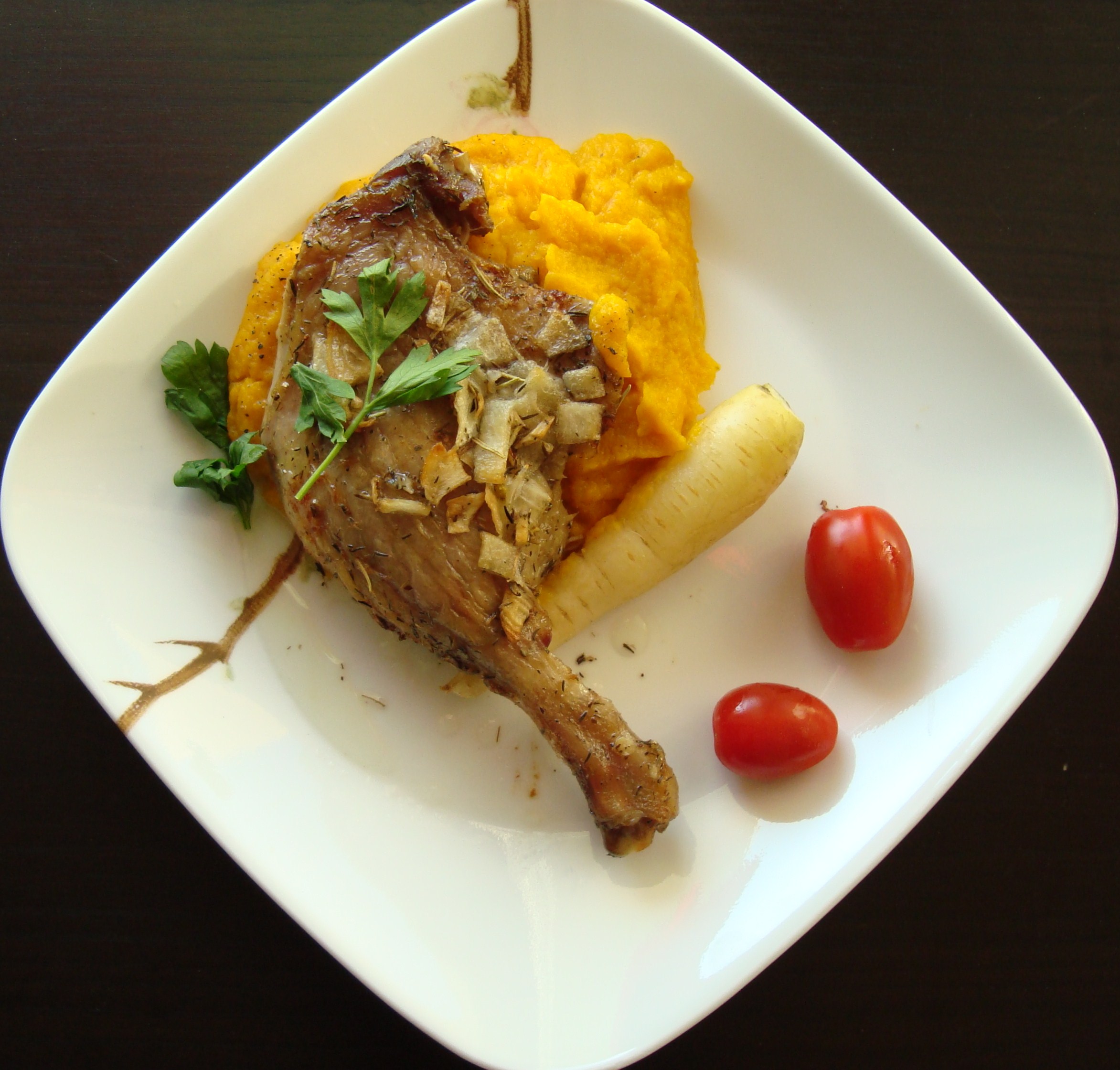
Duck or goose confit is one of the most luxurious of foods in French cuisine. Gently cured duck legs bathed in their own fat and slowly cooked to falling-off-the-bone perfection. The preparation of this dish in the traditional way can be time-consuming. However, using a sous-vide water oven, nothing could be easier. The first stage of this recipe involves brining the duck legs in a dry cure of 50/50 salt and sugar.

Equipment

A temperature-controlled water bath

A food vacuum sealer

Method for two duck legs

  1. To brine the duck legs, apply a dry cure (15 g sea salt and 15 g sugar, ) to two duck legs.duck confit cooked
  2. Store the legs in a glass or strong plastic container in the fridge overnight or for up to 24 hours.
  3. Gently rinse the duck legs and pat dry.
  4. Vacuum seal the legs together with a tablespoon of duck fat, a few juniper berries, some freshly crushed black peppercorns, and whatever additional seasoning you want in a food-grade plastic pouch.
  5. Immerse the pouch in the water bath with the temperature set at 80 ˚C and leave for 8-10 hours.
  6. Remove from the water bath and drain the liquid into a bowl. [Reserve this liquid in the fridge. When cooled you can separate the fat from the stock. Use the stock in soups and store the fat for use when roasting vegetables or when preparing more duck confit.]