Lesnes Abbey – a poem set in ancient woodland

lesnesabbey

Located in the London Borough of Bexley, Lesnes Abbey was founded in 1178 by Richard de Luci. De Luci had been involved in the murder of Thomas Becket in Canterbury Cathedral in 1170, and it is assumed that the foundation of the abbey was an act of penance. In any event, de Luci spent the last four month of his life in retirement at the abbey and was buried in the grounds.

I have visited the abbey on so many occasions and in the company of a number of people who were so very dear to me in my emotional life that its history has become a part of my history. The grounds and the shape of many of its trees have become permanently lodged in my affective memory.

In addition to a formal flower garden, the site of the ruins is backed by extensive remnants of the ancient woodland that gave its name to the location.

The poem below was inspired by the extraordinary beauty of that woodland. Sometimes a simple poem may be composed of little more than a list of things or attributes, and this is what I sought to do here: to select some of the characteristics of this delightful stretch of nature and to assemble them into phrases that would be carried forward by the rhythm.


Lesnes Abbey

In the ancient woods
     around the Augustinian abbey of Lesnes where
            Richard de Luci’s crime was laid to rest,
      daffodil, bluebell, violet and wood anemone
            thrive, along with foxglove, heather,
willow herb,
      red campion, figwort, dogs mercury, ramson,
            St Johns wort, yellow archangel and yellow iris.
      Here the shadows of hornbeam and mulberry
            and larch and swamp cypress are also
to be found,
      and in silence or above the raucous cry of the magpie
            or the great spotted woodpecker’s fevered drill,
      the chirrup of the robin, the song thrush, the blackbird,
            the wren or the collared dove may be heard.

Fernando Pessoa – what’s in a name?

pessoaI began to study Portuguese as an optional special subject, in my second year at Oxford. The Portuguese tutor in literature was Tom Earle, and it was he who first introduced me to the poetry of Fernando Pessoa, the colossus of 20th Century Portuguese poetry. Pessoa spent his early childhood in Durban and grew up completely bilingual. He wrote a number of poems in English, notably a sequence of sonnets in the Shakespearean mode. But he is far better known for his poetry in Portuguese.

Pessoa (his surname means ‘person’ in Portuguese) is famous for having written under the guise of around seventy-five heteronyms. Far more than simple pseudonyms, Pessoa imagined entirely different personae for these fragments of personality within himself and described the experience of being possessed by the different characters at different times and being driven to write in a style markedly peculiar to each individual.

Below, I have chosen to translate poems written by four of these heteronyms: Pessoa himself, Ricardo Reis, who wrote odes in a more classical style, Alberto Caiero and Álvaro de Campos. The selection is insufficient to give anything more than a taste of Pessoa’s craft, but interested readers will find plenty of information online to sate their curiosity.

In the end I was not able to complete my special subject, but the phenomenon of Fernando Pessoa has been with me all my life, and his poetry a constant source of pleasure.


It’s raining. There’s silence

It’s raining. There’s silence, because the rain itself
Makes no noise but falls gently.
It’s raining. The sky sleeps. When the soul’s a widow
Which you can’t know, feelings are blind.
It’s raining. Who I am (my being) I disown. . .

So calm is the rain that drifts in the air
(there seem to be no clouds) so that it seems
Not to be rain but a whisper
That of itself, with a whisper, forgets it exists.
It’s raining. No wish to do a thing. . .

No hovering wind, no sky that I can sense
It’s raining far far away and indistinctly,
Like a certainty that deceives us,
Like some big desire that lies in our face.
It’s raining. I feel nothing inside. . .

Fernando Pessoa

*

Come sit with me, Lydia, by the river’s edge

Come sit with me, Lydia, by the river’s edge.
Quietly watch it flow and understand
That life goes on, and our hands aren’t clasped.
(Let’s clasp hands.)

Then think, as children who have grown up, that life
Flows by, never lasts, leaves nothing, never returns,
But flows on into a far-off sea, at the foot of the Fado,
Beyond the gods.

Let’s unclasp hands because no point in us tiring.
Enjoy it or not, we flow on like the river.
Better to understand how to move silently with the flow
Without major upsets.

Without love, nor hatred, nor passions that cry out,
Nor longings that over-excite the eyes,
Nor cares, for regardless of cares the river flows on,
Will always run down to the sea.

Let us love without fuss, thinking that we could,
If we wanted, exchange a kiss, an embrace, a caress,
But it’s better just to sit side by side
And listen and watch as the river flows by.

Let’s pick flowers, you gather them and keep them
In your lap, and let their scent soften the moment
This moment when at peace we have no beliefs,
Innocently decadent pagans.

At least, if once there were shades, you should remember me
But not let my memory burn or hurt or move you,
Because we never clasped hands, nor ever kissed
Were never more than children.

And should you hand the dark boatman his coin before me,
There’ll be nothing to bring me pain when I remember.
Gently my memory will recall you thus – by the river’s edge,
My own sad pagan with flowers in your lap.

Ricardo Reis

*

That lady has a piano

That lady has a piano
Which is nice but not the flow of rivers
Nor the murmur the trees make. . .
Why must one have a piano?
It’s better to have ears
And to love Nature.

If I could crack the whole earth

If I could crack the whole earth
And feel it had a palate,
I’d be happier for a moment. . .
But I don’t always want to be happy.
You have to be occasionally unhappy
In order to be natural . . .

It’s not all sunny days,
And the rain, after much drought, is required.
So I treat unhappiness and happiness the same
Of course, as one not surprised
That there are mountains and plateaux
And there are rocks and grass. . .

What’s required is to be natural and calm
In happiness or unhappiness,
Feel like someone who notices,
Think like someone who walks,
And when you’re dying, remember that the day dies,
And that the sunset is beautiful, beautiful the night that remains. . .
So it is and so be it. . .

Alberto Caeiro

*

Magnificat

When will this inner night, the universe, pass
And me, my soul, have its day?
When will I wake from being awake?
I don’t know. Impossible to stare
As the sun on high glares.
The stars shimmer coldly
And can’t be counted.
The heart beats so remotely
And can’t be heard.
When will this theatreless drama
Or this dramaless theatre pass
So I can go home?
Where? How? When?
Cat staring at me, eyes agog with life, what do you hold deep inside?
He’s the one! He’s the one!
Like Joshua he’ll order the sun to stop, and I’ll awake;
And then it’ll be day.
Smile, as you sleep, my soul!
Smile, my soul, it’ll be day!

Álvaro de Campos

What’s in a name, Shakespeare? A ramble, a rant!

corbynThe name Labour Party, for instance, the party that grew out of the Labour Movement to represent the interests of labour, of trade unions, and those working people who actually built this country’s infrastructure and prosperity, often with their bare hands. The surge of grassroots support for Jeremy Corbyn has nothing to do with nostalgia, although there are those among us who do pine for the days when there were no food banks, when housing was affordable for all, when access to higher education was free, when the unemployed were not being constantly harassed, when disabilities were not always being poked to see if they were genuine, when NHS waiting lists were not so horrendously long, when there was, in short, a momentum in the country to move towards an ever fairer society, in real terms.

Year in year out we witness the pomp of parades in honour of those who died in the two World Wars. How easy it is to pay lip service at such events. Did these men and women make their sacrifices in the name of child poverty, zero hours contracts, austerity measures that employ the devices of hunger and lack of heating in order to whip the so-called workshy into excruciatingly low paid jobs? In times of war there was austerity for all: nowadays it is targeted using the latest computer technologies like the latest cruise missiles and our very language is corroded by the use of truly nauseating terms, “the working poor” for example.

The Labour Party did not perform badly at the last election, it seems to me: for the most part, the Labour Party did not participate in the last election. Where was the voice of working people? Under the Miliband band of brothers it seemed more like a Conservative Party by any other name. Career or conviction politics, you pay your money (taxes) and you make your choice. And don’t even think of mentioning Chilcot, or the banking debacle.

As I have said in a previous post, my own politics developed purely out of literature, and the aesthetics of John Keats and the beauty and truth arguments. These views were later bolstered by the Justice and Peace movement and liberation theology. I still have a book on my shelves written by José Porfirio Miranda, a Mexican Jesuit, entitled Marx and the Bible. It presents an extremely erudite and persuasive linguistic analysis of the Bible, highlighting its true prophetic role, which had nothing to do with predicting the future and everything to do with the promotion of social justice, defence of the orphan, the widowed, the dispossessed.

The British National Assistance Act of 1948 heralded the greatest social revolution the world has ever known, with not a single bullet fired. The values enshrined in that legislation are the values for which I believe our servicemen and women fought in those World Wars and for which so many died. We dishonour them by turning the clock back. Under austerity, child poverty is expected to grow in this most powerful of world class economies. What Labour Party in its right mind (and conscience) could possibly even consider not opposing such measures with all its might? So bring it on, Jeremy, we have nothing to lose but our deep sense of shame.

St Mary’s Church, a Bexley view

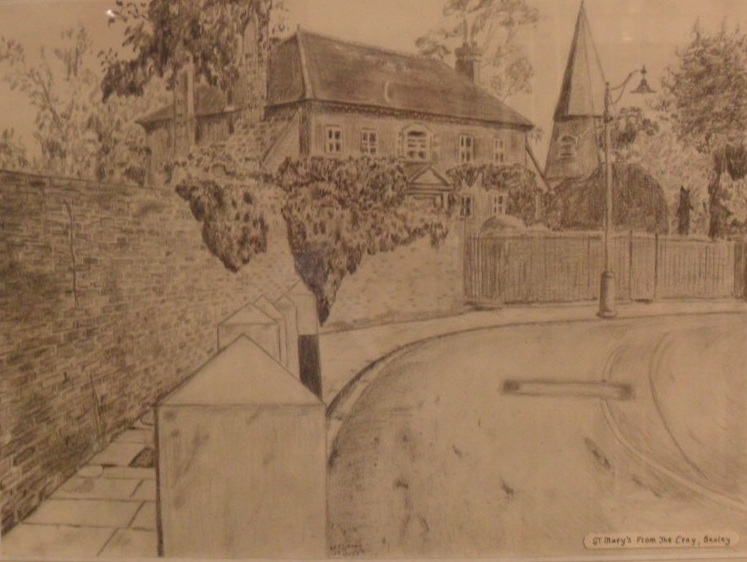
St Mary'sMy father was an exceptionally gifted man. He taught English and History in secondary schools for most of his life after being demobbed in 1946. In addition he was a trained violinist and had played in an orchestra in Woolwich while he was a student at Goldmith’s College before the War. He wrote reams of poetry, mostly dedicated to my mother, and he was also an accomplished artist. I remember that with a friend, he used to attend evening art classes in Bexleyheath run by Mr Stutz, an old Austrian Jew who like so many of his compatriots had fled to England in 1938 to avoid the Nazis.

Stutz lived with his Austrian wife on Watling Street in a rather sombre house on the opposite side of the road to St Catherine’s School. Going into that stuffy and dimly lit house as I often did with my father, was like going into another world. It was full of art objects and paraphernalia some of which Stutz had collected and some of which he had made himself. On each visit, he would give me hundreds of stamps for my collection and on one occasion he also presented me with a Meccano stationary steam engine that functioned with a small methylated spirits burner under the water tank, for a long time my pride and joy!

Over the course of a year or two, our house began to fill up with artefacts manufactured at the classes run by Mr Stutz. There were coffee tables covered in mosaic, there were ornamental plates and dishes with designs my father had drawn, there were portraits of St Thomas More and St John Fisher which he transferred onto tiles to be glazed and assembled and which were eventually donated to the respective churches. And when not at his art classes my father sculpted using wood off-cuts, and he also loved to draw local views, such as the one illustrated, a view of St Mary’s Church in Bexley village. It was to this church that William Morris, at the time a Bexley resident, took his daughter Alice to be christened in 1861. For these drawings he would usually work from photographs, but one summer we all went out with him to the five-arches bridge in Footscray where he set up an easel to paint a view of the bridge in oils while we played in the fields.

Bleeding Hearts – a foray into fiction

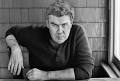
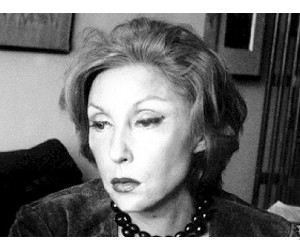
carverOver twenty years ago I began to write a collection of short stories called Bleeding Hearts. I took my inspiration from the short fiction I was reading at the time, in particular the brilliant stories by Raymond Carver (pictured) and Richard Ford. Written in a spare style, these narratives were about failure and loss, about life and lives falling apart, about dead-ends and dead-beat jobs, and in the case of Carver, hopeless addictions. They were human stories on a par with the best of Chekov and they dealt with the tragedies of everyday life which are every bit as profound as those of Sophocles or Shakespeare, God rest his soul.

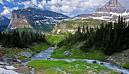
I completed thirteen of my own stories, all set in the USA in places like Montana or Oregon. I knew nothing about these states other than what I’d picked up from the stories I was reading, but in a sense it didn’t matter: it was all theatre and the dramas could be staged anywhere, not excluding the moon, anywhere that human dreams and aspirations could come tumbling down, anywhere that love could slip through your fingers like a cool mountain stream, anywhere that heartache could burn through the soul like the royal waters of aqua regia.

I took the stories with me when I went to live in Central America for a couple of years in the early nineties, and I translated all thirteen into Spanish. A number of them were published in the Saturday supplement of the Sandinista newspaper, El Nuevo Diario. Shortly after, I ceased writing prose and concentrated on my poetry, which at the time I was writing and publishing in Spanish.

A dear old friend of mine read a handful of the stories a few months ago and when she’d finished she said: “Yes, all right, but when I get to the end of them I always want to know what happened next.” “Don’t we all,” I replied. She’s going to be even more frustrated if she reads today’s post.

Below is a fragment from a story which I never completed but which will convey some idea of how I was writing in those days. At some point in the future I will post a complete story, but for now this is it. Life is full of fresh beginnings and false starts and wrong trails, and it takes courage to press on to the end, and sometimes we just have to accept that we may never get there. So best sit back and enjoy the journey, one day at a time. . . .


Good Fortune

montanaI wake at dawn. Gayle is still fast asleep. My throat is dry. I reach for the glass of water on the bedside cabinet and drain it. My hands are shaking. I put down the glass. Gayle turns over and for a moment her eyes open. She looks at me and smiles. I lean across and kiss her on the forehead. She mutters something in a sleepy drawl which I cannot understand. I pull the covers up around her shoulders. You go back to sleep, I say. She smiles again and closes her eyes. I run my fingers through her grey hair. The hair is dry and brittle. Her soft skin is marked now with fine deep lines like a spider web of pain.

Years ago I used to think that we would never grow old, that somehow time would pass us by, we were so happy. Time did pass us by, but not in the way I imagined! This much I have learned: that nothing goes the way you think it will. When we were young, just starting out, we both believed that we would make it, that loving each other the way we did would be enough to get us through. We were both wrong. Gayle would say to me: I’ve got you, Luke, what more do I want? And I would say the same thing. We were that happy, and that naive. This is Montana, the Treasure State, and we haven’t a dollar to our name. We still have each other, still love each other. That’s something.

I slide out of bed and walk across to the window. I open the curtains a fraction and peer out. The sky is already a soft cerise. The world outside is silent but for the chorus of birds in the trees across the way. I know what I have to do. There is a sick feeling in my stomach, as though I have swallowed a great quantity of lead in the night. I let the curtain fall back. It’s going to be a fine day, a fine summer’s day, and for me, for me and Gayle, a make or break day. I skirt around the bed but before I leave the room I stop and stare at Gayle once more. In two months’ time she will be sixty. On the cabinet her side of the bed, her reading glasses are lying on top of a open copy of Fortune Magazine. Last night we read the story of a retired plumber in Milwaukee who made a million bucks in one year. After a lifetime attending to burst pipes during the winter months, he hit upon the idea of electrified lagging which would switch on automatically once the temperature dropped.

In the corner by the wardrobe is Gayle’s walking frame. Her hips are getting worse. . .

Brazil – two poems

toucanI like to think that the ten years I spent living in Brazil enhanced my powers of observation, particularly, of the environment. The colour and diversity of the tropical and sub-tropical flora and fauna fascinated me endlessly. Birdlife in particular always caught my attention and my imagination. It was wonderful to see and hear the buzz of humming-birds or to see textbook toucans flying at a leisurely speed past my study window, or to observe the mating ritual of small birds that would hop up and down incessantly on the garden wall as though they had springs attached to their legs.

Where there is abundant rain and sunshine, nature appears to enter into overdrive and plants and trees grow at a staggering pace. It was a constant reminder of the richness of the earth and the bounty of life: the life that is there to be lived and enjoyed, one day at a time.


At night cattle graze
      upon the hillside,
I see them in the moonlight,
      their white hides glow
incandescently. Night
      shadows are the deepest
although also the quickest
      to be displaced. I raise
my eyes from the book
      I am reading and the cattle
have disappeared. Their
      sluggish shadows trail
behind them, hopelessly
      dragging the light
into the darkness.

*

Earth banana they call plantains
banana da terra
and thus metaphor for all food
all basic foods that derive
from the earth and feed the earth;
from clay the nutrients that will feed
the clay that one day will be laid
to rest in clay. What we call the food chain
which sounds so cold and technical
compared to the lifeline
life chain that in reality it is,
the earth feeding its own
like any mother would,
the papaya and coconut
before my eyes today
in Arraial d’Ajuda, Brazil
this 22 December
the succulence of their flesh
both humid and firm.
Why the consumption of food
is so close to being a sex act
utterly pure and essential.
Not fantasy food
but minerals that confirm our
blood relationship to fields
of rice and barley and wheat,
to the cattle that trample upon
vast plates of pasture.
Bounteous earth, fired by endless sun,
bathed in ocean blue, swept
by the breath of life.
The descent of poetry into science
is inevitable, though Shelley
recognized that all life ascends,
only death dips back to the earth
and to rebirth.
If life is location it is love too
chemical communities,
fire in the blood, iron in the soul:
what binds us to our humanity
is this magnetism and the desire
      to be less than one
so as to be completed, even if
bi-lateral love sounds geometric.

César Vallejo – three poems in translation

vallejoThese three poems by the Peruvian poet, César Vallejo (pictured), were among the first translations I undertook while I was at Oxford in 1969. A friend of Pablo Neruda, and a defender of the Republic during the Spanish Civil War, Vallejo was a very intense individual and as he developed his poetry over the years, that intensity began to manifest itself in a density of language that is both beautiful and challenging. Not all poetry yields its fruit on first reading. Thomas Merton, the famous Trappist monk, called Vallejo the greatest of all the Latin American poets. The youngest of eleven children, Vallejo lost his brother Miguel when he was quite young and later wrote a poem dedicated to the memory of the games they had often played together. Always was a most sensitive poet, Vallejo remained committed to the cause of ordinary working people throughout his life.

I am dedicating this post to the memory of Paul Kavanagh, a cousin of mine who died recently in Waterford, Ireland. As a young boy I would occasionally stay with his parents during the summer holidays, and Paul and I became very close friends. At that time my uncle owned a small bar on the Quay in Waterford and the family lived in the flat above. In the summer of 1963, the year John Kennedy was assassinated, I stayed with Paul and learnt so much from him. Among other things, I discovered the joys of fly fishing, and he taught me two essential skills for a young lad: how to whistle with my fingers in my mouth and how to cup my hands to make owl calls. I nearly drove my uncle and aunt mad with that. The same year, I bought two Beatles albums from Paul who wasn’t too impressed with their music. I still have the vinyl records.

My cousin also possessed an old steel-string guitar which I would pick up from time to time and strum away, pretending I could accompany any song on the radio. In reality I hadn’t a clue and it was probably totally out of tune and a further instrument of torture for my long-suffering uncle and aunt. Nevertheless, all good grist to me: and when I returned to London at the end of the holiday I acquired a guitar of my own and so began my own erratic journey as a musician.


For my brother Miguel

in memoriam

      Brother, I’m now on the bench at home
where you are so endlessly missed!
I remember we’d play at this time, and that mamá
would gently chide us: “Now, boys . . . ”

     Now I hide,
as before, during all these evening
prayers, and I hope you won’t find me.
In the living room, the hall, the corridors.
Then you hide, and I can’t find you.
I remember we laughed ourselves to death
in that game, brother.

      Miguel, you hid yourself
one night in August, as dawn broke;
but instead of laughing as you hid, you were sad.
And your twin heart from those dead and gone
afternoons tired of not finding you. And now
a shadow falls across the soul.

      Hey, brother, hurry up
and come out. Okay? Mamá will be worried.

*

The Black Heralds

      There are blows in life so hard. . . I don’t know!
Blows like the hatred of God; as though in the face of them
the undertow of all that has been suffered
simply welled up in the soul. . . I don’t know!

      There aren’t many, but some. . . They open dark furrows
in the fiercest face and in the strongest back.
They could be the colts of barbarous Attilas perhaps;
or the Black heralds of Death’s dispatch.

      They are the deep falls of the Christs of the soul,
of some adorable faith that destiny blasphemes.
These bloody blows are the sizzling
of some bread we’ve burnt in the oven mouth.

      And man. . . poor. . . poor man! He turns his eyes back as
when someone greets us with a slap on the shoulder
turns his mad eyes, and all that he’s been through
wells up, like a pool of blame in his gaze.

      There are blows in life, so hard. I don’t know!

*

And if after so many words

      And if after so many words,
the word does not survive!
If after the wings of birds,
the bird at rest does not survive!
It would be better, indeed,
for it to be gobbled up and be done.

      To be born to live out our death!
Rising up from the heavens to earth
through one’s own disasters
and to spy the moment one’s shadow shrouds one’s darkness!
It would be better, frankly,
for it to be gobbled up, and be damned!

      And if after so much history, we succumb,
no longer to eternity,
but from these simple things, such as being
at home or weighing things on our mind!
And if we then find,
suddenly, that we are living,
to judge from the height of the stars,
for the comb and the stains on a hanky!
It would be better, indeed,
for it to be gobbled up, of course!

      It might be said that we have
in one eye much suffering
and in the other, much suffering
and in both, when they focus, much suffering. . .
Well then. . . Of course! . . . Well then. . . not a word!
Andy Warhol and a can of worms

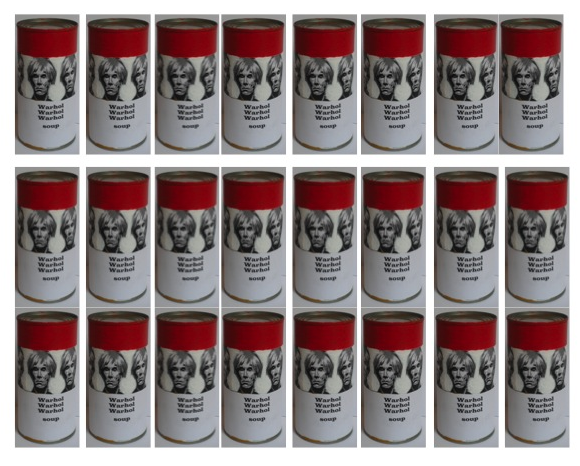
can_regimentWhen Andy Warhol produced what is probably his most famous painting, known as Campbell’s Soup Cans in 1962, many people were dismissive. This is not art, they said, this is copying, and he didn’t even paint, he just screen-printed the design. Where’s the skill? No, definitely not art!

But of course it was art and every bit as serious as the work of any other great artist, a Titian, for example, who in his mind sought to envisage the Nativity scene with Mary and Joseph and their newborn child, and to transfer that image onto canvas. Art is observation expressed through a medium, which might be words, or paint or musical notes, or mime, or whatever. In other words, art is consciousness transferred, so all art is, initially at least, conceptual. There can be good and bad art, serious or light art, but art is everywhere, everywhere that human consciousness exists.

But come on, you might say, where’s the art in reproducing an identical image of a can of soup? There are many possible responses to that. But the one that strikes me as the most plausible is that Warhol, in a humorous way, wanted to draw our attention to the fact that although nowadays we live in a highly designed world, our preoccupations differ very little from the preoccupations of our artist ancestors, those who decorated the walls of their cave in Altamira with images of the food they hunted for survival: an iconic deer or buffalo enclosed in its skin over the course of the millennia has become today’s ox-tail soup enclosed in a can. Technology does not destroy human appetites it merely alters the delivery of the product to be consumed. The modern mass production of images is made possible through technologies that can turn out millions of identical portraits of Marilyn Monroe or Marlon Brando, or of you and me. It was playing around with these ideas that I came up with the primitive design for what I call the Warhol Soup Can. Is it art? Course not. Just me having a bit of fun!

Emily Dickinson – a breath of fresh air

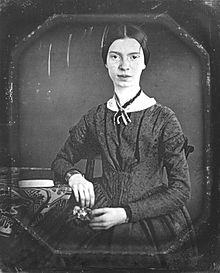
dickinsonIt is impossible to exaggerate the importance of the influence of Emily Dickinson’s poetry on subsequent generations of male and female poets writing in English or indeed any other language throughout the world. Although she wrote almost 2000 poems, only a handful were published in her lifetime. Scholars have since written extensively on the themes of her poetry: the beauty of flowers and nature, the inevitability of death, her Christian faith and what she called the undiscovered continent or the landscape of the spirit.

Her preoccupation with the mystery and complexity of human consciousness brings with it a desire to shape her poetry in a truly revolutionary manner. Her verse is renowned for its unconventional syntax, for the use of dashes and irregular capitalisation. It would be easy to dismiss this as an idiosyncratic fad: but that would be to ignore the true character of her genius. The syntax, the form of the poem on the page, represents a deliberate challenge to the status quo; and the freedom Dickinson demands in her verse is the freedom to breathe and to express her breath as she feels it. When contemporary readers of her poetry suggested she might make concessions by adding a few commas and full stops instead of her dashes, she was adamant that such a practice would destroy her poetry.

The poem below was written in homage to a lady who, in all her modesty, tore up the poetry rule book. It was a truly remarkable act of emancipation. As with earlier poems on this blog in homage to Marianne Moore and John Berryman, I sought to convey my admiration for Dickinson’s work by adopting, as far as I could, the vocabulary and the stylistic devices typified in her poetry. An impossible task! But this was done in the spirit of those artists who set up their easel in front of an old master in the National Gallery and seek to reproduce a painting in order to learn new techniques and appreciate the challenges faced by the original painter. A learning curve that can bring knowledge and skill, but alas, not genius.


Emily Dickinson

On the cusp of the Night –
Hands clasped as though
in Prayer – she observes
the last flicker of the Candle

Light’s demise – tinged
with the scent of Beeswax –
signals no Death
of the Imagination

Silence and Darkness:
these could be loved –
eternally – intimately
No human Consolation

between the cold white
Sheets – but Words warmed
on her Breath – mind Forms
of companionable Poetry

Early memory

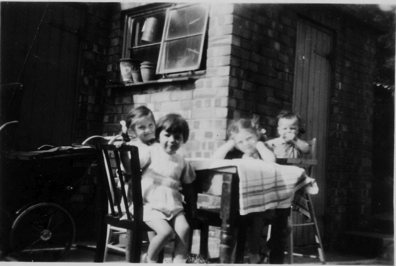
shedThe photo I always use as wallpaper on all my computer screens was taken by my father, one summer’s day when he decided we would all have a picnic outside instead of eating in the dining room. I’m sitting in a high chair close to a table where my three sisters are patiently waiting for their lunch. In the background, the old brick shed and the old pram which saw such good service, there being six of us children in total. I must have been eighteen months old at the time, as you can probably tell from my lack of hair. Looking a little fed up and probably hungry, Shevaun is sitting on the side of the table closest to me, and opposite her, smiling, are my two other sisters, Annette, the eldest, and Mary. Mary is in the foreground, closest of all of us to the photographer. She is wearing a short summer dress, undoubtedly home-made, and she has turned in her chair to look straight at my father. For me this picture is particularly poignant, given Mary’s eager posture: she is the only one of my siblings to have already died, and it is almost as though she is leaning slightly forward to say bravely, “I will go first into that unknown country.” I keep this wallpaper so that every day I will remember her and she will know she is loved and missed now as much as ever. Although my father always treated us equally, Mary, his youngest daughter, was probably the apple of his eye.

The photo is also important to me because it captures the first real and vivid memory of my childhood. My father was standing at the bottom of some steps, which led up to the space where he had laid out the table, and then to the right, the garden beyond. Behind him was the back door into the kitchen where my mother was preparing lunch. The table had been made by my father. He found the legs somewhere and a large rectangular piece of flat wood to make a top; you can tell this simply by looking, because the colour of the surface is different from the stained legs. There is a cloth on the table, which heightens the suggestion of a picnic. We rarely ate outdoors, but this was an exceptionally warm day. So there is novelty in the situation, an improvised gesture of parental creativity which was typical of my father, his trademark in fact.

On that day I clearly remember my father disappearing after telling my mother he wanted to take a picture, and when I heard this I began to get upset. I’m sure I bawled out something like: “No time for photos, I want my dinner.” But probably my words were far less articulate than that and more strident. My right hand is hidden by Shevaun’s head but in it I was holding my spoon and I kept banging the spoon on the tray of the high-chair as I shouted out, demanding that my dinner be served. We always used the word dinner for lunch when we were small. My father returned shortly after, brandishing his Kodak, and with a broad grin, told me to calm down and to sit still for the photo. “It’ll only take a minute, John. Lunch won’t be long.” I was not easily appeased in those days, I remember, not where food was concerned.

But that cherished minute has long gone! Only the photo remains.