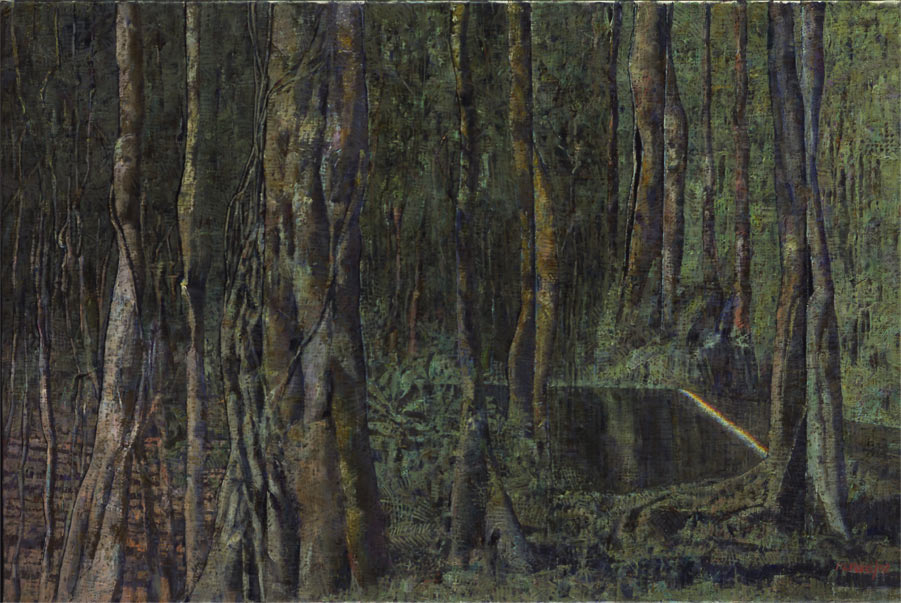
Armando Morales (1927–2011) was an internationally renowned Nicaraguan artist, a contemporary and friend of the poets, Ernesto Cardenal and Carlos Martínez Rivas.
Morales was famous for his voluptuous still lives, in particular, sensual studies of apples and pears that evoked the softness of human skin. He later moved on to the painting of the female form, and in 1971, at the Galeria Bonino in New York, he showed a series of stunning nudes in which the fine detail of every muscle, of every inch of skin, reveals an unsurpassed sensuality.
I visited Armando at his studio in Vauxhall many years ago during a brief period he spent in London. On that day he was preparing a huge canvas, and in the course of our conversation many times he climbed a ladder to access the top of the canvas. In one hand he held a magnifying glass and in the other a razor blade, poring over the surface in search of the most minute imperfections, meticulous to a fault.
I have chosen his beautiful woodland study to illustrate the poem below, the title of which is based on the opening line of Dante’s Inferno.
In the midst of a great forest
What treasures I have amassed are immune to fire and theft though I have indeed known loss loss of the body and loss of the soul and live now in a quiet space catching the drift of birdsong of the splenetic spider that plays upon its frosty web I can resist all things better than my own changeability I breathe the air but do not breathe it all I am not proud and know my place : the moth and the fish-eggs are in their place too so too the bright suns and the wide golden moon that shone last night so too the phantom dawn that creeps through the mist to smother dreams What is palpable is in its place What is impalpable is in its place Whether we fall by ambition blood or lust like diamonds we are cut with our own dust I seek the grail of laughter a life that will turn upon the axle of devotion a kiss not singed by the eventual flame
These are the lanes of death where our footfall falls Here love is a moment and pain another and our mutual friends are ash and dust moth and termite here time runs amok wields a thirsty blade cuts to the very bone
Flying by day this spineless boneless innately venomous creature is a paragon of brash invertebrate beauty but beauty comes at such a price Native only to Madagascar it flits from bloom to bloom its long proboscis supping by preference on the nectar of white flowers More choosy still are the larvae that that feed only on plants from the toxic Omphalea family They hatch from eggs laid on the underside of the leaves of these plants The white or pale yellow larvae with bright red feet will once they emerge mercilessly devour the entire plant leaf flower stems and all before moving on to decimate another of the same family From tip to tip their wings span a good three inches and boast shades of black and blue and red and yellow and emerald green Patterns of kaleidoscopic effect are produced by the wings’ curved scales creating optical interference as light is reflected at sharply different angles Toxicity is their defence for though the caterpillars eat the poisonous plants the toxins are not digested : these remain in their bodies through pupation into adulthood To most predators a most noxious foul-tasting moth— the iridescence of their wings a salutary warning
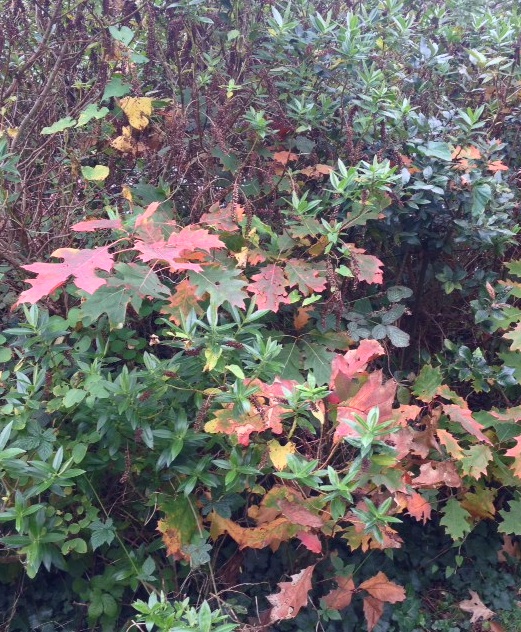
It’s that time of the year again. Clocks have gone back, the temperature is beginning to drop and we are all bracing ourselves for winter. The landscape is unrecognisable from the bright summer days, yet every season has its magic and its mood. Autumn, a sensitive time for nostalgia, for poring over memories by an open fire, for meditation; a season which John Keats has indelibly marked forever as a time for poetry. And so we are pleased today to present a new poem by our dear friend, Molly Rosenberg.
Autumn Thoughts
Through gold Through ruby red Burnt orange Amber glow
Like us the magnificence of beauty reaches its crescendo, as the array of colours overwhelms the Ravensbourne Valley. It takes my breath away. So short a time like our youth so fleeting.
Fluttering Drifting Crunching underfoot
Beauty turned to nuisance now like us when our purpose is served, all will be swept away.
The sharpness of the air pricks my cheeks. I wrap myself in the softness of cashmere. Relish the feeling of summer feet now clad in suede as I tread lightly through these golden autumn days.
Jonah, our indestructible blogsworth, is sitting in The Catherine Wheel, the charming Wetherspoon in Henley-on-Thames, on a bright autumn afternoon. He’s just had a brisk stroll down by the river. Trees turning to gold and brown and copper; seen a few herons, some geese, and more swans than he could shake a stick at; then a quick gander at the grave of poor old Dusty Springfield and he’s popped into the pub to kill the massive appetite he’s been carrying around all morning.
So he’s ordered his meal deal: a pint of what he likes and the fish and chips with mushy peas. Now he’s sitting there, sipping his drink, waiting for his grub to arrive, looking around the gaff and generally minding everyone’s business till he catches the drift of two old codgers lunching at an adjacent table:
Tom More: You been reading about tax credit cuts? Erasmus: Alice in Wonderland?
Tom More: Just about. Only worse. No laughs in this one; plenty of mad hatters, though.
Erasmus: You British, I dunno. You have an uncanny talent for political disasters. There’s gonna be trouble over this, mark my words.
Tom More: Whatcha mean?
Erasmus: Poll tax and now tax credit cuts. Political bloody disaster. You people vote in these governments that then proceed to clobber part of the population to death. It don’t add up, sunshine. On the one hand it’s sadism and on the other its masochism. Fifty bloody shades of I dunno what.
Tom More: But the deficit, the national debt. Something’s gotta be done.
Erasmus: But at whose expense, laddee? Not the working poor, surely? Tom More puts down his knife and fork, wipes his lips with his serviette, coughs to clear his throat and looks Erasmus in the eye. Tom More: No, you’re right. Makes my blood boil.
Erasmus: What sort of a country is this? I mean the very notion of working poor is an abomination. It’s a bad joke. Who does these jobs? Teaching assistants, social workers, so I’ve been told, but loads of other keyworkers too. Tom More: Keyworkers. Erasmus: So what does that mean, keyworkers? Key to what? Key to whom, if you don’t mind my pompous grammar? Are these jobs not important enough to deserve a living wage?
Tom More: Yeah, you’re right. It’s all wrong. Millions of families on or just below the breadline. . . Erasmus: About to be clobbered. So many of this once proud nation’s kids growing up in poverty. It goes quiet as the two old men take a breather and dip into their drinks. And Jonah’s meal arrives. Lovely golden batter on the fish, and the taste, so fresh. Erasmus: You know, a country that doesn’t care for its young doesn’t deserve to be called a country. It’s a bloody disgrace. Children in need! It’s a bad joke! No wonder the Scots want out.
Tom More: You’re right, you’re dead right, mate.
Erasmus: Poverty is a social construct, you know that. Nobody’s born poor, it’s not genetic. People are born into poverty or they fall into poverty, but it’s not in their DNA. It’s structured. You take the total wealth of a country, or the total wealth earned by a country in one year and you parcel it up, you decide who gets lucky and who has to struggle. I’m all for the ‘work should pay’ philosophy, but work should pay. These tax credits they want to cut, they’re not charity, they’re really nothing more than subsidies to the employers of the working poor. So to cut them is more than a bit like Alice in bloody Wonderland, “Off with their heads”. Tom More has a faraway look in his eyes; maybe the beer has gone to his head which he now begins to shake slowly. Tom More: One nation. . . The party of the family. . . Jesus wept.
Erasmus: Exactly! Suffer little children. . . !
On the train from Victoria he sits opposite me in his brown Franciscan habit and sandals. He is balding at the crown but wears a long beard. Forty-three years of age, pale blue eyes, slim and just under six foot, I estimate.
Life is a horizontal fall, a slow motion stampede dustwards.
From a rucksack he takes a packet of chocolate-covered raisins and tips five into his left hand: one by one he devours them, a half-decade.
Sensitive appetite is the passive power by which one is moved to some immediate response presented by the senses.
A professional-looking, large-beaded rosary hangs clipped from his rope belt and the wooden cross sways as he returns the remains of the raisins to his bag.
By the monastery path, the brittle leaves crushed underfoot. Time drops in decay.
From a bottle of water he takes a short sip, consults his mobile, which is not a smart phone and looks nervously around the carriage.
In the monastery garden, everywhere visible, time’s disfiguring touch.
Next he produces a paperback, Carlo Caretto’s Love is for living; reads a paragraph, marks his place with a label, closes the book and closes his eyes, raising a clenched fist to his breastbone.
Intellectual appetite: the passive power by which one is moved to a more reasoned response to particular objects as presented by the intellect.
He is still for several minutes, quite motionless, lost in his meditation. His eyes open. Signs of a visible sadness, a loneliness, a tangible longing.
It is not happiness but the divine will that grounds moral norms.
He reads again, now grasping and tightly twisting his beard, as though he wished to wrench it from his face. Then eyes closed, clenched fist once more at his breastbone, a deep sigh.
We need to have the power to restrain the natural appetite for happiness so that we can will as He would have us will.
The minutes pass.
Time and the world and all things dwindle.
Now he returns the book to his rucksack and sits with eyes shut and an inner focus on the heavens, and on his sacrifice.
Frost will paint the pines in winter and snow will settle on the simple wooden crosses that mark where they lie.
Down from Victoria, counting the twelve stations, the daily cross he bears, on his way back to Our Lady of the Angels.
Prayer cannot detain the torrent of descending time but one can pray for a light footfall.
Upon arrival he is the first to dismount, and as he leaves the station he halts to glance back over his shoulder at the shadow that has been following him, shadowing him throughout his journey, shadowing him throughout his life.
These are the shadows of dreams, the shadows, doubtless, of unborn time.
But he sees no one, and so he hurries off, burying himself in the distance, in the echoless darkness.
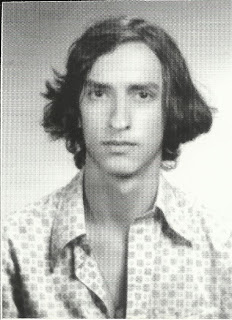
Ernesto Castillo Salaverry (1957-1978) was born in Managua, Nicaragua; he died barely two months before his 21st birthday, fighting against Somoza’s National Guard on the streets of Leon. His poetry reads like a diary of the daily struggle against the dictatorship, interwoven with love and nostalgia. Days before his death he wrote a letter to his parents:
Sunday, August 27, 1978.
To all those who love me, and among them, especially you.
I had thought not to write these lines, because you know I do not like goodbyes, I believe that every separation is temporary because when several people are together, when they love each other in the way that we love each other, it is impossible to forget each other, and at happy times, in the sad moments, we are together, sharing, as we have done so often. You are always with me. You are in the rain, you are on the streets mingling with the people, accompanying me every time I go to work. When I talk with colleagues, and we touch on family matters, matters of love, I just smile, because I have the good fortune to have your support; I am happy to know that you understand the need to fight; happy because the training I received made me aware of the need for change, for the revolutionary transformation of an unjust society.
In addition to having you, I am not alone; colleagues who work with me are very fraternal, we live together in danger, we share the same ideology, and our Sandinista convictions make us brothers. The people, the workers, the taxi driver, the newspaper seller, the cornershop keeper, they all accompany me. They trust me, without even knowing me, they love me, they have great faith in me, in us.
For you, for them, for Nicaragua, I am willing to fight to the end.
I cannot say that I don’t miss you, that would be a lie. I’d like to be with you, sharing every moment, enjoying every word, every gesture, every look. Today it’s not possible, but we must sacrifice ourselves, and I confess that I find it hard, we must fight in these conditions so that thousands of families can come together, so that Nicaraguan mothers do not continue to see their children murdered by the National Guard.
I’m not afraid, I know I’m going to brush with death, and I’m not afraid. You, and an entire nation, are with me. I love you.
Ernesto.
4 poems by Ernesto Castillo
The list of revolutionary martyrs is long; I know that the road to Liberation is painful; but if I fall, another will take my place and maybe fight longer than me, and his work combined with what has been done, may finally achieve victory.
* The streets wet with rain reflect the night. I crawl along the path as though trying to prolong the steps that must take me to my death.
*
September 1978
Some are for your sister; let her enjoy them if she likes them , if not, let her accept them, because it was she who created them; not all, just some. The others are scattered in women’s names I’d already have forgotten, had I not written them in my poems. The last ones, the most recent, are yours, I wasn’t sure before. These poems and these feelings are yours because you earned them.
* Thanks for having given me your kisses, your moments of joy and loneliness thanks for sharing my problems.
I can only leave you my poems and my memories, the memory of the silent nights with my hands running across your body and my eyes glistening as our mouths met.
I see you rereading my letters and poems, remembering the why of each sentence, trying to revive my love in every one of those pages.
I’ll leave my sensation of loneliness, because where I’m going you cannot reach me; and in your sleepless nights you’ll remember that I can never come running to you, that you’ll no longer even have my distant presence, because my body will be eaten by worms that will erase every trace of your kisses on my neck.
Time will turn my bones to dust, everyone will forget me, but you will sometimes feel the urge to cry; a veil of sadness will overwhelm you and my memory will reappear in your eyes.
Translations by John Lyons
Following the United States occupation of Nicaragua from 1912 to 1933, during the so-called Banana Wars, the Somoza family political dynasty was installed, and, with US backing, would rule the country until the final dictator was ousted in the 1979 Nicaraguan Sandinista Revolution.
In the 1970s the Sandinista National Liberation Front (FSLN) had begun a guerrilla campaign with isolated attacks which led to national recognition of the group in the Nicaraguan media and solidification of the group as a force in opposition to the dictatorship. The Somoza regime, was defended by the National Guard, a force highly trained by the U.S. military, that used torture, and extra-judicial killing, intimidation and censorship of the press in order to combat the FSLN attacks. In 1977, mounting international condemnation of the regime’s human rights violations led the Carter Administration to cut off aid to the Somoza regime. By the end of January 1978, civil disobedience had turned into a full-scale popular uprising throughout the country, ending in July 1979 when Somoza abandoned Nicaragua and the first Sandinista government was installed.
The silkworm is the larva or caterpillar of the domesticated silkmoth, Bombyx mori. A silkworm’s preferred food is white mulberry leaves, but it may also eat the leaves of any other mulberry tree. It is entirely dependent on humans for its reproduction and does not occur naturally in the wild.
Sericulture, the practice of breeding silkworms for the production of raw silk, has been underway for at least 5,000 years in China, from where it spread to Korea and Japan, and later to India and the West.
The poem below was inspired by these verses from the Rubaiyat of Omar Khayyam:
You have formed me of earth and of water, What can I do? Whether I be wool or silk, it is You that have woven me, and what can I do? The good that I do, the evil that I am guilty of, Were alike predestined by you; what can I do?
Here we go round the mulberry
silkworm cocoons
The low branches of morus alba, with its wide spreading crown and scaly orange-brown bark pocked with lenticels to oxygenate and
expel toxic gases, and lush orbicular-shaped leaves with serrate margin: dioecious flowers–the narrow male, one to two inches long, the plumper
female at barely an inch–boys and girls in slender zigzag come out to play. Twigs with silvery white filaments draped with fleshy multiples of drupes,
cylindrical fruit, akin to the blackberry, from June to August maturing. The larva fed on this foliage, its spittle passing through spinneret lips so hardening to tensile-as-steel silk,
each cocoon wound with a single mile-long thread, the oven- baked pupas, soaked in boiling water, whence five strands spun on wooden bobbins, the yarn woven into the cloth of kings. So do not
hasten to consign Emily Dickinson’s breath to dust, nor the intemperate slobber of Walt Whitman’s leaves of grass to the furnace, in all modesty our poetry too is nothing less than solidified saliva.
In a world almost deafened by the constant noise of social media, a world in which self-promotion seems to be the order of the day, it is worth taking time out to rediscover the pleasure of reading an author who sought to understand the nature of the world and his own humanity through self-examination.
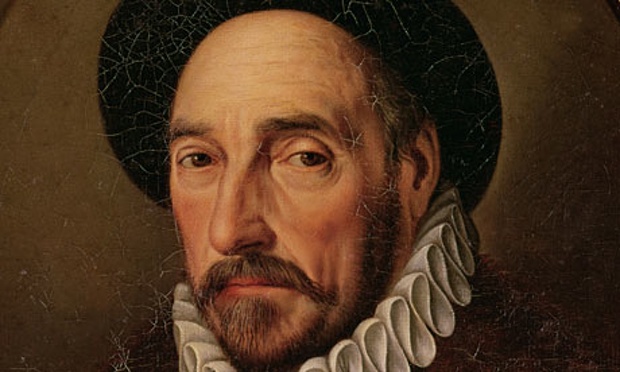
Michel Eyquem de Montaigne (1533 – 1592) was one of the most significant philosophers of the French Renaissance, known for popularizing the essay as a literary genre. His work is noted for its merging of casual anecdotes and autobiography with serious intellectual insight; his volume of Essays [Essais] contains some of the most influential essays ever written. Montaigne influenced writers all over the world, including most notably, Francis Bacon (1561-1626), whose own volume of Essayes: Religious Meditations. Places of Perswasion and Disswasion. Seene and Allowed was published in 1597.
Despite all the entrancing novelties that the Internet brings us, despite all the dazzling apps and games and alternative means of relating to one another that modern technology delivers, essentially, there is still nothing new under the sun. Undoubtedly, the wealth of knowledge available in this digital age has grown astronomically, but personal wisdom, which derives not from facts but from experience and good judgment, is as great a challenge as ever. In the words of Montaigne: “There’s no knowledge so hard to acquire as the knowledge of how to live this life well and naturally.”
Montaigne believed that in order to understand others and to understand the purpose of life, it was vital to know oneself first: his famous declaration, ‘I am myself the matter of my book’, was viewed by his contemporaries as self-indulgent. But Montaigne was unrepentant and spent a lifetime examining the world and human relations through the lens of the only thing he could depend on implicitly—his own judgment—and this makes him more accessible to modern readers than any other author of the Renaissance.
Below is an extract from Book 2, Chapter six of the Essays entitled “On Experience”, in which Montaigne justifies his approach:
There is no description so difficult, nor doubtless of such great use, as that of a man’s self: and withal, a man must curl his hair and set out and adjust himself, to appear in public: now I am perpetually tricking myself out, for I am eternally upon my own description. Custom has made all speaking of a man’s self vicious, and positively forbids it, in hatred to the boasting that seems inseparable from the testimony men give of themselves [. . .]
My trade and art is to live; he that forbids me to speak according to my own sense, experience, and practice, may as well enjoin an architect not to speak of building according to his own knowledge, but according to that of his neighbour; according to the knowledge of another, and not according to his own. If it be vanity for a man to publish his own virtues, why does Cicero not prefer the eloquence of Hortensius, and Hortensius that of Cicero? Perhaps they mean that I should give testimony of myself by actions and results works, not merely by words. I chiefly paint my thoughts, a subject void of form and incapable of operative production; it is all that I can do to couch it in this airy body of the voice; the wisest and most devout men have lived in the greatest care to avoid all apparent effects. Effects would more speak of fortune than of me; they manifest their own office and not mine, but uncertainly and by conjecture; patterns of some one particular virtue. I expose myself entire; it is a body where, at one view, the veins, muscles, and tendons are apparent, every of them in its proper place; here the effects of a cold; there of the heart beating, very dubiously. I do not write my own acts, but myself and my essence.
I am of the opinion that a man must be very cautious how he values himself, and equally conscientious to give a true account, be it better or worse, impartially. If I thought myself perfectly good and wise, I would rattle it out to some purpose. To speak less of one’s self than what one really is is folly, not modesty; and to take that for current pay which is under a man’s value is weakmindedness and cowardice, according to Aristotle. No virtue assists itself with falsehood; truth is never a matter of error. To speak more of one’s self than is really true is not always mere presumption; it is, moreover, very often folly; to, be immeasurably pleased with what one is, and to fall into an indiscreet self-love, is in my opinion the substance of this vice. The very best remedy to cure it, is to do quite the opposite to what these people direct who, in forbidding men to speak of themselves, consequently, at the same time, prohibit thinking of themselves too. Pride dwells in the thought; the tongue can have but a very little share in it.
They imagine that to think of one’s self is to be delighted with one’s self; to frequent and converse with one’s self, to be overindulgent; but this excess springs only in those who take a rather superficial view of themselves, and dedicate their main inspection to their affairs; who call it mere reverie and idleness to occupy one’s self with one’s self, and the building one’s self up a mere building of castles in the air; who look upon themselves as a third person only, a stranger. If any one is enraptured by his own knowledge, looking only on those below him, let him merely turn his eye upward towards past ages, and his pride will be abated, when he shall there find so many thousand wits that trample him under foot. If he enters into a flattering presumption of his personal worth, let him merely recollect the lives of Scipio, Epaminondas; so many armies, so many nations, that leave him so far behind them. No particular quality can make any man proud, that will at the same time put the many other weak and imperfect ones he has in the other scale, and the nothingness of the human condition to make up the weight. Because Socrates had alone digested to purpose the precept of his god, “to know oneself,” and by that study arrived at the perfection of setting himself at nought, he only was reputed worthy of the title of sage. Whoever shall so know himself, let him boldly speak it out.
Other aphorisms taken from Montaigne
♦ Lend yourself to others, but give yourself to yourself.
♦ The most certain sign of wisdom is cheerfulness.
♦ Let’s give Nature a chance; she knows her business better than we do.
♦ He who establishes his argument by noise and command, shows that his reason is weak.
♦ There were many terrible things in my life and most of them never happened.
♦ Marriage is like a cage; one sees the birds outside desperate to get in, and those inside desperate to get out.
In these austere times, when one of the world’s richest countries calls upon some of its poorest citizens to bear the brunt of national debt repayment, it is salutary to re-read Thomas More’s Utopia. The word ‘utopian’ has long passed into the language, but these days relatively few people take the trouble to read More’s text which was originally published in Latin by his friend Erasmus in 1516 – note the 500th anniversary comes up next year. The text of Utopia first appeared in English translation in 1551 after More had been royally executed by Henry VIII.
Utopia takes the form of a discussion between More himself and his learned friend, the narrator/traveller, Raphael Hythlodaeus, based on the character of Erasmus. They discuss the ills of contemporary Antwerp, and describe the social and political structures prevailing in the imaginary island country of Utopia. The name Utopia is normally understood to mean “no place”, somewhere which does not exist; but the term is in fact a Greek pun signifying simultaneously ‘no place’ and ‘good place’. Utopia compares the contentious social life of European states with the perfectly orderly, reasonable social arrangements of Utopia and its environs.
In Utopia, there are no lawyers because of the simplicity of its laws and because social gatherings are in public view, thus encouraging participants to behave well; communal ownership replaces private property; men and women are educated alike; and there is almost complete religious tolerance. Readers of More’s humanist work will also notice in the enlightened communities he describes, the complete absence of zero hours contracts, food banks and poverty and social injustice. Salutary reading for our times, methinks!
Sir Thomas More (1478-1535) was a lawyer and a councillor to Henry VIII in addition to being a noted Renaissance scholar. Disagreement with the king on a point of Canon law led to him being tried and executed for treason. Below is an extract from More’s masterpiece, but readers can access the full text at http://www.gutenberg.org/cache/epub/2130/pg2130.txt.
UTOPIA, by Sir Thomas More (extract)
“Is not that government both unjust and ungrateful, that is so prodigal of its favours to those that are called gentlemen, or goldsmiths, or such others who are idle, or live either by flattery or by contriving the arts of vain pleasure, and, on the other hand, takes no care of those of a meaner sort, such as ploughmen, colliers, and smiths, without whom it could not subsist? But after the public has reaped all the advantage of their service, and they come to be oppressed with age, sickness, and want, all their labours and the good they have done is forgotten, and all the recompense given them is that they are left to die in great misery. The richer sort are often endeavouring to bring the hire of labourers lower, not only by their fraudulent practices, but by the laws which they procure to be made to that effect, so that though it is a thing most unjust in itself to give such small rewards to those who deserve so well of the public, yet they have given those hardships the name and colour of justice, by procuring laws to be made for regulating them.”
“Therefore I must say that, as I hope for mercy, I can have no other notion of all the other governments that I see or know, than that they are a conspiracy of the rich, who, on pretence of managing the public, only pursue their private ends, and devise all the ways and arts they can find out; first, that they may, without danger, preserve all that they have so ill-acquired, and then, that they may engage the poor to toil and labour for them at as low rates as possible, and oppress them as much as they please; and if they can but prevail to get these contrivances established by the show of public authority, which is considered as the representative of the whole people, then they are accounted laws; yet these wicked men, after they have, by a most insatiable covetousness, divided that among themselves with which all the rest might have been well supplied, are far from that happiness that is enjoyed among the Utopians; for the use as well as the desire of money being extinguished, much anxiety and great occasions of mischief is cut off with it, and who does not see that the frauds, thefts, robberies, quarrels, tumults, contentions, seditions, murders, treacheries, and witchcrafts, which are, indeed, rather punished than restrained by the seventies of law, would all fall off, if money were not any more valued by the world? Men’s fears, solicitudes, cares, labours, and watching’s would all perish in the same moment with the value of money; even poverty itself, for the relief of which money seems most necessary, would fall. But, in order to grasp this correctly, take one instance:
“Consider any year, that has been so unfruitful that many thousands have died of hunger; and yet if, at the end of that year, a survey was made of the granaries of all the rich men that have hoarded up the corn, it would-be found that there was enough among them to have prevented all that consumption of men that perished in misery; and that, if it had been distributed among them, none would have felt the terrible effects of that scarcity: so easy a thing would it be to supply all the necessities of life, if that blessed thing called money, which is pretended to be invented for procuring them was not really the only thing that obstructed their being procured!
Suddenly the mild weather returns bringing with it grey skies and a rising wind that rattles the eaves
Lethargy abounds on this annual day but I sit at my desk I read I write I think or at least attempt
to gather my thoughts feeling my way
through the day For so much of my life
I have been a dissident a rebel
held strong opinions refused to swim with the tide Persist in the face I tell myself
In every space a hint of more though more is often less a bouquet of roses for example : too many is to miss the point
My life has not been a single line but many strands woven into many lives some but not all at odds
In the dark night I am consumed by memories of the many lips to which I paid service perhaps pointlessly but always lovingly and eager always for redemption Henceforth I shall act so that there is no centre no borders or edges to my life become an agglomerated existence a condensation of selves with no hierarchy of moments or archeologies all change all transformations contained within a single singularity
Time is change of colour difference refracted in the quality in the aspect of light Time is temperature oysters consumed at Whitstable or in Trancoso Time is shadow that brings relief Time is syllable formed in the throat shaped between tooth and tongue Time is here and now a weight that slips from my shoulders
Time is many particles of self of selves held in suspension
Time is the river at Henley the trees shutting down shedding leaves to weather the winter : the purity of the white swans on the water herons perched on wooden beams the cackle of geese dogs racing along the towpath all in a world of their own
worlds within worlds within worlds
The slow float of the evening light descends to the sound of birdsong : nature in all its innocence disdains the mockery of human ambition even as moths feed on our fabric
How will this beauty be preserved : by what breath between the high cloud and the hill ?
So to the frail dust of success life’s bitter-sweetness
the tenderness of love the despair of failure
and inevitable loss Dusty Springfield
lies solo in the graveyard of St Mary’s Church I only want to be You don’t have to say To be with you. . . Just be close at hand







 johnjosephlyons