Out of words


Out of words

Out of words
     a life made out of words
words that bind us
     to the people
and the things around us
     and within us
words transformed
     into actions
actions transformed
     into words
in the beginning
     was the word
was consciousness
     of the world
the word-world :
     the sounds are immaterial
by any other name
     love shines through
as does the rose
     or the beauty
of the hummingbird
     no bigger than a thumb
that flits back and forth
     supping nectar
from the bright blooms
     the warm air vibrating
from the buzz of its wings

How insatiable is life
     and love – and appetite
is a glorious virtue
     Time and the world
are ever in flight
     but the word is bedrock
my word is my bond
     and even as the stars
dwindle above the chimney pots
      on Doughty Street
I will love you to the ends
     of the universe
you have my word

John Lyons

A poem

A poem

A poem
     a seed planted in the dust
of your dreams
     a space and a possibility
fenced with words
     that leap over boundaries
that simply will not
     be contained

Silently
     she held me in those blue
engaging eyes
     my tight-lipped love
In this wide universe
     there will be other frosts
other days and other nights
     but no other us

The mind too
     is a place of cultivation
where the rose
     and the rhododendron
may flourish
     What beauty in those names
the lily and the marigold
     gardenia and wild cherry

Winter will pass
     Sparrows will refresh the nest
new voices to enrich
     the dawn chorus :
in truth
     beauty much more
than a backdrop to love
     is its essence

John Lyons

Capital snow

Capital snow

Star-feathers
     f-f-f-f-falling
softly
     softly
a light litter dusting
     the streets of London
coffee and indecision
     life catching its breath
left dangling in the moment
     the unrepentant pulse of life
that lives through us
     and in and around us
the flotsam fluff
     of icy condensation
teach yourself to be simple
     the simpler the better
make the music
     poetry to my ears

today is anyone’s guess
     shall I go
shall I eat a peach
     shall I take a stroll
on Whitstable beach
     it’s all hard-core Hamlet
down to the shore
     street snow is cheap insulation
but a reality check all the same
     perhaps too nature’s make-up
blush that masks the blemish
     blinkers us to a multitude of sins
and the birds curiously
     sensibly silent on the subject

     the eye enthralled
     by her shape
     a lover’s kiss
     I want no other

what now – we ask
     and for how long ?
a blanket of urban snow
     – paws – pause –
a peripatetic time for reflection
     time to watch our step
“I’ll watch mine
     if you’ll watch yours”
_____________________

discarded lines :

what angel wakes me
     in the dead hours ?
small talk
     apparently
of no consequence
     go back to sleep

a thin dusting of snow
     on her heart –
the snow long gone
     her heart too –
this wintry drizzle
     will soon fizzle out
roll on summer

John Lyons

Brevity

Brevity

The ripple of words
         tipped into the silence
spoken out of emotion
         feelings directly expressed
one person facing another
         devoid of affectation
pure breath

A cold clear morning
         sun burning up the frost
at a loss as to what to regret
         basking in the warmth
of her enduring love
         and all that has happened
within the memory
         of a rose and the song
of a nightingale

John Lyons


Fireflies

Caravaggio-Baptist-Toledo (1)
John the Baptist, by Caravaggio (c. 1598)

Fireflies

Deep in the forest
           the beckoning body beacons
advertising their love
           bioluminescent beetles
that hunger for a mate
           their bellies packed
with light-bearing enzymes :
           through the air
they drift
           selling sex
their soft cold lamps
           switching on and off
on and off
           on and off
as they cruise
           the shadows
of the unmarked
           boulevards

Chiaroscuro—
           bright glow
in the darkness
           of Caravaggio’s studio
the gleam in his eye
           the canvas awash
with the powder
           of dried firefly
to prepare a sensual
           photosensitive surface
for a Baroque
           baptism of light

John Lyons


Tender Buttons

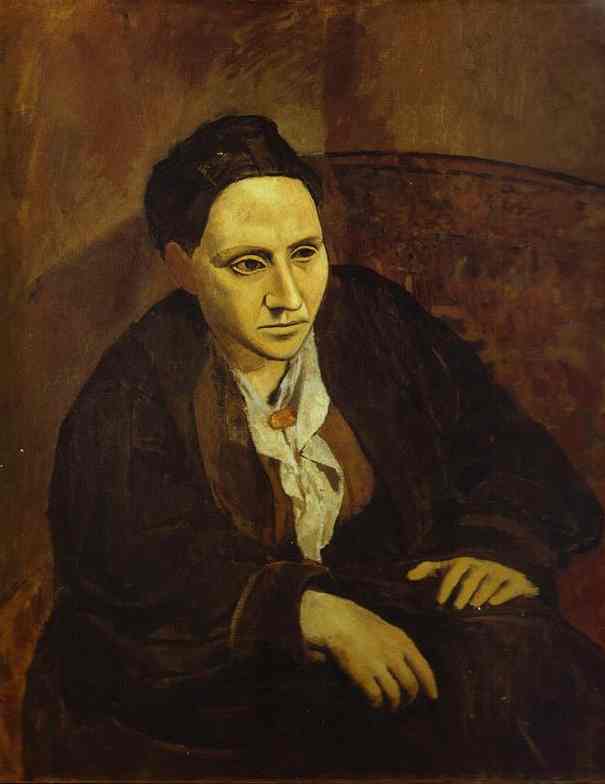
Gertrude-Stein-Pablo-Picasso
Gertrude Stein by Pablo Picasso (1906)

First published in 1914, Tender Buttons, by the American writer, Gertrude Stein, is a collection of poems written in a style which some critics have described as verbal Cubism. Stein’s close friendship with Pablo Picasso, detailed magnificently in The Autobiography of Alice B. Toklas (1933), undoubtedly exerted a great influence on the experimental style of composition in which everyday objects are described in ways that detach them from their familiar context so that the reader has to reassemble the parts in order to derive the sense. Plainly, it is a modernist work that demands some effort on the part of the reader, and this explains why it is one of the great unread classics. This is a pity because the work contains some of Stein’s very best writing and with the correct approach it can bring a good deal of pleasure. Each poem has to be read slowly and with a relaxed, meditative voice so as to handle each fragment of syntax with care, to examine it closely and allow the unconscious to assist in the process of assembly. There are many beautiful observations within the poems but they have to be teased out by a sympathetic reader, one who genuinely enjoys the true power of poetry and is attuned to its often unconventional rhythms and syntax. The theme of the work is, of course, explicit in the title, which celebrates the tenderness of homely relationships, including the people who occupy the home and the ordinary, everyday objects that surround them and which they use.


Tender Buttons

A reading for Gertrude:
           a table means
necessary places
           cutlery on the starched
white linen
           and a glass of any height
a looking glass
           a lamp and a cake
a tin lined with crumbs
           a precocious blue
but not so sad after all
           green can be lean
but nothing tendered
           nothing gained
A table means also
           and also perhaps
full of possibilities
           a commitment
and a compromise :
           the light was gracious
one might say forgiving
           so that they all
looked their best
            A table is geometry
and dynamics
           and sometimes crosstalk
and sometimes silence
           it has moods and expectations
and some things are certain
           and some things are not
A wet-weather window
           opens us to the elements
and chance as we know
           is a very fine thing

Picasso once ate
           and drank and smoked
at her table and loved
           in her all that there was
to love and more
           and Alice once sewed
a button on his shirt : :
           that was a tender
thing to do
           don’t you think ?

John Lyons

Showtime


Showtime
           
Winter simplifications
           pared back to the essentials
the bare bones of nature
           a softly blue wedgwood sky
frost crackles underfoot
           the tops of trees swaying
catching a rhythm
           dancing to the notional tune
of unseen gusts
           birds cavorting
in the crisp circus air
           nothing still
nothing quite silent
           nothing quite pointless
hope not quite abandoned

Machinations out of sight
           life under marching orders
rest and recuperation almost over
           the muster of forces
ready to burst forth
           onto the boards
crocus and daffodil
           messaging the way
for the country rose
           for the urban petunias
feisty energies raring to go
           longing to display
their concupiscent colours
           a bluebell and a cowslip
here and there
           Irrepressible remorseless life
from single cell
           to the distant galaxies
picks itself up
           dusts itself down
gets on with the show

John Lyons

Provence


Provence*

Who but me knows the precise thrill
       that rises out of the deeplyness
of your beauty — a beauty steeped
       in the tenderness of your gesture
a beauty beyond definition
       that tears language apart
that reduces poetry
       to a meaningless rubble
of senseless sentiment
       It is not that the fabric of your skin
is softer than any silk
       though it is that too
nor that your smile floods
       whatever space you occupy
with a savage starlust
       of almost unbearable brilliance

No
       The memory of fields of lavender
of orchards overburdened
       with the fragrance
of competing blooms
       the wild perfumes that rose up
from a land soothed
       by the summer breeze
vineyards swept
       by the wayward dusts of Provence
and on the Mediterranean shore
       the fine pilgrim sand
that shifts so slowly in time
       Those were restless days
and months and years
       now long gone
a remnant glimmer that
       with undimmed youth
I hold in my eye
       a beauty that knows no repose
matched by a sweet desire
       that will never die

John Lyons


*The above poem was inspired by the following line,”Who out of deeplyness rose to undeath”, taken from a poem by e.e. cummings, published in 1931 in a collection entitled W [ViVa]. To read the whole of the poem by cummings click here http://plagiarist.com/poetry/3713/.


The Land of Nod

The Land of Nod

Savage rain through the night
       lashing the windows
punishing the land
       seeping into the murky fabric
of my unconscious – the land of nod
       that other country
where the brain toils overtime
       labours double-time
Brave Hector is in the dust
       Helen too my friends
and the walls of my Troy
       are endlessly burning

We all live double lives
       and each feeds off the other
back and forth we travel
       day and night
Forsaken mariners
       we plough an empty ocean
and hanker for guiding stars
        and for a glimpse of El Dorado

Blind ambition :
       when I grow up
I want to be me
       or perhaps more simply
I want to be

Wind through the hedges
       the garden a war zone
plants and pots topsy-turvy
       but the nests barely disturbed
: come spring there will be eggs
       a beautiful egg-shell blue
I’ve seen them hatch
       before my eyes
bright beaks eager to guzzle down
       what they can get of life
dejection unknown
       certainly no lethargy
build their strength
       and take to the wing

But for us an eternity
       and the marriage
between heaven and hell
       hands on the plough
but hands that go down
        with the dust
Sparrows that envy
       the butterfly

John Lyons


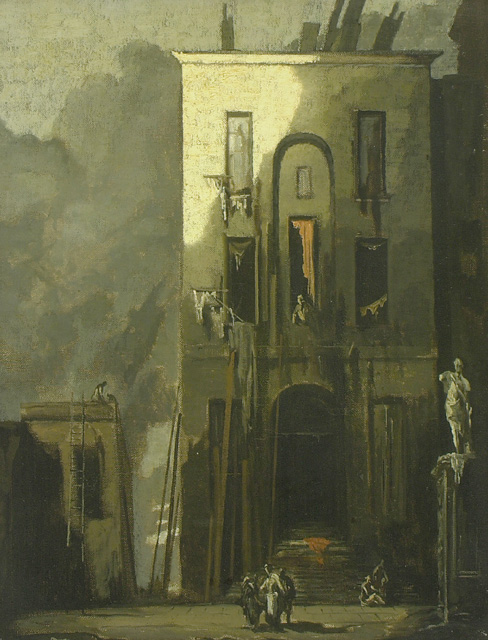
The Slum – James Ferrier Pryde

Pryde
James Ferrier Pryde, The Slum, (oil on canvas) 1916

James Ferrier Pryde (1866-1941) was a Scottish artist and sometime actor. His principal occupation was the design of theatrical sets and posters. In 1930 he designed the sets for Paul Robeson’s Othello at the Savoy Theatre

However, Pryde is best remembered for a series of highly personal paintings of architectural subjects. During the First World War, these became increasingly sombre, dwelling on the theme of ruin and decay. ‘The Slum’, completed in February 1916, is one of the most monumental of these studies and evokes the grim tenement buildings of the Edinburgh of Pryde’s childhood.

What I admire in this portrait is the deep sense of irony which Prude infuses into his subject. The setting may well be Edinburgh but the gaunt building has echoes of Canaletto’s Venice, albeit the backstreets close to the Rialto. Notice the classical clothing of the figures featured in the painting. Pryde’s painting telescopes history in order to underline the degree of decadence, as if to say ‘this is how far we have come in the journey down to the pit of human indignity’. A once proud nation has been reduced to its knees, every detail is ragged and torn and misery drips from the buildings. The billowing shadows in the background are perhaps from the War raging somewhere off in the distance, but in the midst of the carnage on the battlefield we are not to forget the urban carnage of slum housing and what was in effect a war on the poor and dispossessed. The social and political climate that led to Easter 1916, I would suggest, is an unwritten part of the larger context, and Pryde, through his art, reaffirms the importance of artists as the antennae of their generation.

This magnificent canvas can be viewed at the Ashmolean Museum of Art and Archaeology in Oxford.