Dead Men Don’t Send Flowers

I had a friend years ago in Nicaragua, where the story was written, whose name was Irma Prego, a great wit and a brilliant short story writer. She would read all my stories and when she’d finished one of them she’d say, “But I want to know what happens next.” Well life is full of stories, full of scripts and personal narratives without endings. Sometimes we do get to know what happened next, there is a resolution, a definitive event or a decision that sends a clear signal that things are over, that the drama has gone off the boil, that people have gone their separate ways, that new lives and new narrative threads have commenced. While it is true that sometimes what you suspect will happen does actually happen, there are other times when life can completely surprise you, people can do an about-turn, have a change of mind, or a change of heart.

Whatever the case, stories are an essential part of life. We tell the stories of what is happening in our families and in our relationships and friendships in order to have an understanding of who we are, in order to place our emotions in context, so that a story is always a kind of reflection on our strengths and weaknesses, a kind of open-ended soliloquy. We read and listen to stories for the same reason: for the community of feeling, for the understanding of our own humanity. We identify with the lives of the strangers we meet in fiction because in fact they are not really strangers. This is one of the great lessons we get from James Joyce, whether in Dubliners or in Ulysses: Leopold and Molly are part of the family, along with Blazes Boylan, Stephen Dedalus, Buck Mulligan, Paddy Dignam R.I.P., and all the rest.


Dead Men Don’t Send Flowers

20_red_roses_bunchEverybody loved Nancy Holden. Nobody wanted her to die and when she did finally succumb to the muscle-wasting disease which over the last five years of her life had slowly reduced her to a cripple, everyone who knew her died a little too. It was an emotional occasion, her funeral. I helped carry her body to the graveside. And when it was all over, Patsy and I drove Dan back to our place. He was in a terrible state. Nancy was only forty-two years old. Dan slumped in an armchair in our living room and refused all offers of food—Patsy had prepared a chicken salad. There’s a time for eating and a time for drinking, it says in the Bible. I guess this is not one of those times for eating, he said. All afternoon he sat there, shaking his head as he poured more whisky into his glass. Forty-two is no age, he kept saying. She had her whole life ahead of her. Her whole life. I just can’t believe it! From time to time Patsy would call me from the room. She was concerned. Don’t you think he’s had enough alcohol for one day, she asked. I knew that she was saying this because she cared for Dan and not because of anything she had against heavy drinking. Honey, I said to her, he’s had enough whisky for a fortnight, but I’m not about to take the bottle from him, not today, not until he drops. Around five o’clock that afternoon he did drop. Not exactly drop. He just passed out. Patsy came in to look at him. His mouth was open and you could see the gold caps on his back teeth. The skin around his eyes was slack and discoloured. Such a sad, pathetic sight you could hardly bear to look.

Dan had once been our mailman. That’s how we got to know him. This was when me and Patsy first moved to Missoula and had no friends there. We’d been living down in California since we got married, trying to scratch a living on a small fruit farm just outside of Red Bluff. Trying and failing. Nothing we ever tried to do seemed to go right in California. The debts just grew bigger and bigger, no matter how hard we worked. Life was closing in on us, slowly but surely like some sort of vast sprung trap with huge, jagged teeth. Before our legs finally got caught forever, we decided to make a run for it. Montana was where we landed. Missoula, to be precise, and that’s where we began to rebuild our lives. Patsy got a job in a nursery and I was lucky enough to be hired by a building contractor. Been working ever since. God bless Montana, is what I say and I know Patsy says it too. Montana saved our lives. The Holdens were a bonus. After a few months they were regulars over at our house and on Friday nights we’d play bridge together. Nancy was the best bridge player I ever knew. She and Dan used to beat us every time. But it didn’t matter. Patsy and me weren’t playing to win. We were just glad to be alive and have company and not to have to worry about sudden frosts, or blight or the rising price of pesticides.

Some weekends I would head off hunting with Dan. He knows Montana like the back of his hand. The best hunting I ever did in my life was alongside Dan Holden. Teal, geese, pheasant, any kind of fowl you care to mention. And those weekends we were away, Nancy would move in with Patsy. She had her own bed made up for her in the spare room and over the bed she’d draped one of those colourful Indian ponchos she’d bought on a trip she and Dan had made to Guatemala. Patsy and I used to call that room Nancy’s room. God knows if we’ll ever call it anything else, even though she’s no longer with us. The poncho is still there along with some books of hers. Nancy was a real cultured woman and poetry was what she enjoyed reading most. Kind of strange that the men could be out in the country pumping leadshot into the wildlife while the women were back home swapping recipes and listening to Verdi and the like and reciting Emily Dickinson and Amy Lowell. Still, that’s life, I suppose, kind of strange, but never dull. What I liked about Nancy was the fact that she never looked down on anyone who had less education than herself. Patsy and I for instance, and Dan too. Looking at the pair of them you might have thought that she had married down. But that was not the case. Not at all. Dan has qualities all of his own. People marry for different reasons, and yet the only valid reason is when two people love each other. Nothing lasts without love. That ought to be obvious, but somehow, considering how many marriages fall apart these days, it probably isn’t anymore. Tramping through the sagebrush out on the benchland with our shotguns over our shoulders, Dan would often talk about himself and Nancy. Isn’t she something, he’d say to me, isn’t she someone really special? Yes she is, I’d say to him. She’s one of the best and you’re a lucky man. That I am, he’d say proudly, nodding and smiling at me as he thought of Nancy. She was a petite lady—barely five foot, I’d say—and she wore her crimped, honey-blonde hair in a long cascade that reached down her back almost to her waist. And she had fine features. You could almost see the culture in her bones, in her small, delicate mouth, in her sharp, inquisitive eyes. And Dan adored her. From the moment her illness was diagnosed he devoted as much time to her as was humanly possible. They may be the last years, he’d say to me, but I want them to be the best, the most comfortable of her life. Do you understand that, Ray? Yes, I’d tell him, I know just what you mean and you’re right. Nancy deserves nothing but the very best. And Patsy and I did what we could. Naturally we had to cut down on the hunting trips, but the two of them still came over to play cards, right up until the very last weeks of her life. And Nancy. . . Jesus, that lovely woman was an inspiration. She never complained, she never lost her good humour. She was determined, it seemed, to die the way she had lived: with dignity and patience. Sometimes Patsy would cry after the Holdens had gone home. She’d lie in bed and tears would stream down her face as she thought of what was happening to her friend, her sister—Nancy was like the sister she’d never had, the older sister with everything to give. Jesus Christ, she’d say to me, it just isn’t fair. Why Nancy? If life were about fairness this would be a very different world, I’d say to her. We might never have had to leave California, we might never have met Dan and Nancy. Life is swings and roundabouts. I said these things not because I thought they could be of any comfort to Patsy but simply because I had nothing else to say. And Dan, she’d say. What about Dan? Dan is such a good man. How is he going to cope when he’s all alone? Do you think he’ll cope, Ray? I didn’t know the answer to that one. Who can tell? But I remembered the way he used to speak about Nancy when the two of us were alone and to me it seemed most likely that he would not cope that well. This is not what I said to Patsy. To Patsy I said: Sure, sure he’ll get by. It’ll take time but he’ll make it. I’m sure he will.

A few days after the funeral, a dozen long-stemmed red roses were delivered to the house. It was a Saturday and I’d just finished installing a new radio-cassette player in the car. I looked up from the newspaper I was reading. Patsy tore open the little envelope and glanced at the message. It’s not signed, she said. And then she was thoughtful for a moment. I know these lines, she said, I’ve read them or heard them before. It’s from a poem. Listen to this. And she read me the message:

   Nobody knows this little Rose –
   It might a pilgrim be
   Did I not take it from the ways
   and lift it up to thee.

Must be from Dan, she said breathlessly, her face flushed and yet smiling. Only Dan would think of sending those words. I think they’re taken from one of Nancy’s books. God bless him, it’s his way of saying thanks. Don’t you think it’s a charming verse, she asked. I do, I said, yes I do. And I did. I’m going to call him, she said smiling. I’m going to call him right now and invite him over. Today or tomorrow. He can stay for lunch or for dinner. Poor Dan! You do that, honey, I said. What I love about Patsy: she’s all heart. Wisest move I ever made, marrying her. Lesser women would have walked out on me, the way things were going in California. It took courage to stand by me. Patsy has loads of courage, loads of sticking power. Call him now, I said. And tell him hello from me. Say how’s he doing. Then I returned to my paper. More bad news. Lay-offs up and down the country. Hard times and getting worse. I was glad my job was secure. And glad too that I’d gotten out of farming. Farmers were getting it in the neck all the way along the line. Jesus Christ, I thought as I read on, who’d be a farmer in this day and age. Who would?

About ten minutes later Patsy came into the room carrying a tall vase with six of Dan’s roses. She set the vase on the mantlepiece and took a few paces back to admire the flowers. Aren’t they gorgeous, she said. I put three in the bedroom and the others in Nancy’s room. That’s nice, I said. That’s a real nice gesture. She gave me a sweet, kind of nervous look. You call him, I asked. No reply, she said. I’ll try again later. But I could see she was disappointed. Come here, I said, finally casting aside the newspaper. Come and sit here. She walked over and sat on my lap. Could be he’s gone away for a few days. You never know. It can’t be easy. Living in that house. Then it struck me that these were not the right things to say at all. Patsy’s eyes filled up. I pulled her closer to me and began to stroke her hair, her fine auburn hair. She twisted around and hugged me tightly. For a while I just stroked her hair with slow, easy motions, trying to help her work the grief out of her system. Then gently I unfastened a few buttons on her blouse and reached inside. Her skin was cold.

All day Sunday Patsy tried to reach Dan but there was no reply.

And Patsy wasn’t sleeping. I’d wake at two or three in the morning and find her gone and when I looked for her, she’d be in Nancy’s room, lying on the bed reading one of Nancy’s books or sitting in the easy-chair with the Guatemalan poncho wrapped around her, blankly staring into space. I’d have to take her by the hand and lead her like a child, back to bed. And she was jumpy in the mornings, the least thing upset her and all she could talk about was Dan Holden.

Come Saturday she said to me: Ray, I don’t know what’s going on but this thing is driving me insane. It’s no good, I can’t seem to think straight anymore. And then she gave me one of her determined looks. I’m going on over to Dan’s place, see for myself. God, Ray, you don’t think…what if he’s done something foolish? Patsy, I said, not believing what I was hearing. No, no, she insisted. These things do happen, they happen when people get down, I know they do. They do things you might never imagine. I want to go, I have to go. Ray, please! I’ll admit, when she put things in that light it did make me think. She could be right. So we drove over there. But there was no answer when we tried the door. I strolled around to the back to look for signs of life.

I peered in through the kitchen window. Everything was neat and tidy. Nothing that might alarm you. But it was a strange feeling, gazing into someone’s house like that. An empty house but so full of memories. Hanging over one of the kitchen chairs I spotted a brown woollen shawl that Nancy had often worn when she visited us, and there were other things, like cups and dishes and jars, homely things that brought back so much. The times we’d sat around that table in the kitchen and talked! Just talked. The pleasure of talking of life, of love, the future, the way you do with close friends. Where the future is not the important thing, just the talking about it, the sharing of dreams, of hopes. And Patsy. Patsy had probably heard a hundred poems read to her at that same table while Dan and I chased Canadian geese through the great outdoors. I joined Patsy at the front of the house. She was staring up at Dan and Nancy’s bedroom. The curtains were drawn. He may be inside there, she said in a whisper. You really think so, I asked. You honestly think Dan’s the sort? Anyone, she replied. Anyone’s the sort if the pain is bad enough. How can you tell? Being brave is just a mask. There comes a point when the pain just takes over, forces you to choose the lesser of two pains.

A dozen red roses were lying on the doorstep when we arrived. And there was another unsigned card. We assumed the flowers were from Dan. Who else?

Back in the living room, Patsy was standing in front of the flowers. She didn’t hear me come in. I watched as she reached out and began to pull petals from one of the roses. She was muttering something under her breath. When I cleared my throat noisily to let her know I was there, it made her jump. She span around and looked at me but she was not smiling. She looked more beautiful than ever. My own rose: a tall, pliant body which I so loved to dress and undress, to caress, to bathe with, to lie with, to love. I held out my arms and waited for her to walk towards me. Instead she closed her eyes and sighed. She raised a hand to her right cheek and bowed her head. A silence opened up between us. I wanted to tell her about the florist but couldn’t speak. My hands were shaking. She needs to be alone, I thought, alone with the flowers. Perhaps I should just slip away and call the police. Something had to be done. I knew that now. On her face a haunted, remote look. I needed her and she was nowhere. I looked down at her feet. There were rose petals on the carpet. Patsy reached out and took another flower from the vase. One by one she pulled at the petals until the stem was stripped bare, and all the time her lips were moving, silently. Words, but words not meant for me.

Dead men don’t send flowers. Not in Missoula, at least, and the officer laughed at his own wit.

That night she slept in Nancy’s room. I lay awake thinking of Nancy and of how much pain her death had brought upon us all. How the world without Nancy was not the same place and never would be. One person and all that difference. Nothing lasts forever. Nothing endures. And Patsy, where was she? One confusion after another. I wondered too what had become of Dan, why had he sent the roses, and what did it all mean, and most of all I wondered how long it would be before Patsy returned to my bed.

John Lyons, 1992


Augusto Monterroso – a fable and a tale

Augusto-Monterroso
Augusto Monterroso (1921-2003)

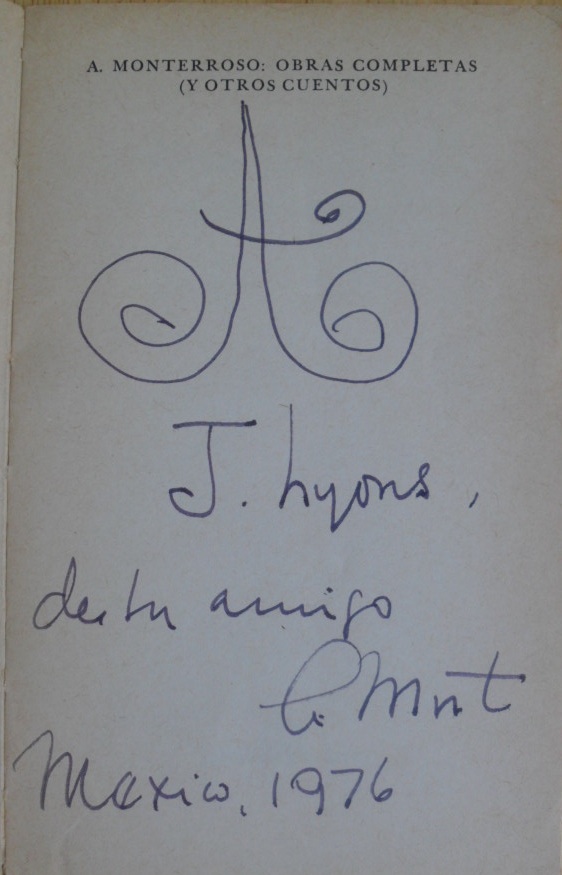
One of the most delightful writers I met in Latin America was Augusto Monterroso. A Guatemalan, he lived for much of his life in Mexico, where he taught in the UNAM university. Before leaving London, I had been given the telephone number of a Nicaraguan poet, Ernesto Mejía Sánchez, and I called him as soon as I got to Mexico City. We agreed to meet one lunchtime at Sanborn’s café, which was where all the artists and writers usually met. At that time Mejía Sánchez was going through a difficult patch in his life, and the conversation was rather strained and dull until Augusto Monterroso turned up. He had with him copies of three of his published works and in each of them he wrote a very individual dedication to me. “I hate to burden you,” he said as he handed them to me. “But you can chuck them into the Atlantic when you fly back to London if you like.” Naturally, I held onto them, still have them today, and they are among my most prized possessions.

mont_dedicAugusto, was extremely warm and jovial and the conversation soon became filled with laughter and great stories and even managed to draw poor Mejía Sánchez out of himself. Monterroso’s writings tend to be short pieces, fables and short stories but always with a humorous and satirical slant. The Colombian Nobel Prize Winner, Gabriel García Márquez said of one of his works: “This book should be read with your hands in the air: its danger is based on its sly wisdom and the deadly beauty of its lack of seriousness”. With a sense of humour very much in tune with that of Julio Cortázar, it was no surprise that when the latter died in 1984, his apartment in Paris was ceded to Augusto Monterroso.


Years after that meeting in Mexico, I was asked by Index on Censorhip to translate a story by Monterroso, entitled “Mister Taylor”. This was a satirical tale about the export of shrunken Guatemalan heads to the American market where they had become fashion accessories. The tone, of course, was very much that of Jonathan Swift’s “A Modest Proposal”. In a subsequent book, Augusto touchingly singled out this publication with these words: “I’ve just received a copy of Index on Censorship from London where I story of mine, “Mister Taylor”, translated by John Lyons, has just appeared. Most surprising!” The circle was thus complete!


The frog who wanted to be a real frog

There was once a frog who wanted to be a real frog, and every day she struggled to be so. First she bought a mirror into which she gazed for hours hoping to see her longed-for authenticity. Sometimes she thought she’d found it and sometimes she did not, depending on the mood of that day or hour, until she grew tired of this and put the mirror away in a trunk.

Finally she thought that the only way to be sure of her own worth was through the opinion of others, and she began to do her hair and to dress up and undress (when she had no other option) to see if others approved of her and recognised that she was a real frog.

One day she noticed that what they most admired about her was her body, especially her legs, so she started to do squats and jumps in order to have to better legs, and she felt that everyone applauded her.

And so she continued to push herself harder and harder, and was willing to go to any length to get others to consider her to be a real frog, she even allowed her thighs to be ripped off for others to eat, and as the others devoured them she was still able to hear bitterly when they said, “Excellent frog. Tastes just like chicken.”


The mirror that could not sleep

There was once a hand mirror which when left alone with no one looking into it, felt absolutely dreadful, as though he didn’t exist, and perhaps he was right; but the other mirrors laughed at him, and when at night they were put away in the drawer of the dresser they slept soundly, oblivious to the neurotic’s worries.

Translations by John Lyons


Beau Visage Belle Vie

Below is another of the stories I wrote in the early nineties. As I have explained before, at that time I was in the thrall of the American short story writers, Raymond Carver and Richard Ford. One of the things I discovered from reading their work was that nothing really had to happen in a story in order for it to work as a story: after all, they were not writing action stories but really meditations on life, on what it is to be human, to struggle, to fall in love, sometimes to lose that love, to fail and to come to terms with one’s failures, with the fact that life is not perfect, or at least we as human beings do not lead perfect lives but we can always be honest and try to do our best. The stories of these two writers were subtle and they often contained pearls of worldly wisdom drawn from observation and particularly in the case of Raymond Carver, from experience, some of it quite bitter. The bitterness, however, is always offset by the nobility of the story telling art.

No matter what means of expression we choose, be it drama, poetry, painting or fiction, art always rescues us, it always adds dignity to our lives and to our experiences, and this is because it always separates out something good in our lives, whether it is a bison drawn on a cave wall, or a simple refrain from a song that comes from the heart. Art is always from the heart. And we can fail in our art too, it can fall short of our own expectations, but it is always there, always something upon which we have focused our attention and which therefore has been salvaged from the endless drift of time. We see this in its most innocent form in the work of young children who at the school gate rush to show to a parent a painting or a sketch that they have done in class. Their pride in their production stems from the emotion of having made something of the moment, something true and something beautiful.

No worldly wisdom here below, I’m afraid, but I did my best at the time.


Beau Visage Belle Vie

ChicagoI was completing my final year at college in Chicago when my mother walked out on my father. The news came as no surprise to me, I have to admit. I had heard them quarrel throughout my teens and if anything, the surprising thing was that they managed to last as long as they did. I received a letter from my mother just before my exams started. The letter was posted in Dallas where she was now living with a man named Alvin who owned a string of donut shops. Finally, she said, I’ve met someone who appreciates me for what I am. I was happy for my mother but at the same time I knew that my father would find it difficult to get by on his own. My mother’s letter made no mention of him. It was as though he no longer existed. That part of her life was gone forever. Although she said that she loved me and promised to keep in touch, I suspected that this letter was in reality a fond farewell.

When I returned home to Helena, I found that my father was drinking again. He was still able to control it, but only just. He’d lost weight and looked older and more tired than before I had gone away and he was reluctant to talk about what had happened, about what had finally brought things to a head. These were difficult times for me. I loved my father. I knew he had his faults but that was no reason not to feel sympathy for him.

Having been away more or less for three years, I’d lost touch with almost all of my local friends in college and so most evenings I would stay in and talk with my father. Sometimes we would play chess. My father is a superb player and I have never once managed to beat him but he taught me a great deal. Often though he would not be in the mood for games and we would just sit and talk. Mainly he would talk and I would listen. Life was his theme. Life and its complexities and surprises. I expected him to be morose but in actual fact, despite the drink, he managed to retain a certain amount of optimism. He was still a good-looking man: tall and slim and with the sort of thick grey hair which gave him a certain aura. I felt sure that sooner or later he would find himself a divorcee or a widow if only he would make the effort and get out of the house a bit more often. He just needs time, I told myself. Events like these can damage a man’s confidence. It’s going to take him a while to get back on the road, to find his way again. The fact that he had also lost his job did not help. For as long as I can remember he had worked at the hydroelectric station. But the installation two years ago of new computerized equipment had made his job unnecessary. He was not unduly concerned. The terms of the settlement he’d reached with the electricity company were such that his financial security was more or less guaranteed. But work would have taken his mind off things, mixing with people would have forced him to make an effort to be sociable. I was looking for work myself as a newly qualified engineer, but in Montana there was little on offer. It occurred to me that I might have done better to remain in Chicago. Still, Chicago was always there and it could wait.

As I said, the nights when we didn’t play chess or merely sit in front of the television, my father would talk. He always was a good talker. The more whisky he took the more he opened up, and for the first time in my life I began to get a picture of the man. At first I used to enjoy our conversations, I felt I was learning something that would stand me in good stead. My father spoke with such assurance that everything appeared to have the ring of truth to it. Life, he would say, life is about coming to terms with loss. When you’re young you have so much, you gain so much, you grow so much, in so many ways. And you get to thinking that this is the pattern, that learning and growing and adding to your general stock of things is what it’s all about. Wrong! Dead wrong. That’s only a phase, an immature phase which sure we all have to go through. But it’s only a preparation for what’s to follow. And what follows it loss. I thought when he said this that he was referring to his own life, to the loss of my mother, but he made no mention of her. Life is learning to be a good loser. Life is knowing when you’re beat and not fighting battles you can never win. But after many evenings of him talking in this vein I began to recognise these sentiments for what they really were: an expression of his own helplessness. Even now I distrust any sentence that opens with the word life. The problem with those general statements is that they can give you a false sense of security, they can make you believe that there is somehow, somewhere, a perfect solution and this I simply do not buy. I’d look at my father topping up his glass of whisky or lighting another cigarette and think to myself: He’s just a lonely man, desperately talking to fill the void in his life. The game he’s playing is a game of make-believe.

When I was growing up, people would often comment on how much my father and I were alike. And we were very close. He would often take me fishing when I was old enough and he promised also to let me in on one of his hunting trips but this he never got around to. He used to go off for whole weekends with Jim Douglas and Phil Baines, two friends from work. Occasionally I would remind him of his promise: Sure thing, son, he’d say. One of these days, you can bet on it. But then something happened. Jim Baines got blinded in a shooting accident and though my father was not at all responsible for this, he took it very much to heart and the hunting trips stopped. I could see that physically I had a lot in common with my father, but hearing him night after night going on about life, I sure did hope that I would not end up in such a state.

One night the conversation we were having did turn to my mother. I can’t recall now whether it was me or him who brought up the subject of her departure. Whatever the case my father appeared to take it all very much in his stride. The trouble with your mother, he said, was that for years she wanted too little out of life. I know she blames me for that, but it really was none of my doing. I tried to encourage her but she always insisted that she was happy the way she was. The truth is, she allowed herself to be squeezed into a space that was so narrow it left her eventually with no room to breathe. And when this Alvin came along and offered to let her out, she just jumped at the chance. Then he paused and stared into the bottom of his whisky glass and rattled the ice. I just hope she’s happy, he added. That’s all. I don’t miss her. Fact is, I’m glad she’s gone. That may shock you, but then you young people are always so much easier to shock. I’m glad, I tell you. Perhaps now she’s getting what she’s wanted for all these years. What she maintained she was missing out on.

Then I met Glenda. Glenda was working as a beauty therapist at the Beau Visage Belle Vie parlour just off Main Street. She had just turned twenty-two and she was the prettiest thing I ever did get my hands on. About my height and with long brown hair and hazel eyes, I fell for her straightaway. She rented the small apartment above the parlour and I soon began to spend more and more time there with her. She was everything I ever wanted from a woman. She had spirit and a great sense of fun. I’m telling you, from the moment I first slept with her I felt like a man who had just struck gold.

What is this beauty therapy, my father asked me one day when I called in to see how he was doing. Just another term for getting you to look good, I told him. Glenda says that looking good makes you feel good and anything that makes you feel better than you felt before is a kind of therapy. He thought about this for a while and then he said: I’d like to meet her. Bring her over sometime? Introduce her, perhaps a lunch one Sunday. I couldn’t see the harm in that and so I promised him I would put it to her. Naturally she had no objection. Sure, she said, I’d like to see where you came from. But for several weeks I did nothing about it. There were interviews to go to—not that I was successful at any of them. And there were other things. And there was the simple fact that Glenda was so special, so precious to me, I didn’t feel like sharing her, not even with my own father. And Sundays. . . Sundays were for lying in bed all day with Glenda.

Then late one Saturday afternoon things finally came together. Glenda and I picked up some steaks and burgers and a few bottles of wine and drove over to my father’s place without warning. It was a warm summer’s day and the idea of a barbecue on the back patio really appealed to us. I found my father sitting in the living room with a bottle of whisky on the table and a glass in his hand. He was still in his dressing gown and he hadn’t shaved. But he was pleased to see us. While Glenda and I began to set things up on the patio he went off to shower and shave. By the time he appeared again the smell of charcoal and burning grease was thick in the air. I offered my father a glass of wine and we all toasted his health.

The evening turned out better than I had expected. Glenda and my father talked as though they’d known each other for ages. And my father seemed to be enjoying every minute of it. So tell me about this beauty therapy, he was asking her. Glenda immediately launched into a sales pitch. You should try it, she said. She was teasing him but I think that underneath that she did think a little therapy could do no harm. Come into the parlour one day and we’ll see what we can do for you. My father laughed. I hadn’t heard him laugh in ages, but he laughed talking to Glenda. I can’t see myself wearing a mudpack or any of that nonsense, he was saying to Glenda. And she was laughing too. Things have come on a long way since mudpacks, she told him. We have machines that can work wonders. She was playing it up and he was enjoying every moment of it. Or what about a manicure, she said, taking hold of one of his hands and holding it up to examine the cuticles. You’d be surprised what we have to deal with, she said. Farmers’ wives who’ve abused their skin for forty years and who suddenly come into a little money and want to repair the damage. I’m telling you straight, miracles is our business. Again my father laughed at the sales pitch Glenda was adopting. Then, for the first time in ages I thought of my mother. I wondered what she might be doing at that precise moment, whether she was at the rear of some palatial Dallas mansion, enjoying a rare steak with Alvin by her side, and laughing. I hoped she was. Life felt good and I wanted everyone to be happy.

© John Lyons, 1991

Jonah hits memory lane

Trials and tribulations

You might think it’s easy running a daily blog, but spare a thought. Some poor devil has to find new material every 24 hours to fill the void. So the blog duty editor is on call Friday night and there’s nothing for the Saturday edition. He’s searched the files high and low and there’s nothing he can use. But just as he’s about to despair, in a cupboard close to where they keep the bleach and other cleaning fluids, he comes across a plastic bag full of mouldy old papers and he takes a look and he discovers a couple of typed sheets with the heading “Jonah hits memory lane”. Someone has used a red felt tip pen to scrawl B-I-N in huge letters across both pages. Nevertheless, he starts to read the piece and only a few seconds in, thinks to himself, God, this is real drivel, I’ll never get away with putting this online, the boss’ll sack me the moment he sobers up on Monday morning. Still, beggars can’t be choosers, so he puts the sheets to one side and continues to hunt for material. About three hours later, he’s still looking and getting more and more exasperated; he’s found absolutely nothing and what’s left of his mind has gone completely blank. He picks up the Jonah story and thinks, Well maybe a change would be good for me. New job, new faces. . . you never know! And he takes the plunge! But you have been warned and you may well want to skip this post.


Jonah hits memory lane

JonahWhale
Jonah gets his comeuppance

Jonah is sitting at a desk in the Humanities 1 Reading Room of the British Library, gazing at the spring sunshine streaming through the dusty transom windows and scratching his head. At fifty-eight he still has a good head of hair, but if he keeps on scratching he’s going to wear a patch in it. Next to his beaten-up laptop is a copy of Murphy, Samuel Beckett’s first novel, published in 1938. To his right, an elderly Indian woman has just put down a book called Astrology, why I believe. Jonah smiles to himself. Personally he’s not a believer. Coming up on the train from Dartford, out of idle curiosity he’d looked at the stars in the Metro free newspaper. Jonah is a Sagittarian by birth, a merchant seaman (retired) by trade, an agnostic by nature, and spent almost half his adult life overseas. But he’s been back in London for the past eighteen months having barely survived his most recent shipwreck off the coast of Brazil.

Just outside London Bridge Station he’d noticed that someone had painted #surviville in huge bright green letters on the walls of a rooftop, and that was just about how he felt now he was back in London, a survivor. However, his stars for that day couldn’t have been more confusing. His horoscope read as follows:

You may be suffering from some major delusion, so watch your step and if the going gets too rough, seek professional help pronto. On the other hand you could be on the brink of a financial or emotional breakthrough, so whatever project you have on the go, money or romance, don’t give up too soon, hang in there at least till the fat lady starts to sing.

Fat lady, indeed, Jonah muttered to himself. He’d never liked opera, never would! Without ceremony, he’d screwed the newspaper up into a ball and tossed it into the bin.

*

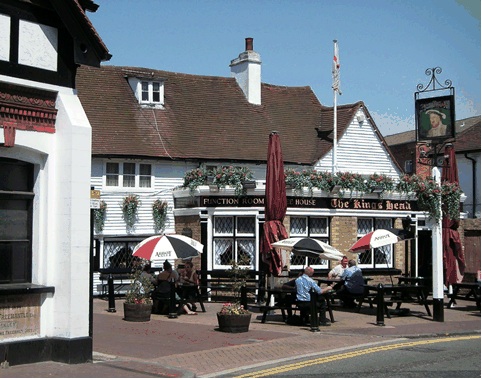
Then there was Anna-Belle. Son-of-a-bitch! Anna-Belle O’Malley! He hadn’t stopped thinking about her since the previous day in Old Bexley. Anna-Belle O’Malley, after all those years. What goes around comes around, he chuckled to himself. He hadn’t been down to the medieval village of Old Bexley in decades, but reckoned it was high time he made his peace with his kid brother, Malachy. Malachy could be a bit tetchy, he being of the quick to anger, slow to forgive type, and they’d almost come to blows the last time they met ten years ago, so you can understand Jonah being a bit wary. Which explains why, upon leaving the railway station in the village he’d decided to pop into the old King’s Head for a couple of pints, to steady his nerves.

pub_kings_head_bexleyIt was just after midday. A laconic sun hung lazily in the sky and a chill wind was blowing up from the south. Anyway, Jonah pushed open the door to the saloon bar and there she was in her vintage Laura Ashley pinafore dress, sitting all alone like a displaced duchess, in the alcove by the fake leaded window, deeply engrossed in a paperback as thick as a brick. She had a gin and tonic on the go which looked as though she’d barely touched it. But maybe it’s not her first, Jonah thought, she’s never been averse to the odd tipple. He’d recognised her immediately. The unforgettable autumnal hues of her bubble-cut hair, cute curls framing a cute little face. And to cap it all, the old dear was even wearing a pair of sensible pumps, just visible under the table. Gone were the days, so it seemed, of stilettos that could pierce a man’s heart!

*

First time Jonah had ever really got to know Anna-Belle was about four decades ago in the Freemantle, a large function hall little more than a llama spit from the King’s Head. It was an eighteenth for one of Paddy Delaney’s girls, Julie or Josephine or Jennifer, or Jane. . . what the hell. . . and there she was, Anna-Belle O’Malley, herself just turned sweet sixteen. How well he remembered that do!

In those days Anna-Belle was one of God’s greatest creations, a little wisp of Jewish thrown in with the usual Anglo-Irish mix, had created something of a blueprint for female beauty. Petite at five foot two out of her plimsolls, she had the sort of endearingly deep ocean blue eyes you could drown in for hours, as long as there was oxygen in your tanks. And she was perky. Boy she had attitude and devilment all rolled into one: in short, she was fun!

That night there’d been a long line of lads snaking out the door waiting to say hello to her and get on her dance card, and her brother Jeremy was puffing and panting, barely able to keep order amongst them. But Jonah didn’t wait in line; he just sauntered up to her, cock-of-the-walk, took her pale lily-white hand into his own, and bent over and whispered “Pleasure,” in her ear. She gave him a cold, hard smile, whispered something like “bastard” under her breath and directed the daggers of her eyes at Jeremy, as if to say: “For the love of God, can you get rid of this creep!”

But she and Jonah, they’d had a history, a secret history. And that first meeting was not, truth be known, the first; nor was it the last, no sir. Now after all those years and the separate lives they’d led, there she was again. Anna-Belle O’Malley. Jonah ordered his pint and when it was ready he sidled over to her table with a sneaky grin on his face.

“Mind if I join you, ma’am?”
“’S a free country,” she said, not taking her eyes from her novel.
Jonah caught the title. She was reading War and Peace!
“You don’t remember me, do you?”
She raised her frosty eyes and examined his features closely, hesitated, and then it hit her.
“Jonah,” she said, “Jesus Christ, Jonah, what the. . . !”
And her mouth dropped and she said nothing else.
“Damn right,” he said, “been a long time, Anna-Belle. Too long?”
She caught the hint but did not react: picking up her glass, she took a gulp of her gin and tonic, spluttered some of it over her novel and set the glass down again, before slowly running her tongue over her lips. Jonah admired her small trembling hands and the manicured nails as she did so.
“Too long,” he said again. “So good to see you. How you been?”
“O,” she said cautiously, “I been. You?”
“O I been too. I been, all right. Plenty to tell if you have the time.”
And he paused and looked her over again. And they both just sat staring into each other’s eyes like two dredgers working the Thames and let the silence and dust of all those years wash over them.
“You’re looking so well,” Jonah said eventually. “By God, all those years and you’re looking so damn well.”
“Diet,” she said. “Melon and salad, and the odd bagel from time to time, can’t beat it. Plus I keep myself busy. Hard work, you ever heard of that?”
But for the merest flicker of a smile, Jonah let the shot pass over his bow without rising to the bait. Sharpest tack in the box as always, he thought to himself. Some things change, some people don’t. And she ain’t changed.
“Still teaching dance?”
“Aha.”
Jonah raised his glass in a toast.
“Well, here’s to you, babe. Anna-Belle O’Malley, son-of-a bitch. Here’s to you. No, here’s to us and to God knows what the future holds. Son-of-a-bitch!”

Editor’s note: This is not to be continued, under any circumstances.

The Cross – A North Kensington Tale

250px-Electric_Cinema_Notting_Hill_2009For the whole of the 1980s I lived in Ladbroke Grove, just up by Harrow Road and close to the Grand Union Canal. This was in the days before the catastrophe of gentrification. I was working at the time as a teacher in Holland Park School, and on Saturdays I would do my grocery shopping in the market at Portobello Road, often meeting pupils of mine who had Saturday jobs on the fruit and vegetable stalls. In the evenings or perhaps for a Saturday matinee, I might go to see a film at the Electric Cinema (pictured) which first opened in Portobello Road in 1910. Nowadays it’s a very smart place, but back then the seats were rickety and mice would be running between your feet as you sat and watched Bob Dylan and Sam Shepard in the crazy film, Reynaldo and Clara, which also featured Allen Ginsberg; or Elliot Gould playing Philip Marlowe in The Long Goodbye. But did I care?

I loved to ferret through the stalls looking for CDs or second-hand books, anything that took my fancy. It was there that I discovered two sensational CDs featuring Joe Arroyo, possibly Colombia’s greatest salsero, bought them for a couple of quid each. And before that, back in the days of vinyl, I bought four of John Lennon’s solo albums in a pop-up shop opposite Tesco, also for a couple of quid each. There was a family butcher’s in the Golborne Road where the meat and the service were always excellent; and I would sometimes go into the Cañada Blanch Spanish School at the very top of Portobello for lunch in the canteen there, where two of my Spanish friends taught: calamares a la romana, delicious! Above all, I loved the colour and the buzz on the streets and loved being part of that community. There were the Rastas smoking ganja on the corners, and the Spanish and the Morrocans and the Portuguese, and so many other nationalities, and everywhere heaved to the sound of Bob Marley. Get up, stand up, stand up for your rights!

Among the many characters in the area, and believe me there were many, there was a black man who used to carry a white cross. I would see him frequently in different parts of the borough but mostly in Ladbroke Grove, and on one occasion I even met him in the big supermarket up by the canal. He had put his cross down just behind one of the check-outs and was paying for his goods.

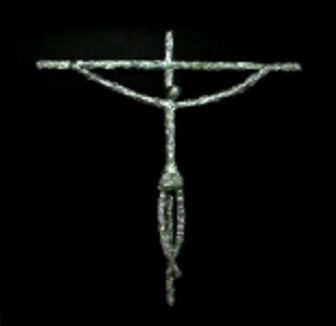
So the story below is actually a true story and it was published in my translation some years later in Managua, in the Saturday supplement of El Nuevo Diario along with the picture of a cross sculpted by the poet, Ernesto Cardenal. 


The Cross

ernesto crossLaminated white wood. An oak cross with white panels. The size of a man. A tall man, almost six foot six. A man with broad shoulders and a long neck. A man with short black hair. A black man, carrying a white cross. He says nothing as he walks along the street. Says nothing to anyone, but talks constantly to himself. Maybe he’s praying. Maybe not. He wears black trousers, worn at the knees. His trousers are tucked inside Wellington boots. His jacket is not black, but dark blue, the cuffs frayed. Under the jacket he wears a polo neck sweater, thin black wool. He goes up the street muttering under his breath and people gape at him as he goes. No one laughs in his face, but behind his back, people roll their eyes and a smile appears on their lips. An eccentric, carrying a huge white cross. Was a time in Virginia, a man could be crucified for less. The Klan would have told him what to do with that cross, that’s for sure. . . .

Bleeding Hearts – a foray into fiction

carverOver twenty years ago I began to write a collection of short stories called Bleeding Hearts. I took my inspiration from the short fiction I was reading at the time, in particular the brilliant stories by Raymond Carver (pictured) and Richard Ford. Written in a spare style, these narratives were about failure and loss, about life and lives falling apart, about dead-ends and dead-beat jobs, and in the case of Carver, hopeless addictions. They were human stories on a par with the best of Chekov and they dealt with the tragedies of everyday life which are every bit as profound as those of Sophocles or Shakespeare, God rest his soul.

I completed thirteen of my own stories, all set in the USA in places like Montana or Oregon. I knew nothing about these states other than what I’d picked up from the stories I was reading, but in a sense it didn’t matter: it was all theatre and the dramas could be staged anywhere, not excluding the moon, anywhere that human dreams and aspirations could come tumbling down, anywhere that love could slip through your fingers like a cool mountain stream, anywhere that heartache could burn through the soul like the royal waters of aqua regia.

I took the stories with me when I went to live in Central America for a couple of years in the early nineties, and I translated all thirteen into Spanish. A number of them were published in the Saturday supplement of the Sandinista newspaper, El Nuevo Diario. Shortly after, I ceased writing prose and concentrated on my poetry, which at the time I was writing and publishing in Spanish.

A dear old friend of mine read a handful of the stories a few months ago and when she’d finished she said: “Yes, all right, but when I get to the end of them I always want to know what happened next.” “Don’t we all,” I replied. She’s going to be even more frustrated if she reads today’s post.

Below is a fragment from a story which I never completed but which will convey some idea of how I was writing in those days. At some point in the future I will post a complete story, but for now this is it. Life is full of fresh beginnings and false starts and wrong trails, and it takes courage to press on to the end, and sometimes we just have to accept that we may never get there. So best sit back and enjoy the journey, one day at a time. . . .


Good Fortune

montanaI wake at dawn. Gayle is still fast asleep. My throat is dry. I reach for the glass of water on the bedside cabinet and drain it. My hands are shaking. I put down the glass. Gayle turns over and for a moment her eyes open. She looks at me and smiles. I lean across and kiss her on the forehead. She mutters something in a sleepy drawl which I cannot understand. I pull the covers up around her shoulders. You go back to sleep, I say. She smiles again and closes her eyes. I run my fingers through her grey hair. The hair is dry and brittle. Her soft skin is marked now with fine deep lines like a spider web of pain.

Years ago I used to think that we would never grow old, that somehow time would pass us by, we were so happy. Time did pass us by, but not in the way I imagined! This much I have learned: that nothing goes the way you think it will. When we were young, just starting out, we both believed that we would make it, that loving each other the way we did would be enough to get us through. We were both wrong. Gayle would say to me: I’ve got you, Luke, what more do I want? And I would say the same thing. We were that happy, and that naive. This is Montana, the Treasure State, and we haven’t a dollar to our name. We still have each other, still love each other. That’s something.

I slide out of bed and walk across to the window. I open the curtains a fraction and peer out. The sky is already a soft cerise. The world outside is silent but for the chorus of birds in the trees across the way. I know what I have to do. There is a sick feeling in my stomach, as though I have swallowed a great quantity of lead in the night. I let the curtain fall back. It’s going to be a fine day, a fine summer’s day, and for me, for me and Gayle, a make or break day. I skirt around the bed but before I leave the room I stop and stare at Gayle once more. In two months’ time she will be sixty. On the cabinet her side of the bed, her reading glasses are lying on top of a open copy of Fortune Magazine. Last night we read the story of a retired plumber in Milwaukee who made a million bucks in one year. After a lifetime attending to burst pipes during the winter months, he hit upon the idea of electrified lagging which would switch on automatically once the temperature dropped.

In the corner by the wardrobe is Gayle’s walking frame. Her hips are getting worse. . .