
One of the most delightful writers I met in Latin America was Augusto Monterroso. A Guatemalan, he lived for much of his life in Mexico, where he taught in the UNAM university. Before leaving London, I had been given the telephone number of a Nicaraguan poet, Ernesto Mejía Sánchez, and I called him as soon as I got to Mexico City. We agreed to meet one lunchtime at Sanborn’s café, which was where all the artists and writers usually met. At that time Mejía Sánchez was going through a difficult patch in his life, and the conversation was rather strained and dull until Augusto Monterroso turned up. He had with him copies of three of his published works and in each of them he wrote a very individual dedication to me. “I hate to burden you,” he said as he handed them to me. “But you can chuck them into the Atlantic when you fly back to London if you like.” Naturally, I held onto them, still have them today, and they are among my most prized possessions.
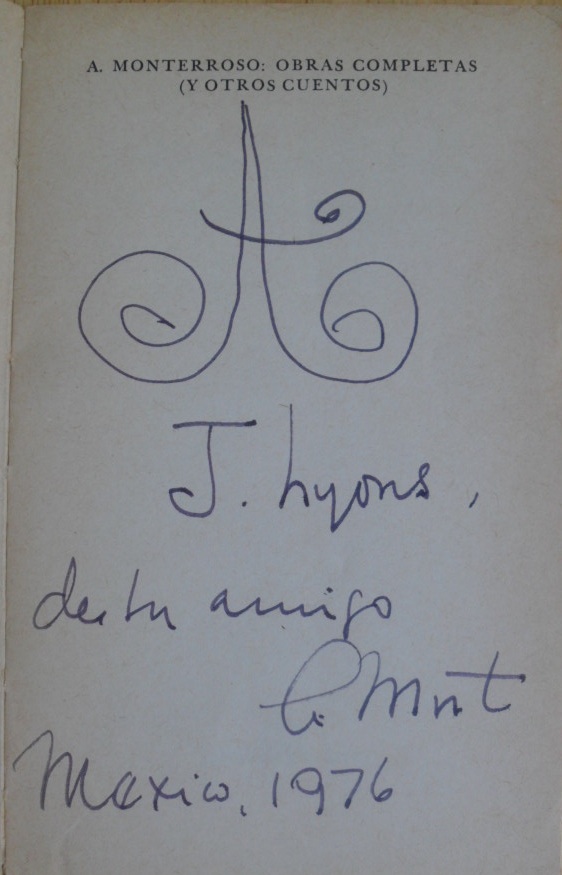 Augusto, was extremely warm and jovial and the conversation soon became filled with laughter and great stories and even managed to draw poor Mejía Sánchez out of himself. Monterroso’s writings tend to be short pieces, fables and short stories but always with a humorous and satirical slant. The Colombian Nobel Prize Winner, Gabriel García Márquez said of one of his works: “This book should be read with your hands in the air: its danger is based on its sly wisdom and the deadly beauty of its lack of seriousness”. With a sense of humour very much in tune with that of Julio Cortázar, it was no surprise that when the latter died in 1984, his apartment in Paris was ceded to Augusto Monterroso.
Years after that meeting in Mexico, I was asked by Index on Censorhip to translate a story by Monterroso, entitled “Mister Taylor”. This was a satirical tale about the export of shrunken Guatemalan heads to the American market where they had become fashion accessories. The tone, of course, was very much that of Jonathan Swift’s “A Modest Proposal”. In a subsequent book, Augusto touchingly singled out this publication with these words: “I’ve just received a copy of Index on Censorship from London where I story of mine, “Mister Taylor”, translated by John Lyons, has just appeared. Most surprising!” The circle was thus complete!
The frog who wanted to be a real frog
There was once a frog who wanted to be a real frog, and every day she struggled to be so. First she bought a mirror into which she gazed for hours hoping to see her longed-for authenticity. Sometimes she thought she’d found it and sometimes she did not, depending on the mood of that day or hour, until she grew tired of this and put the mirror away in a trunk.
Finally she thought that the only way to be sure of her own worth was through the opinion of others, and she began to do her hair and to dress up and undress (when she had no other option) to see if others approved of her and recognised that she was a real frog.
One day she noticed that what they most admired about her was her body, especially her legs, so she started to do squats and jumps in order to have to better legs, and she felt that everyone applauded her.
And so she continued to push herself harder and harder, and was willing to go to any length to get others to consider her to be a real frog, she even allowed her thighs to be ripped off for others to eat, and as the others devoured them she was still able to hear bitterly when they said, “Excellent frog. Tastes just like chicken.”
The mirror that could not sleep
There was once a hand mirror which when left alone with no one looking into it, felt absolutely dreadful, as though he didn’t exist, and perhaps he was right; but the other mirrors laughed at him, and when at night they were put away in the drawer of the dresser they slept soundly, oblivious to the neurotic’s worries.
Translations by John Lyons

 I wake at dawn. Gayle is still fast asleep. My throat is dry. I reach for the glass of water on the bedside cabinet and drain it. My hands are shaking. I put down the glass. Gayle turns over and for a moment her eyes open. She looks at me and smiles. I lean across and kiss her on the forehead. She mutters something in a sleepy drawl which I cannot understand. I pull the covers up around her shoulders. You go back to sleep, I say. She smiles again and closes her eyes. I run my fingers through her grey hair. The hair is dry and brittle. Her soft skin is marked now with fine deep lines like a spider web of pain.
 johnjosephlyons