
Herman Melville – all cut up

melville
Herman Melville

In the 1960s, encouraged by the American poet and painter Brion Gysin, William Burroughs began to experiment with a cut-up technique of writing. He would take a page from a novel by Graham Greene, for example, and cut it into four columns A, B, C and D. He would then rearrange the columns in an order such as C, A, D, B. and glue them to a sheet of paper so that he was able to read the text across the lines of the page CADB as though the words had been written in that order. What interested him was to see what new images and combinations were created in this new arrangement of words.

In an interview, Burroughs stated: “Any narrative passage or any passage, say, of poetic images is subject to any number of variations, all of which may be interesting and valid in their own right. A page of Rimbaud cut up and rearranged will give you quite new images. Rimbaud images—real Rimbaud images—but new ones.”

Some months ago I tried a variation of this technique. Instead of cutting up pages, I consulted a concordance to the work of the American writer, Herman Melville, author of Moby Dick. I searched for usages of the words, ‘bone’, ‘dust’, ‘love’, ‘dream’ and ‘rose’. The text below is a compilation of those references as they occurred in my research.


Dust on the moth’s wing

She was bone of his bone
and his very bones
are as whispering galleries
He laid her bones
upon some treacherous reef
with the bones of the drowned
Not dust to dust but dust to brine
he is dust where he stands
he had dead dust for ancestors
the penalty we pay for being
             what we are—fine dust

Did I dream a snow-white skin
firmament blue eyes :
this beautiful maiden
who thinking no harm
and rapt in a dream was a dream
We dream not ourselves
but the dream dreams within us
How the firefly illuminates its body 
for a beacon to love
Long he cannot be
for love is a fervent flagellant fire
love is all in all—all three : red rose
bright shore and soft heart
             are full of love

Loved one love on
who fell into the very snares of love
Love the living not the dead
great love is sad
             and heaven is love

Dreams dreams golden dreams
: noon dreams are day dreams
Are all our dreams then in vain?
What dream brought you hither Romeo
And sweet Juliet what dream is it
that ails your heart ?
We are but dolls of joy and grief :
breathe grow dream die
             —love not

This earth’s an urn
for flowers not for ashes
Brush your tears from the lilies
and howl in sackcloth and ashes
as thoughts of eternity thicken
Duration is not of the future
but the past : we must build with
the calendar of eternities
Sad rose of all my days : a song sung
             on lips of dust

He’s seized the helm
eternity was in his eyes
Dash of the waves against the bow
and deep the breath of dreaming
Such perils that lie
like a rose among thorns
Her delicate white skin
tinted with a faint rose hue
             like her lips
like rose pearls that once bruised
against my aching skin
             left love stains

Your rose, my sweet
I unfold its petals
and disclose a pearl
yet the full-blown rose
is nearer to withering
than the bud : and Emily asked
             how far is it to hell ?

John Lyons

Eve Grubin – two poems

grubinYesterday Eve Grubin was due to give a talk at the British Library entitled “The Poetics of Reticence: Emily Dickinson and Her Contemporaries”. Unfortunately, owing to circumstances beyond her control, this lecture was cancelled.

Ms Grubin is an excellent poet in her own right and we have decided to print two of her poems which are readily available on her own site which readers may consult for further material (http://www.evegrubin.com/close.php).

It is not difficult to see why Eve Grubin is drawn to the poetry of Emily Dickinson: her own poetry is spiritual and mysterious and driven by minute observations, reflecting the great sensitivity of a life lived intensely, passionately.

We hope that in the not too distant future she will be able to return to the British Library to deliver her talk on Emily Dickinson and in the meantime we send her our best wishes.

Eve Grubin was born and raised in New York City. She was the Programs Director at The Poetry Society of America for five years (2001-2006). She divides her time between London and New York.


When the Light Begins to Close

When the light begins to close, just before it closes,
I am looking out the window or walking beside buildings,

a wave of uncertainty—suffocating, numinous—rushes my throat,
quick, unmistakable.

Suddenly I am my name:
standing in the garden, the fruit eaten, seeds burning the dust.

Loneliness, slanted cold enters the air around my neck.

Eve looks at the wet eyes of the animals, once soft and brown. The rotation of the earth moves through her, me.

Holiness, a slanted cold
sifts the spaces between my fingers.

At end of day, light contracts: I stare into trees and lamps, the gray
sidewalk, shadows walking into shadows. What is it

about the transition between sun and dark, hope and gloaming,
that constricts, elates?

*

A Boat of Letters

arrives, and I lie down in its white wet,
ink prints on my cheek, feet, and dress.
Last night I dreamt my husband
held me like a forceful wind
as I strained forward to hear
a group of girls sing soft, unclear,
in our doorway.
I pushed towards them. They seemed far away.
He was strong, and I struggled against him.
Boat of letters, filled to the brim,
take us to your wild inky swamp
where leaves hang down like muted lamps,
where we can write and read; and with each broken seal,
let there be an answer, a surprise, something delightful!
Emily Dickinson – a breath of fresh air

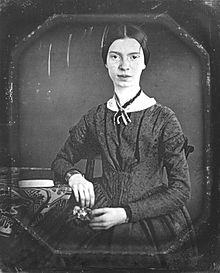
dickinsonIt is impossible to exaggerate the importance of the influence of Emily Dickinson’s poetry on subsequent generations of male and female poets writing in English or indeed any other language throughout the world. Although she wrote almost 2000 poems, only a handful were published in her lifetime. Scholars have since written extensively on the themes of her poetry: the beauty of flowers and nature, the inevitability of death, her Christian faith and what she called the undiscovered continent or the landscape of the spirit.

Her preoccupation with the mystery and complexity of human consciousness brings with it a desire to shape her poetry in a truly revolutionary manner. Her verse is renowned for its unconventional syntax, for the use of dashes and irregular capitalisation. It would be easy to dismiss this as an idiosyncratic fad: but that would be to ignore the true character of her genius. The syntax, the form of the poem on the page, represents a deliberate challenge to the status quo; and the freedom Dickinson demands in her verse is the freedom to breathe and to express her breath as she feels it. When contemporary readers of her poetry suggested she might make concessions by adding a few commas and full stops instead of her dashes, she was adamant that such a practice would destroy her poetry.

The poem below was written in homage to a lady who, in all her modesty, tore up the poetry rule book. It was a truly remarkable act of emancipation. As with earlier poems on this blog in homage to Marianne Moore and John Berryman, I sought to convey my admiration for Dickinson’s work by adopting, as far as I could, the vocabulary and the stylistic devices typified in her poetry. An impossible task! But this was done in the spirit of those artists who set up their easel in front of an old master in the National Gallery and seek to reproduce a painting in order to learn new techniques and appreciate the challenges faced by the original painter. A learning curve that can bring knowledge and skill, but alas, not genius.


Emily Dickinson

On the cusp of the Night –
Hands clasped as though
in Prayer – she observes
the last flicker of the Candle

Light’s demise – tinged
with the scent of Beeswax –
signals no Death
of the Imagination

Silence and Darkness:
these could be loved –
eternally – intimately
No human Consolation

between the cold white
Sheets – but Words warmed
on her Breath – mind Forms
of companionable Poetry