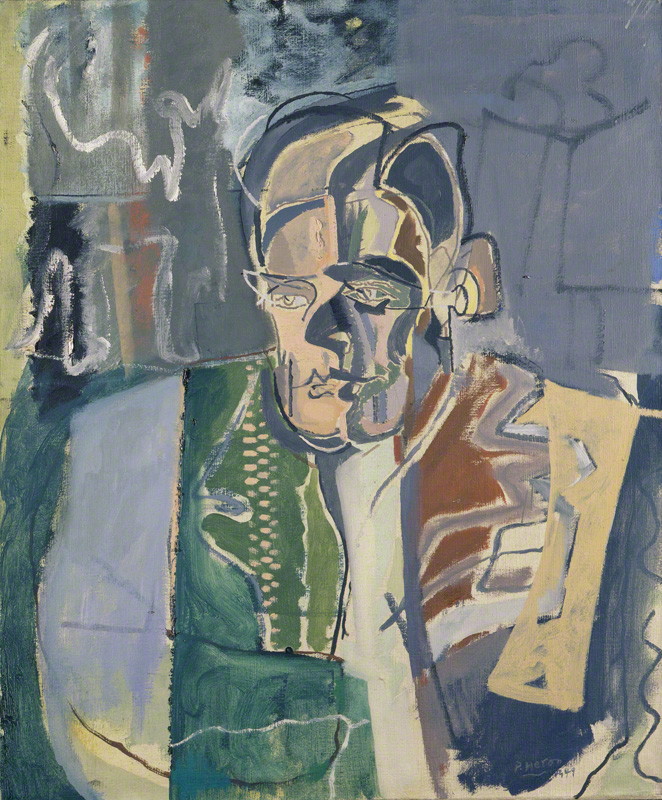
Confirmation – as if it were needed – that painters will render not only what they see but also what they know and feel about a subject. Patrick Heron’s study of T S Eliot – on display at the National Portrait Gallery on Charing Cross Road – is absolutely informed by a reading of the poet’s work and, certainly to some extent, his life.
Painted in 1949, a year after Eliot, the author of The Wasteland (1922) and The Four Quartets (1943) had been awarded the Nobel prize for Literature, Heron’s canvas seeks to convey the complexity of Eliot’s character, including as it does, two primary facets: a formal portrait with the poet sitting face forward, with a simultaneous profile, in the manner of Braque.
Eliot typically dressed in suits, yet Heron subtly deconstructs his appearance by using colour to undermine the formality, and by including elements such as the zip completely out of place, not to mention the discreet crucifix on his chest. The composition of the portrait is absolutely traditional, but the traditional silhouette is broken up into a fluid mixture of geometrical and non-geometrical segments in such a way as to challenge and subvert the rather stuffy personna that Eliot tended to project. And Eliot, in his poetry and in his life too, essentially was the embodiment of a conundrum: a paradox, a highly conservative revolutionary, whose key modernist works radically altered the course of twentieth century poetry.
Below I have quoted the very revealing opening lines of Eliot’s poem, “Ash Wednesday” which was first published in 1930.This poem was written to mark Eliot’s conversion to the Anglican faith. But notice how, into this brilliantly executed portrait, Patrick Heron has incorporated grey ashen tones in the defining lines, in the background and in splashes on the poet’s jacket: greys that contrast with the different shades of green which appear like bold fresh pastures. In the top right-hand corner of the canvas there is the suggested form of a book or pages of text on display, and this would seem to hint at the typical eagle lectern of the Anglican church, which in turn could equally well suggest a phoenix rising from the ashes.
Because I do not hope to turn again
Because I do not hope
Because I do not hope to turn
Desiring this man’s gift and that man’s scope
I no longer strive to strive towards such things
(Why should the aged eagle stretch its wings?)
Why should I mourn
The vanished power of the usual reign?
T. S. Eliot
Born in 1920, Patrick Heron trained at the Slade School from 1937 to 1939. His career was interrupted by the war. One of the most profound influences on his painting was the work of George Braque, which he first came to know during an exhibition of Braque’s art at the Tate Gallery in 1946. In the mid-fifties he became interested in abstract painting. He died in 1999.
 johnjosephlyons