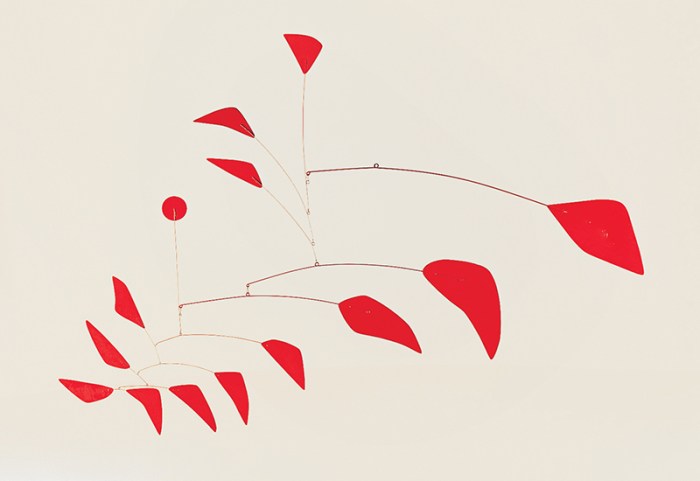
The words wired together below were inspired by a visit to the irresistible Alexander Calder exhibition at the Tate Modern which runs until 3 April 2016.
Maquette
These evocative geometric shapes with rounded edges some large and small leaves some artist’s palettes all wired together so that they hang in perfect equilibrium : the movements are gentle a glide more than a dance though they turn around each other like dancers or lovers locked into patterns of paths lovers driven by the same premise guided by the same promise
Love is the framework that binds and liberates the third dimension that completes the trinity along with beauty and truth for a purpose Permanent adjustment to the shifting shadows of time to the essential choreographies of the day and the night It is kinetic colour essential and minimalist a sun and a moon encapsulating the music of the spheres
In love all things are relative a constant to-and-fro between energy and mass motor and motive hand-held lip-locked hair in the wind eyes awash with emotion the flutter of a heartbeat no-nonsense art nothing overly complex but in your face possibility above probability self-perpetuating renovation and replenishment
And the hierarchies are so simple either you have it or you don’t— the bones know ask the bones
London has some of the finest publicly owned museums and art galleries in the world and it is all too easy to take them for granted or to dismiss them as mere tourist attractions. Access to these great institutions is currently free, and so it should be. These facilities are great learning resources for children and for adults. Art is an essential human activity and has probably been with us for as long as we have had language. The representation of consciousness, of feelings and ideas is fundamental to our sense of identity, whether it be in words or images. That we are complex beings is to be applauded: it is this complexity which generates great drama, great music, great poetry and great art. We are the only species in nature to ask questions about what we observe in the external world and what we endeavour to understand when we look introspectively into our hearts.
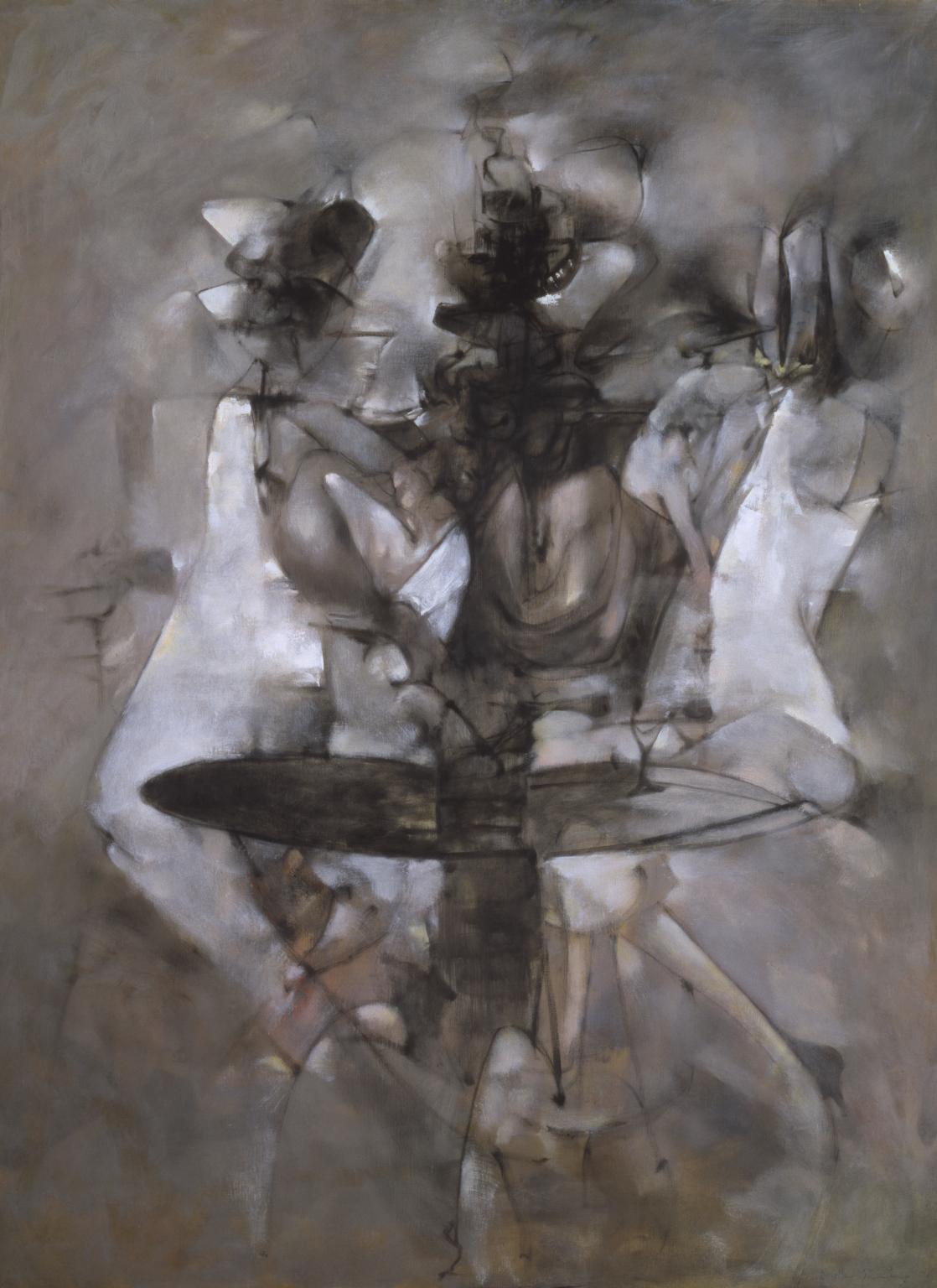
Traipsing round Tate Modern last Sunday, wet through to my soul, and disappointed that the Pollocks I had gone to see were not currently on display there, I needed a piece of art to raise my spirits, and I found several. In particular I was struck by the ethereal beauty of a painting by Dorothea Tanning, À mi-voix, a title which in English means ‘in a low voice’, almost a whisper. This beautifully executed canvas took my breath away, and there is so much that I could say about it, but I won’t go into detail. Suffice it to say that at its heart I see two figures, male and female, bound by a central spinal column, expressing a love that is so delicately intimate it need not be shouted from the rooftops. But maybe that’s just me! Don’t take my word for it, go and see for yourself.
Dorothea Tanning
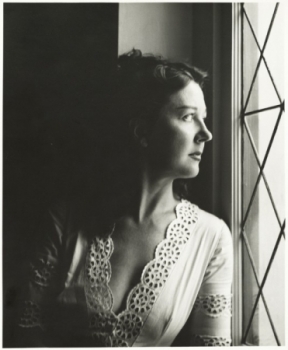
Artist and writer Dorothea Tanning was born in the United States in 1910 and trained as a painter in Chicago. She was associated with surrealism early in her career and she was married to fellow artist Max Ernst for thirty-four years until his death in 1976. Among her friends were Man Ray, George Balanchine, Truman Capote, Virgil Thompson, and Igor Stravinsky. Throughout her life she was always busy busy busy, into everything: painting, printmaking, sculpture, set and costume design, and her work was exhibited in the Guggenheim Museum, the Metropolitan Museum of Art, Tate Modern, and the Philadelphia Museum. In the late 1990s Dorothea turned to writing poetry and two of her poems are presented below. She also wrote an autobiography entitled Birthday (1986) and in 2004 published a novel Chasm: A Weekend. In an epigraph to one of her poetry books she quotes Montaigne : “it’s hard to be always the same person.” She died in 2012 at the age of 101.
Be perfect, make it otherwise.
Yesterday is torn in shreds.
Lightning’s thousand sulfur eyes
Rip apart the breathing beds.
Hear bones crack and pulverize.
Doom creeps in on rubber treads.
Countless overwrought housewives,
Minds unraveling like threads,
Try lipstick shades to tranquilize
Fears of age and general dreads.
Sit tight, be perfect, swat the spies,
Don’t take faucets for fountainheads.
Drink tasty antidotes. Otherwise
You and the werewolf: newlyweds.
*
Sequestrienne
Don’t look at me
for answers. Who am I but
a sobriquet,
a teeth-grinder,
grinder of color,
and vanishing point?
There was a time
of middle distance, unforgettable,
a sort of lace-cut
flame-green filament
to ravish my
skin-tight eyes.
I take that back—
it was forgettable but not
entirely if you
consider my
heavenly bodies . . .
I loved them so.
Heaven’s motes sift
to salt-white—paint is ground
to silence; and I,
I am bound, unquiet,
a shade of blue
in the studio.
If it isn’t too late
let me waste one day away
from my history.
Let me see without
looking inside
at broken glass.
So Sunday morning I wake at six o’clock as per usual and peek out the window. Can see it’s a blustery day and I feel that the grey clouds slopping about overhead are ganging up on me, just waiting for me to step outside. Does not bode well! Still, intrepid as ever, it’s shower, shave, gallo pinto for breakfast and out the door, notebook in hand, optimism in my heart. Head down to the tracks and off to London town in search of Pollocks. Readers may recall my previous Sunday visit to Tate Britain. No Pollocks there, but plenty of other first rate objets d’art so not a wasted journey by any means. This Sunday, it’s Tate Modern, gotta be Pollocks there, surely. Get to Blackfriars on the Tube and as I hit the street all hell breaks loose up above, cats, dogs, anything the weather can throw at me, so I arrive at the old power station drenched to my Wilson socks, shake it off like a dog and enter the monumental arthouse, nip up to the second floor and ask one of the attendants: “Where’s the Pollocks?” She’s very sweet, about 5’ 2”, glasses, dark auburn hair, just a tad overweight, but that’s her business not mine, and the bearer of bad news: “Sorry, my love, they’re all in Tate Liverpool for a big exhibition.” My face is now a pool on the Tate Modern floor. “What? In Liverpool? O for God’s sake! I’ve come all this way!” “Sorry, my love. But they’ll be back sometime soon, second week of September, if I’m not mistaken.” “But I wanted to write a piece about them, I’ve got a blog.” She gives me a long, hard, charitable stare. “Sorry, ducks. Can’t be helped.”
Zhang Enli
Resilience, Battle of Britain spunk. I must have some of that somewhere. So, yeah, sure enough, I thank the girl for her kindness and consideration and traipse off down a few aisles, take a butcher’s at a few Dalis and Picassos, nothing to write home about and then I come across someone who just might be the ticket. Zhang Enli, never heard of him but his series of still lifes grabbed me by the . . . . Anyway, two and two together, cats and dogs, leaking roofs, why not buckets, memories of the Great Dartford Flood of 1968 when the branch of Woolworth’s was up to its ears and staff were obliged to enter the store (I kid you not) by boat, and I think “Eureka, I’ll write about Zhang Enli. Try to turn him into a household name. Do my bit at least.”
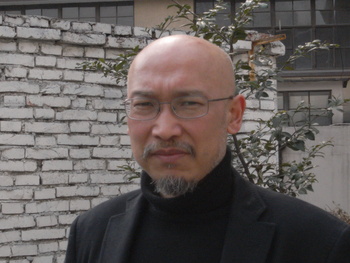
Born in Jilin, China in 1965, a teacher at the Arts & Design lnstitute of Donghua University, Zhang Enli currently lives and works in Shanghai. Doesn’t tell you much but the guy is good and he’s had exhibitions all over the shop.
Zhang Enli, Bucket 5, oil on canvas, 2007
Art is about focus, the mind homing in on something or some emotion before transferring that energy into an artistic product, notes on a stave, steps on a dance floor, words in the mouth of an actor, paint on a canvas, you get the idea, from the mind through the body into or onto whatever is the chosen medium. For a painter, Enli in this case, there are so many options, so many considerations, so many choices, oils, acrylics, board, canvas, grape stems, representational or abstracted, it’s always ‘make your mind up’ time. Art is mind on matter, even if that matter is the thin air fattened by a few Beethoven chords. Long and the short is that our friend Zhang has a technique and an eye that Pablo would have been proud of. Word of warning: No good admiring it on a computer screen, or worse still a crappy iPad. You gotta go and see for yourself the delicacy of the brushwork, the subtlety of the colours, the perfection of the composition. It raises the humble bucket into an icon, but the icon is dedicated to our humanity, to the essential ordinariness of all of us, our common bond in the occasionally very damp and gloomy human condition. Art is elevation. It makes us feel good and alive, and it is not a luxury, it is oxygen to our soul and any attack on the arts, by reducing curriculum time in schools, or failing to fund local arts, national arts, whatever, is an attack on the species. Forget global warming, the battle for the survival of the human race is an artistic battle. Still, that’s enough from me on my hobbyhorse. Uncle Toby would be proud of me, de gustibus non est disputandum. . . and so on and so forth. Get along to the gallery and get a load of it for yourselves.
Meanwhile, busy busy busy. It’s still chucking it down outside when I head back to Blackfriars and I’m sitting on the train bound for Denmark Hill when the blog editor comes on the mobile blower to say we’ve had another sweet comment on Jonah and Anna-Belle, our running soap, from dear old Molly Rosenberg. She’s such a darling, melts my heart every time. A ray of sunshine on a godawful day!
Note to myself: must get more sleep and slow down!


 johnjosephlyons