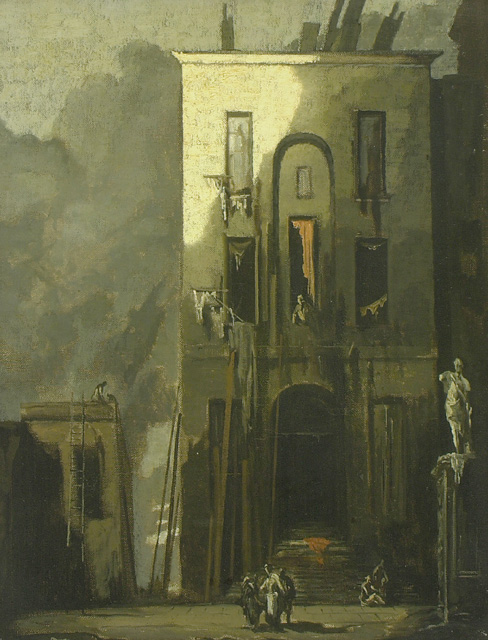
James Ferrier Pryde (1866-1941) was a Scottish artist and sometime actor. His principal occupation was the design of theatrical sets and posters. In 1930 he designed the sets for Paul Robeson’s Othello at the Savoy Theatre
However, Pryde is best remembered for a series of highly personal paintings of architectural subjects. During the First World War, these became increasingly sombre, dwelling on the theme of ruin and decay. ‘The Slum’, completed in February 1916, is one of the most monumental of these studies and evokes the grim tenement buildings of the Edinburgh of Pryde’s childhood.
What I admire in this portrait is the deep sense of irony which Prude infuses into his subject. The setting may well be Edinburgh but the gaunt building has echoes of Canaletto’s Venice, albeit the backstreets close to the Rialto. Notice the classical clothing of the figures featured in the painting. Pryde’s painting telescopes history in order to underline the degree of decadence, as if to say ‘this is how far we have come in the journey down to the pit of human indignity’. A once proud nation has been reduced to its knees, every detail is ragged and torn and misery drips from the buildings. The billowing shadows in the background are perhaps from the War raging somewhere off in the distance, but in the midst of the carnage on the battlefield we are not to forget the urban carnage of slum housing and what was in effect a war on the poor and dispossessed. The social and political climate that led to Easter 1916, I would suggest, is an unwritten part of the larger context, and Pryde, through his art, reaffirms the importance of artists as the antennae of their generation.
This magnificent canvas can be viewed at the Ashmolean Museum of Art and Archaeology in Oxford.
 johnjosephlyons