I met Alejandro Oliveros in March 1977 in Caracas, Venezuela. A poet of great kindness, Alejandro was an ardent adherent to the poetics of Ezra Pound, and despite the tropical climate, his mode of dress was a kind of homage to Pound. The poem below, from Espacios (1974) owes much to Pound’s imagism.
Landscape with man
In the grounds of the park A gardener collects leaves and trash With his broom. Tired. Weathered Face his hands hardened.
To one side between the leaning trees The river runs. Narrow. Bone dry.
The man advances a few steps Observes the clouds Against the pink summer sky.
Uneven shapes hint at The neighbouring mountains. Crops and fields turn yellow.
Night descends. The gardener gathers His tools and walks off. The wind blows.
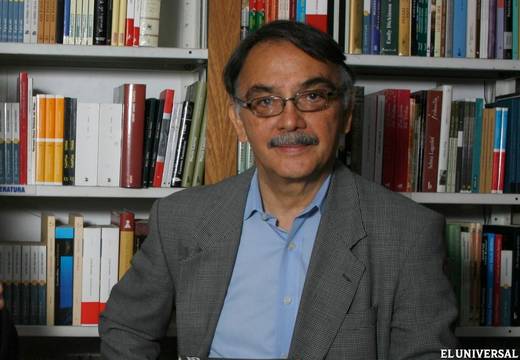
In March 1977 I arrived in Caracas and was immediately contracted by the Venezuelan Ministry of Culture to select and translate an anthology of modern Venezuelan poetry. Among the poets I chose to include was Eugenio Montejo (1938-2008) whom I met shortly after starting the project. I met many poets in the course of the next three months, but none more gentle and unassuming than Eugenio.
Years later Eugenio was to become famous when Sean Penn spoke some of the words from a poem he had written in the film 21 Grams, directed by the Mexican, Alejandro González Iñárritu.
The earth turned to bring us closer it turned on itself and within us until it finally brought us together in this dream as written in the Symposium.
I completed my work in Caracas in May 1977. Since that time I have not looked at the translations below, nor have I revised them. At the time I had shown my versions to Eugenio and he had been pleased with them and that was enough for me. Outwardly, Eugenio was the stereotypical professor of literature: yet his poetic voice was the most original of his generation.
Earthness
To be here, for years, on the earth, with the clouds that arrive, with the birds, suspended in fragile hours. On board, almost adrift, closer to Saturn, more distant, while the sun goes round and pulls us and the blood runs on in its ephemeral universe more sacred than all the stars.
To be here on the earth: no further than a tree, no more unexplainable, lithe in autumn, bloated in summer, with what we are or are not, with the shadow, the memory, the desire, till the end (if there is an end) voice to voice house after house, whether who gains the earth, if they gain it, or who hopes for it, if they wait for it, sharing at each table the bread between two, between three, between four, without forgetting the leftovers of the ant that always travels from remote stars to be present at the hour of our supper although the crumbs are always bitter.
*
The table
What can a table do by itself against the roundness of the earth? It already has enough to do allowing nothing to tumble, allowing the chairs to converse softly and in turn to come together on time.
If time blunts the knives, dismisses and brings diners, varies the topics, the words, what can the pain of its wood do?
What can it do about the cost of things, about the atheism of the supper, of the last supper?
If the wine is spilt, if bread is wanting and people grow absent, what can it do but remain motionless, rooted between hunger and the hours, with what intervenes though it should wish?
*
The stones
The stones intact in the river absorbed in the bank, sitting alone, in conversation. The stones deeper than childhood and of more solid scenery. When they see us they lift their faces now cracked and they do not recognise us, you have to speak to them so loudly!
They have no notion of masks and journeys, they perceive time through touch, they believe that our image in the water was erased in the sands downriver.
In the afternoons the shadow of an aeroplane passes over them and they are unaware that they go in the suitcases on board, that they are our only luggage, so tightly have they shut their eyelids.
 johnjosephlyons