The cold earth at dawn darkness still and a restless mind Motion lives in space and in our thoughts and poetry must resist the pull of intelligence
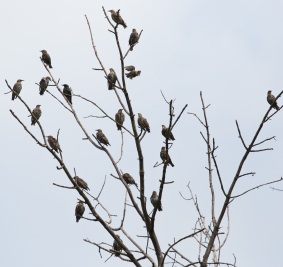
Yesterday in the car park a singing tree a young leafless sapling to be precise and a horde of fledged starlings thirty or more perched on the branches singing in unison a real piece of choral music that startled me with the beauty of the melody
As I closed the car door a gust of wind caught it and so it slammed shut but the birds did not flinch nor did they miss a note
A magical singing tree such as you might read of in The Arabian Nights each bird a particle of a single song each bird dressed for the occasion looking straight ahead facing symmetrically south : and I admiredthe complexity of their harmonies their resolution admired the iridescent metallic sheen of their plumage and above all their all-for-one one-for-all attitude
Song lives in space and is orchestrated in the mind At night a canopy embroidered with sparkling beads by day the baton is never still
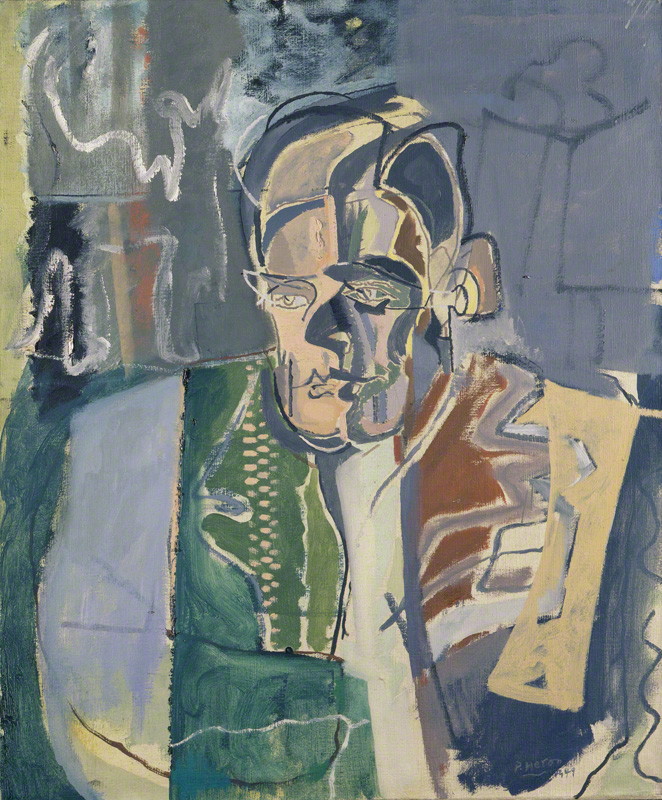
Confirmation – as if it were needed – that painters will render not only what they see but also what they know and feel about a subject. Patrick Heron’s study of T S Eliot – on display at the National Portrait Gallery on Charing Cross Road – is absolutely informed by a reading of the poet’s work and, certainly to some extent, his life.
Painted in 1949, a year after Eliot, the author of The Wasteland (1922) and The Four Quartets (1943) had been awarded the Nobel prize for Literature, Heron’s canvas seeks to convey the complexity of Eliot’s character, including as it does, two primary facets: a formal portrait with the poet sitting face forward, with a simultaneous profile, in the manner of Braque.
Eliot typically dressed in suits, yet Heron subtly deconstructs his appearance by using colour to undermine the formality, and by including elements such as the zip completely out of place, not to mention the discreet crucifix on his chest. The composition of the portrait is absolutely traditional, but the traditional silhouette is broken up into a fluid mixture of geometrical and non-geometrical segments in such a way as to challenge and subvert the rather stuffy personna that Eliot tended to project. And Eliot, in his poetry and in his life too, essentially was the embodiment of a conundrum: a paradox, a highly conservative revolutionary, whose key modernist works radically altered the course of twentieth century poetry.
Below I have quoted the very revealing opening lines of Eliot’s poem, “Ash Wednesday” which was first published in 1930.This poem was written to mark Eliot’s conversion to the Anglican faith. But notice how, into this brilliantly executed portrait, Patrick Heron has incorporated grey ashen tones in the defining lines, in the background and in splashes on the poet’s jacket: greys that contrast with the different shades of green which appear like bold fresh pastures. In the top right-hand corner of the canvas there is the suggested form of a book or pages of text on display, and this would seem to hint at the typical eagle lectern of the Anglican church, which in turn could equally well suggest a phoenix rising from the ashes.
Because I do not hope to turn again Because I do not hope Because I do not hope to turn Desiring this man’s gift and that man’s scope I no longer strive to strive towards such things (Why should the aged eagle stretch its wings?) Why should I mourn The vanished power of the usual reign?
T. S. Eliot
Born in 1920, Patrick Heron trained at the Slade School from 1937 to 1939. His career was interrupted by the war. One of the most profound influences on his painting was the work of George Braque, which he first came to know during an exhibition of Braque’s art at the Tate Gallery in 1946. In the mid-fifties he became interested in abstract painting. He died in 1999.
Below is a poem written in 1968, while I was still at school. I’m using this today due to problems with the WordPress site which is preventing me from uploading images at present. The post intended for today was a brief commentary on Patrick Heron’s portrait of the poet, T.S. Eliot.
Circus
A thousand ostriches stare at the ceiling A guest Jamaican spider hangs from his net Woven at a height to top all heights The cackling dies down and only the sound Of crunched sugar corn nibbles at the silence The pat of the drum breaks into a gallop The ants below in the sawdust hold hands The little flies forget their grievances And pray crossing their wings anxiously
The spotlight spins wildly and drags the beam Up to where the nonchalant performer Spits into six of his legs and then waves To a group of relatives sitting way below As he now begins the eight-legged hop People faint at liberty throughout the enclosure He slowly swings from one leg to another One two three four he stops smiles Scratches his back five six he slips And tumbles down like a feather into the arena Some scream some cry and some just marvel At the grace and control as he fell earthwards
The rusty tinkle of coins is heard As clean hankies are pulled from pockets To soak up the tears A doctor arrives The spider is dead go home that’s all today
Back with more thrills next week says the ringmaster
No one remembers our Jamaican friend any more And his black widow just spins and spins Day in day out slip one Day in day out slip one
It’s not easy to maintain a daily blog, but I have no complaints. Over a lifetime of reading and wide experience, I have a lot of cultural material at my disposal; and the supply of such stimuli is endless, living, as I do, in a city such as London where there is so much going on and so many events and galleries and museums and places of interest to visit, not to mention people to observe.
The fact that the main focus of this blog in on poetry is a further advantage. In his preface to the Selected Poems of Ezra Pound, T. S. Eliot wrote that a poet should write every day, that the poet should in fact write for the sake of writing and not be overly concerned about the quality of the verse. The discipline of writing every day Eliot compared to the fireman keeping his engine in good working order by polishing it daily. True inspiration, as every poet knows, is rare and cannnot be summoned, and it can come and go in a flash. Shelley wrote of the same phenomenon in his Defence of Poetry (see my earlier post including an extract from that essay).
So most days I rise and I write, just as I did this morning. I have notebooks at my disposal should I want for ideas, and in these notes there are many quotations from other sources: writing is, after all, re-writing. Today, for example, a couple of lines from Robert Herrick seemed appropriate and I have consciously slipped them into my own poem, other references are unconscious.
The vocation is sacred, nothing else!
Discrepant age
How brightly the flame of beauty burns in the mind’s eye and how jealously the memory guards the precious memory They may replace my hips or my knees or my teeth or my hair as I slip into that other state that other country that is still not quite the end With scalpel they may sculpt a fresh smile or tighten the failing skin across my pale cheeks They may in so many ways breathe new life into old but how brightly burns the flame of memory in the mind that never flags that never tires of recalling the silk of her flesh the soft impress of her lips nor the sweetness of her voice the ruby niplet of her breast the love that struck me with such gentle cruelty
Peddlers of time beware of passions that do dislodge the hourglass from its pedestal that smash the unholy bulbs to smithereens
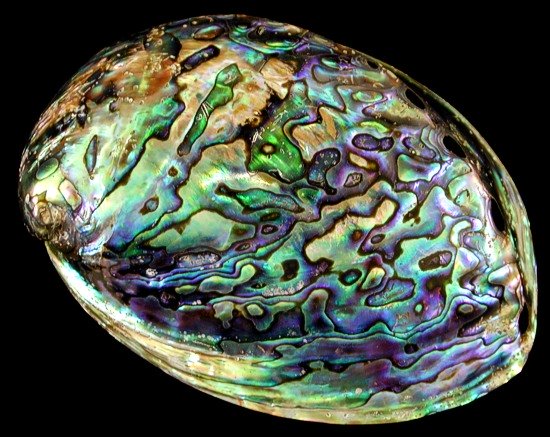
There is much to be learned from the simplicity of the abalone, an edible mollusc, housed in an ear-shaped, mother-of-pearl
shell in which there are up to nine respiratory pores. Its muscular foot has strong suction power permitting it
to clamp tightly to rocky surfaces. The abalone lives and breathes sex since its eggs and sperm are broadcast into the water
through its pores, along with its respiratory current. Crabs, lobsters, gastropods, octopuses, sea stars, and sundry fish all prey on juvenile abalones.
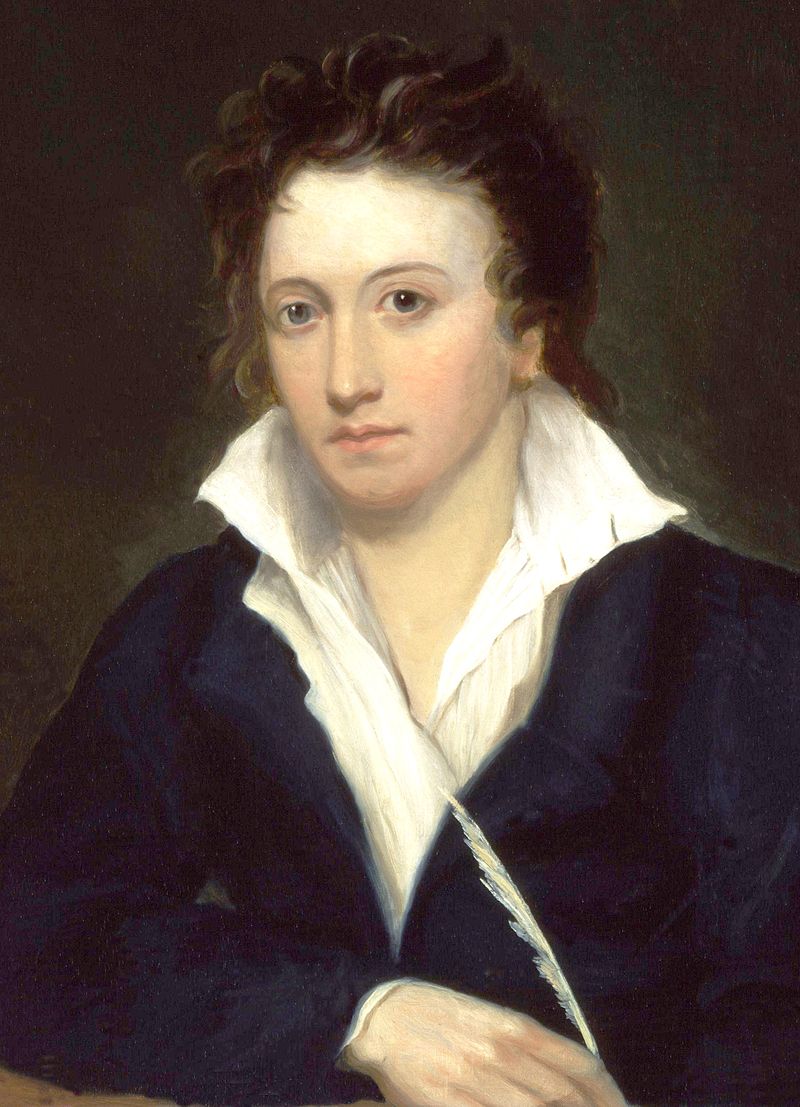
The British Romantic poet, Percy Bysshe Shelley (1792-1822) wrote his celebrated essay, A Defence of Poetry, in 1821. It was published posthumously in 1840. It is not difficult to perceive in the tone and content of Shelley’s eloquent and passionate thesis, a reflection of the civic values of the French Revolution (Liberty, Equality and Fraternity) which so fired the imagination of the Romantic poets in England.
In the wake of the terrible atrocities perpetrated in Paris on 13 November, it is important to remain vigilant and to defend the core human, cultural values to which Shelley alludes in his defence of poetry. These universal, life-affirming values are enshrined in the liberties of the great French cultural tradition that has enriched the world’s heritage with timeless works across the whole range of the arts from poetry to painting to music to dance, liberties that should never be surrendered.
A Defence of Poetry (an adapted extract)
Poetry is indeed something divine it is the centre and circumference of knowledge it comprehends all science it is the root and blossom of all other systems of thought it is that from which all spring and that which adorns all and that which if blighted, denies the fruit and the seed and withholds from the barren world the nourishment and the succession of the scions of the tree of life It is the perfect and consummate surface and bloom of all things it is as the odour and the colour of the rose to the texture of the elements which compose it as the form and splendor of unfaded beauty to the secrets of anatomy and corruption What were virtue lovepatriotismfriendship what were the scenery of this beautiful universe which we inhabit what were our consolations on this side of the grave and what were our aspirations beyond it if poetry did not ascend to bring light and fire from those eternal regions where the owl-winged faculty of calculation dare not ever soar ? Poetry is not like reasoning a power to be exerted according to the determination of the will A man cannot say « I will compose poetry » the greatest poet even cannot say it for the mind in creation is as a fading coal which some invisible influence like an inconstant wind awakens to transitory brightness this power arises from within like the colour of a flower which fades and changes as it is developed and the conscious portions of our natures are unprophetic either of its approach or its departure
Memories. Reading this poem to Carlos Martínez Rivas in the lobby of the Sheraton Hotel in San José, Costa Rica in 1977. Directness and extreme simplicity. Yeats. Ezra Pound, William Carlos Williams. The poem is a machine. The sad rose of all my days: the poetry in that simple metaphor. I remember a face and a gesture, a dress; long flowing hair, a smile, a kiss, none of which are in the poem below. That was another poem, adjacent to the one reprinted today, a couple of frames on in the stream. Wisdom out of the old days. Wisdom sometimes, not always, not often. Self-distrusting, despite the affirmations. Style. Self-conquest, reining in the tendency to be sentimental, striving for that sensual silence: passion but without thought. The expression of conviction, and how words can set a moment in stone, for all time. A moonless, wordless night. All my days. The sad rose. Self-distrusting. Word against word. Golden sunlight on the leaves. November. Berries still ripe for the picking. A black cat slips down from the garden wall, moves stealthily across the lawn. Time’s light footfall.
Near the Loire
River running without sound, cutting into the banks. On the far side cattle are grazing, near side an old man hunched over a rod, fishing. Long path leading up to the house, past a plot of vegetables, all looking dry, neglected. Outside staircase to reach the bedrooms; below, the dark kitchen, no hot water, a primitive stove, low chairs, well polished tiles; an old woman sitting beside a radio, her face sunken into her body, groping for the past. A dog barks in the yard, stops, begins again and then wanders off down the path towards the river, the man fishing.
Here is a poem written many years ago when I was travelling in Central America researching my doctoral thesis. I remember showing it to Ernesto Cardenal while I was staying in his commune in Solentiname, on one of the islands in the south of Nicaragua’s Great Lake. He told me then that it reminded him of Ezra Pound’s poem “Provincia deserta” and that indeed – in addition to my own experience – was the inspiration.
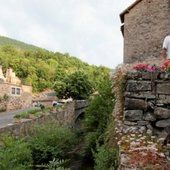
Le Minier is a very small village close to Le Viala du Tarn and not too far from the town of Roquefort, famous for its sheep’s cheese. Once a thriving mining community, nowadays the principal activity in the region is rearing sheep. In the time when I used to visit the village, many of the houses were in disrepair or in the process of being renovated as second homes for families who lived in Montpellier or other cities in the Languedoc.
Ezra Pound’s poem begins:
AT Rochecoart, Where the hills part in three ways, And three valleys, full of winding roads, Fork out to south and north, There is a place of trees … gray with lichen. I have walked there thinking of old days.
This morning I awoke thinking of old days, and of the days that lie ahead. I still remember the sound of the sheep bells at dusk when the shepherd would drive the flock down the hill, through a narrow street, past the house where I was staying. The form of my poem was intended in part to suggest that descent.
Le Minier, L’Aveyron
The river flows beneath the old bridge, swollen by recent storm rains, polishing the stepping stones in the bed, racing down the weir. In the square a memorial stone 1914-1918 Le Minier at war with Germany. On the slopes that run up from the square are their deserted houses, some still with roof, but mainly caved in, windowless, doorless By the memorial the little chapel built by the names on the stone, perhaps helped by their fathers. Room for sixty or more on the worn benches though now at eight o’clock, before the sun has broken the hill top, only a handful of women dressed in black hear a mass said by the frail priest who cannot shave so early in the morning. Few returned to the village and their young soon left for the cities where they could bury themselves in life. Now a few come back in retirement, back to the village so suited for dying. At night the sheep come down from the hills for shelter, the shepherd’s stick keeping the pace steady, the anxious dog guarding the rear: through the narrow paths for shelter. The copper mine is finished, no work. Perhaps a few women making gloves at home, making lace for tourists. Summer visitors arrive like a transfusion, but the blood seeps out through the cracked walls, gushes from broken window frames. You may see a young couple kissing passionately by the river, pledging a life of love together. How can you tell if the next year will not see them miles apart lives apart.
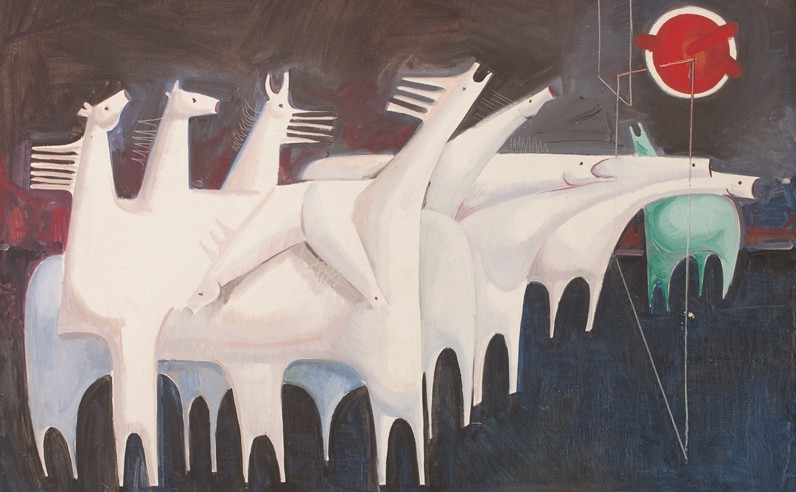
Kadhim Hayder, Fatigued Ten Horses Converse with Nothing (oil on canvas) 1965
Please note: The text below is a revised version of the post which appeared earlier today.
Iraqi artist Kadhim Hayder’s stunning canvas (pictured above) is currently on display at the Whitechapel Gallery, as part of an exhibition of Arab art on loan to the gallery from the Barjeel Art Foundation until 6 December.
In a spacious, well-lit room, full of striking paintings, all vying for attention, Hayder’s stylized horses really catch the eye. Two things struck me when I first saw this picture. The first is that Hayder’s war weary horses are every bit as iconic as the more widely known emblematic peace dove, and arguably the horses are more eloquent, captured as they are literally in conversation.
Over and above the most immediate element, namely the candid purity of these creatures, I find the composition particularly striking: here we are presented with a group of ten white horses in poses that suggest not only exhaustion but also the virtues of trust, affection and mutual support. An eleventh horse, of a different shade, would appear to be outside the group seeking admission. The fierce red warrior sun is clearly an element that alludes to battle, but these are not war horses, and in this harsh landscape they are clearly longing for rest and for peace. The respite from fighting allows them to engage in that most human activity: conversation, dialogue.
The second thought that struck me was the extent to which art transcends frontiers and ideologies, and the particulars of historical time to create, as it were, a universal plane or dimension of expression in which every single work produced contributes to a single, artistic, life-affirming communion, one of abiding relevance to our shared humanity. This community has a universal language of values which reflects the essential aspirations of humanity: love and solidarity along with truth and beauty. It is for this reason that artistic products do not date, or why, in a nutshell, all art is contemporary.
Jonathan Swift refers to Thomas More’s Utopia (1516) in his 1727 preface to Gulliver’s Travels, and I would suggest that no reader of Swift’s dystopia could fail to see in Hayder’s painting something of the wisdom of the Irishman’s Houyhnhnms – the race of intelligent horses described in the last part of his satire.
Piling on the irony in his preface, Swift writes that even from the most degenerate specimens of these Houyhnhnms, he still had much to learn from their virtues. And in describing the time he spent in Houyhnhnmland under the wise tutelage of one of their elders, he says:
Yahoo as I am, it is well known through all Houyhnhnmland, that, by the instructions and example of my illustrious master, I was able in the compass of two years (although I confess with the utmost difficulty) to remove that infernal habit of lying, shuffling, deceiving, and equivocating, so deeply rooted in the very souls of all my species; especially the Europeans.
In authentic art, the thrust for truth and beauty is everywhere apparent, and although Swift’s satire was directed at the political classes of his day, it transcends its historical context and is as relevant now as ever: and I would argue that the same could be applied to Kadim Hayder’s beautifully expressive canvas.
There are, of course, many other fascinating paintings in this exhibition at the Whitechapel Gallery, so well worth the visit if you have the time. See http://www.whitechapelgallery.org/
After studying art in Baghdad in the 1950s, Kadhim Hayder (1932-85) pursued theatre design and graphics at the Royal School of Art and Graphics in London. He returned to Iraq in 1962, founding the department of design at the Institute of Fine Arts and chairing its visual arts department.
Often when I am faced with the challenge of writing a poem in the moment, I will turn for inspiration to the poetry of the great American poet, Wallace Stevens, whom I featured in an earlier post on this blog, (see, “A study of two pears”).
This morning has been no different. Initially I considered writing a few lines on the painting, “Studies for a portrait of T.S. Eliot,” by Patrick Heron, which I saw recently in the National Portrait Gallery, but I decided against this as it would require further re-reading of Eliot’s poetry and would therefore take too much time. Instead I turned to the Collected Poetry of Wallace Stevens and read two short poems. The first, “Adult Epigram,” is copied below: the second, “Men Made Out of Words,” is available on the internet.
What one learns from the work of Stevens is that poetry is many things and that no single definition can do it justice. Today he reminds me that poetry is often human revery, propositions which come to us as we meditate on our experiences, propositions torn by our dreams amid the clash of sparring realities: nevertheless he concludes that the whole human race is a poet, the whole race being made out of words, adding that poetry may not always make immediate sense but that this is not the fault of poetry and it is a strength rather than a weakness.
ADULT EPIGRAM
The romance of the precise is not the elision Of the tired romance of imprecision. It is the ever-never-changing same, An appearance of Again, the diva-dame.
Wallace Stevens
What Lies Beneath
What lies beneath the veneer of words what thoughts what feelings what expectations ? I read myself I have become my own book my own text my autumn and my winter months my future and my past all wrapped into this present These are mere words and yet I feel them at times as caresses at times as mortal wounds the casket of my body wracked with discomforts : and yet hope flowers still desire and love well up within me
Life and its propositions all in the mind I hear the wood-doves sing against the backdrop of waters
that rushover the weir I hear the howl of the wind lashing against my skin
If there is justice in the world where is it concealed ? If there is peace who has purloined it ? If there is love who will reveal it and live it to the hilt untainted by niggard judgments and petty jealousies ?
Poetry is the sensethat the world does not always make : it cuts
to the quickand is of the essence I once glimpsed in the shallow book of her affections the facsimile of a smile the feigned beauty of a gesture sensed the sullen softness of a kissnever meant to be given beheld a bed of perfumed lace and Egyptian linen made ready for the maze of love
only for that love to be denied
John Lyons
Note: this poem is slightly revised from the text posted earlier this morning.

 johnjosephlyons