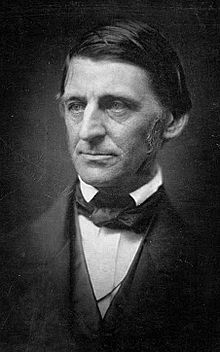
One of the seminal essays on the central role of poetry in society was written by the American poet and lecturer, Ralph Waldo Emerson (1803-1882). In his essay, entitled simply “The Poet,” and published in 1844, Emerson passionately defends not only the poet’s artistic vocation but places poetry at the heart of cultural life. His central thesis is that human society is incomplete if it lacks cultural expression: “For all men live by truth, and stand in need of expression.” Man is only half himself, the other half is his expression; words are actions, actions are words!
By extrapolation, Emerson’s arguments can be applied to all forms of artistic expression including music, theatre and the plastic arts. The artist is representative not of his individual wealth but of the commonwealth. Below, is an edited extract from Emerson’s essay, the complete text of which can be accessed at http://www.bartleby.com/5/110.html. It follows from this that poetry, and the arts in general, should be central to the curriculum of young people and should be given pride of place in our schools.
The poet (an adapted extract)
The poet is the sayer the namer and represents beauty He is a sovereign and stands at the centre
For the world is not painted or adorned but is from the beginning beautiful Beauty is the creator of the universe Criticism is infested with a cant of materialism which assumes that manual skill and activity is the first merit of all men and disparages such as say and do not overlooking the fact that some – namely poets – are natural sayers sent into the world to express
The poet does not wait for the hero or the sage but as they act and think primarily so the poet writes primarily what will and must be spoken
For poetry was all written before time was and whenever we are so finely organized that we can penetrate into that region where the air is music we hear those primal warblings
Poets of more delicate ear write down these cadences and these transcripts though imperfect become the songs of nations For nature is as truly beautiful as it is good or as it is reasonable and must as much appear as it must be done or be known
Words and deeds are quite indifferent modes of universal energy Words are also actions and actions are a kind of words
In these austere times, when one of the world’s richest countries calls upon some of its poorest citizens to bear the brunt of national debt repayment, it is salutary to re-read Thomas More’s Utopia. The word ‘utopian’ has long passed into the language, but these days relatively few people take the trouble to read More’s text which was originally published in Latin by his friend Erasmus in 1516 – note the 500th anniversary comes up next year. The text of Utopia first appeared in English translation in 1551 after More had been royally executed by Henry VIII.
Utopia takes the form of a discussion between More himself and his learned friend, the narrator/traveller, Raphael Hythlodaeus, based on the character of Erasmus. They discuss the ills of contemporary Antwerp, and describe the social and political structures prevailing in the imaginary island country of Utopia. The name Utopia is normally understood to mean “no place”, somewhere which does not exist; but the term is in fact a Greek pun signifying simultaneously ‘no place’ and ‘good place’. Utopia compares the contentious social life of European states with the perfectly orderly, reasonable social arrangements of Utopia and its environs.
In Utopia, there are no lawyers because of the simplicity of its laws and because social gatherings are in public view, thus encouraging participants to behave well; communal ownership replaces private property; men and women are educated alike; and there is almost complete religious tolerance. Readers of More’s humanist work will also notice in the enlightened communities he describes, the complete absence of zero hours contracts, food banks and poverty and social injustice. Salutary reading for our times, methinks!
Sir Thomas More (1478-1535) was a lawyer and a councillor to Henry VIII in addition to being a noted Renaissance scholar. Disagreement with the king on a point of Canon law led to him being tried and executed for treason. Below is an extract from More’s masterpiece, but readers can access the full text at http://www.gutenberg.org/cache/epub/2130/pg2130.txt.
UTOPIA, by Sir Thomas More (extract)
“Is not that government both unjust and ungrateful, that is so prodigal of its favours to those that are called gentlemen, or goldsmiths, or such others who are idle, or live either by flattery or by contriving the arts of vain pleasure, and, on the other hand, takes no care of those of a meaner sort, such as ploughmen, colliers, and smiths, without whom it could not subsist? But after the public has reaped all the advantage of their service, and they come to be oppressed with age, sickness, and want, all their labours and the good they have done is forgotten, and all the recompense given them is that they are left to die in great misery. The richer sort are often endeavouring to bring the hire of labourers lower, not only by their fraudulent practices, but by the laws which they procure to be made to that effect, so that though it is a thing most unjust in itself to give such small rewards to those who deserve so well of the public, yet they have given those hardships the name and colour of justice, by procuring laws to be made for regulating them.”
“Therefore I must say that, as I hope for mercy, I can have no other notion of all the other governments that I see or know, than that they are a conspiracy of the rich, who, on pretence of managing the public, only pursue their private ends, and devise all the ways and arts they can find out; first, that they may, without danger, preserve all that they have so ill-acquired, and then, that they may engage the poor to toil and labour for them at as low rates as possible, and oppress them as much as they please; and if they can but prevail to get these contrivances established by the show of public authority, which is considered as the representative of the whole people, then they are accounted laws; yet these wicked men, after they have, by a most insatiable covetousness, divided that among themselves with which all the rest might have been well supplied, are far from that happiness that is enjoyed among the Utopians; for the use as well as the desire of money being extinguished, much anxiety and great occasions of mischief is cut off with it, and who does not see that the frauds, thefts, robberies, quarrels, tumults, contentions, seditions, murders, treacheries, and witchcrafts, which are, indeed, rather punished than restrained by the seventies of law, would all fall off, if money were not any more valued by the world? Men’s fears, solicitudes, cares, labours, and watching’s would all perish in the same moment with the value of money; even poverty itself, for the relief of which money seems most necessary, would fall. But, in order to grasp this correctly, take one instance:
“Consider any year, that has been so unfruitful that many thousands have died of hunger; and yet if, at the end of that year, a survey was made of the granaries of all the rich men that have hoarded up the corn, it would-be found that there was enough among them to have prevented all that consumption of men that perished in misery; and that, if it had been distributed among them, none would have felt the terrible effects of that scarcity: so easy a thing would it be to supply all the necessities of life, if that blessed thing called money, which is pretended to be invented for procuring them was not really the only thing that obstructed their being procured!
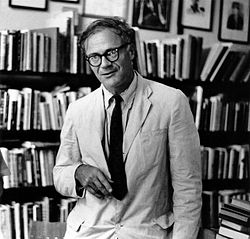
In a letter dated 10 August 1964, the American poet Robert Lowell wrote to his great friend, Elizabeth Bishop, another very distinguished American poet, about the death of Flannery O’Connor. Bishop was living in Brazil at the time.
“Did you read about Flannery O’Connor’s death? I gather she must have died of the bone disease, lupus, that plagued her all these years. It seems such a short time ago that I met her at Yaddo, 23 or 24, always in a blue jean suit, working on the last chapters of Wise Blood, suffering from undiagnosed pains, a face formless at times, then very strong and young and right. She had already really mastered and found her themes and style, knew she wouldn’t marry, would be Southern, shocking and disciplined. In a blunt, disdainful yet somehow very unpretentious and modest way, I think she knew how good she was. I suppose she knew dimly about the future, the pain, the brevity, the peacocks, the life with her mother. She was 38 when she died, and I think always had the character of a commanding, grim, witty child, who knew she was destined to live painfully and in earnest, a hero, rather like a nun or Catholic saint with tough innocence, well able to take on her brief, hardworking, hard, steady, splendid and inconspicuous life. I think the cards seemed heavily stacked against her, and her fates must have felt that they had so thoroughly hemmed her in that they could forget, and all would have happened as planned, but really she did what she had decided on and was less passive and dependent than anyone I can think of.”
In her reply to Lowell, Bishop wrote: “I feel awe in front of that girl’s courage and discipline.
Flannery O’Connor
Flannery O’Connor was born in Savannah, Georgia, in 1935, and was diagnosed with the debilitating disease of lupus in 1951. At the time she was only expected to live for another five years: however, she managed to survive fourteen years and in that period she wrote two novels and dozens of short stories. Her stories are among the very best short fictions written anywhere in the world, and the generosity of Lowell’s appraisal of her character is well-founded. She worked as hard as her illness permitted, and by all accounts she never complained or wallowed in self-pity.
The extract below is taken from the title story of the 1955 collection, A Good Man is Hard to Find. If you are unfamiliar with the work of Flannery O’Connor, I would encourage you to find this collection and discover what happens when the family run into The Misfit, and if you are not blown away by her writing, I would suggest that you probably need to lose weight (if you know what I mean)!
A Good Man is Hard to Find (Flannery O’Connor)
THE GRANDMOTHER didn’t want to go to Florida. She wanted to visit some of her connections in east Tennessee and she was seizing at every chance to change Bailey’s mind. Bailey was the son she lived with, her only boy. He was sitting on the edge of his chair at the table, bent over the orange sports section of the Journal. “Now look here, Bailey,” she said, “see here, read this,” and she stood with one hand on her thin hip and the other rattling the newspaper at his bald head. “Here this fellow that calls himself The Misfit is aloose from the Federal Pen and headed toward Florida and you read here what it says he did to these people. Just you read it. I wouldn’t take my children in any direction with a criminal like that aloose in it. I couldn’t answer to my conscience if I did.”
Bailey didn’t look up from his reading so she wheeled around then and faced the children’s mother, a young woman in slacks, whose face was as broad and innocent as a cabbage and was tied around with a green head-kerchief that had two points on the top like rabbit’s ears. She was sitting on the sofa, feeding the baby his apricots out of a jar. “The children have been to Florida before,” the old lady said. “You all ought to take them somewhere else for a change so they would see different parts of the world and be broad. They never have been to east Tennessee.”
The children’s mother didn’t seem to hear her but the eight-year-old boy, John Wesley, a stocky child with glasses, said, “If you don’t want to go to Florida, why dontcha stay at home?” He and the little girl, June Star, were reading the funny papers on the floor.
“She wouldn’t stay at home to be queen for a day,” June Star said without raising her yellow head.
“Yes and what would you do if this fellow, The Misfit, caught you?” the grandmother asked.
“I’d smack his face,” John Wesley said.
“She wouldn’t stay at home for a million bucks,” June Star said. “Afraid she’d miss something. She has to go everywhere we go.”
In Marcel Proust’s monumental study of voluntary and involuntary memory, In Remembrance of Things Past, the narrator, now an adult, describes how the taste of a madeleine cake brings flooding back to him the days of his youth in Combray where he grew up.
So what better for a dreary Bank holiday Monday monsoon than a fine cup of tea with madeleines to dip, if you so desire, associated hopefully with the memory of an August Bank holiday in days gone by when the sun shone.
Here is the recipe I use, and it never fails. And if you want to enjoy the Proustian experience, see the extract from the novel below:
For 12 madeleines – Preparation time 20 min.
Ingredients
75g melted butter
75g sugar
75g wheat flour
1 large egg
2 tsp baking powder
1 tsp rose / orange blossom water (optional)
Method
Pre-heat the oven to 200 C.
Mix together the egg with the sugar, then add the rose / orange blossom water.
Add the flour and the baking powder and stir well.
Add the melted butter. Stir well.
Pour some mixture in the madeleine mould. Make sure you don’t fill it to the top.
Bake for exactly 10 min.
Keep an eye on the madeleines so they don’t burn.
When done, take the madeleines out and leave to cool a little before you unmould them.
From Marcel Proust: In Remembrance of Things Past
Marcel Proust
Many years had passed during which nothing of Combray, except what had to do with the theatre and the drama of my going to bed there, had any existence for me, when one winter’s day, as I arrived home, my mother, seeing that I was cold, offered me some tea, something I didn’t normally drink. At first I refused, but then, for no particular reason, I changed my mind. She sent out for one of those short, plump little cakes called ‘petites madeleines,’ which look as though they’ve been moulded in a fluted scallop shell. And so, tired after a tedious day with the prospect of a depressing day to follow, I mechanically raised to my lips a spoonful of the tea in which I had soaked a morsel of the cake. No sooner had the warm liquid, and the crumbs with it, touched my palate than a shudder ran through my entire body, and I stopped, intent upon the extraordinary changes that were taking place. An exquisite pleasure had invaded my senses, but individual, detached, with no hint of what had caused it. And at once the vicissitudes of life had become indifferent to me, its disasters innocuous, its brevity illusory—this new sensation having had on me the effect which love has of filling me with a precious essence; or rather this essence was not in me, it was me. I had ceased now to feel mediocre, accidental, mortal. Where had it come from, this overpowering joy? I was conscious that it was connected with the taste of tea and cake, but that it infinitely transcended those flavours, could not, indeed, be of the same nature as theirs. Where had it come from? What did it mean? How could I grasp and define it?
. . .And suddenly the memory came to me. It was the taste of the little piece of madeleine which on Sunday mornings at Combray (because on those mornings I didn’t go out before mass), when I went to say good morning to her in her bedroom, my aunt Léonie would give me, dipping it first in her own cup of tea or tisane. The sight of the little madeleine had recalled nothing to my mind before I tasted it; perhaps because I had so often seen such things since, without tasting them, on the trays in patisserie windows, that their image had dissociated itself from those Combray days to take its place alongside others more recent; perhaps because of those memories, so long abandoned and put out of mind, nothing now survived, everything was scattered; the shapes – including that of the little scallop-shell of pastry, so richly sensual under its severe, devout folds – had either been obliterated or lain dormant so long that they had lost the power of expansion which would have allowed them to resume their place in my consciousness. But when from a remote past nothing survives, after the death of people, after things have been destroyed and scattered, still, alone, more fragile, but with more vitality, more ethereal, more persistent, more faithful, the smell and taste of things remain a long time, like souls, ready to be recalled, waiting and hoping for their moment, amid the ruins of all the rest; and bear unfaltering, in the tiny and almost impalpable drop of their essence, the vast structure of memory.
Adapted by John Lyons from the Scott Moncrieff translation of 1922
“I remember very well the impression I had of Hemingway that first afternoon. He was an extraordinarily good-looking young man, twenty-three years old. It was not long after that that everybody was twenty-six. It became the period of being twenty-six. During the next two or three years all the young men were twenty-six years old. It was the right age apparently for that time and place.”
“So Hemingway was twenty-three, rather foreign looking, with passionately interested, rather than interesting eyes. He sat in front of Gertrude Stein and listened and looked.”
“Gertrude Stein and Ernest Hemingway talked then, and more and more, a great deal together. He asked her to come and spend an evening in their apartment and look at his work. Hemingway had then and has always a very good instinct for finding apartments in strange but pleasing localities and good femmes de ménage and good food. This his first apartment was just off the place du Tertre.”
“We spent the evening there and he and Gertrude Stein went over all the writing he had done up to that time. He had begun the novel that it was inevitable he would begin and there were the little poems afterwards printed by McAlmon in the Contract Edition. Gertrude Stein rather liked the poems, they were direct, Kiplingesque, but the novel she found wanting. There is a great deal of description in this, she said, and not particularly good description. Begin over again and concentrate, she said.”
Extracts from Gertrude Stein, The Autobiography of Alice B. Toklas.
I became fascinated by the writings of Gertrude Stein after reading The Autobiography of Alice B. Toklas, in which she assumed the persona of her partner, Alice, to tell her own life story. There is nothing straightforward about Stein’s writings, many of which represent an insurmountable challenge to most readers, not excluding, at times, myself. Nevertheless, it is always worth persisting with genius.
Over the years I have learnt to read her texts and discovered that to do so, one really has to read them out aloud to capture her breath, much as one has to do with Joyce’s Finnegans Wake. Stein was a very close friend of Picasso and Matisse and Cézanne and other artist contemporaries in the early part of the 20th century, and the salon which she held at her home, 27 rue de Fleurus, in Paris, was frequented by many of the leading avant garde writers from Europe and the United States. It was supposedly Gertrude Stein who coined the term ‘the Lost Generation’ referring to Scott Fitzgerald and Ernest Hemingway, among others.
The story I am posting today, although entirely fictitious, was inspired by my reading of the relationship Gertrude Stein had with Ernest Hemingway as hinted at in the quotations above.
At one point in the Autobiography, she speaks of her agreement with the writer, Sherwood Anderson in these terms: “But what a book, they both agreed, would be the real story of Hemingway, not those he writes but the confessions of the real Ernest Hemingway. It would be for another audience than the audience Hemingway now has but it would be very wonderful.”
“He was an old man who fished alone in a skiff in the Gulf Stream and he had gone eighty-four days now without taking a fish.”
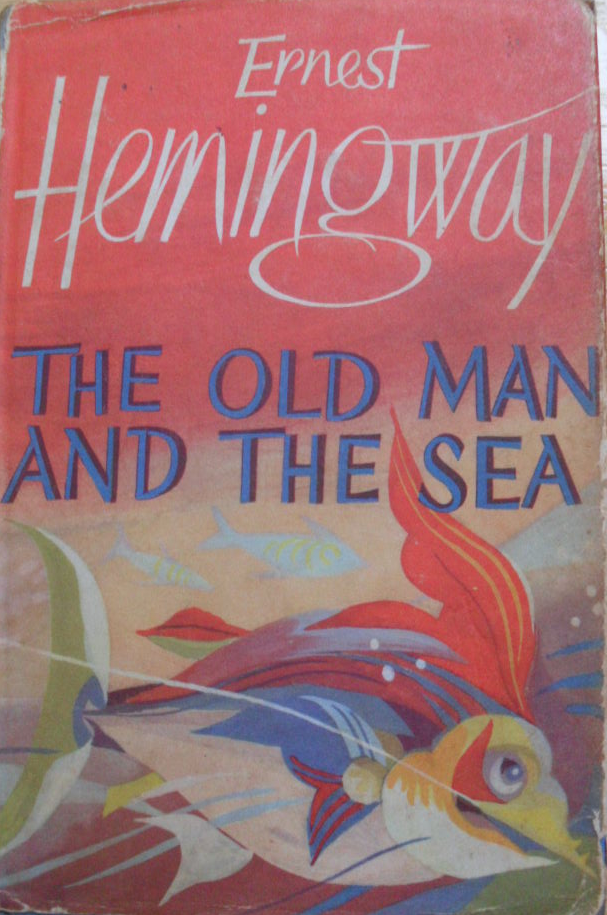
I first read the opening lines from Ernest Hemingway’s novel, The Old Man and the Sea, in 1963. My father had come home from the school where he taught English and handed me a brand new copy of the book. He said: “John, I think you’re going to like this. Give it a read.” I still have that book (pictured) and have read it many times since, and it is a text that never ceases to bring me great pleasure. It is the last book Hemingway wrote and quite different from any of his previous work. It has the stature of a book from the Bible.
Hemingway tells the tale of Santiago, an aging fisherman who, having gone for such a long time without landing a big fish, has lost all credibility in his community and all faith in himself. Fishing all alone one day, he does finally hook a huge marlin. After a fierce struggle, he defeats the fish and lashes it to the side of his boat, but he then has to battle the elements and ward off the attacks from predatory sharks that wish to feed off the fish. By the time Santiago reaches the harbour, little more than a carcass survives, though the head, the backbone and the tail remain as testimony to the immensity of his catch. The following day, Santiago’s fellow fishermen congregate around the skiff to applaud his achievement.
There are many ways to interpret this parable of persistence, but to me the novel has always been about Hemingway’s struggle as a writer, the struggle against writer’s block, the struggle to defeat the blank page and to land a big book that could stand alongside his earlier successes.
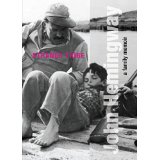
By coincidence, in August 2003 I was invited to give a lecture at the University of Passo Fundo in the south of Brazil during a weeklong literary festival. I chose to talk about the inclusion of women in literature, focusing briefly on the writings of Emily Dickinson, Charlotte Bronte and Jean Rhys. On the coach trip taking various participants in the festival from the city of Porto Alegre to Passo Fundo, a Brazilian academic came up to me and introduced me to the writer, John Hemingway, grandson of Ernest. In the course of the week we spoke very little, but on the return coach trip we sat together and in a journey of three hours, we became very good friends and have remained so to this day. John wrote a magnificent memoir of his relationship with his father, Gregory, entitled Strange Tribe. This is essential reading for anyone interested in the Hemingway clan.
Following our first encounter, I did not see John again until I caught up with him in the first week of July this year when I travelled to the San Fermín festivities in Pamplona. But more of that further down the line.
Tomorrow I will post a story I wrote in 1996, centred on the relationship between Gertrude Stein and Ernest Hemingway.




 johnjosephlyons