Unconfirmed reports are coming in that the author of the saga of Jonah and Anna-Belle has absconded from the secure NHS facility in Whitby where he had been receiving treatment from the eminent Dutch psychiatrist, Dr Van Helsing. This is most alarming if it proves to be true.
Seems that when staff went to our man’s room at around 9.30 this evening to take him his cocoa, they found the room empty, and discovered a note he had apparently left on his bed.
If all is true we know only too well where he will be heading.
Dear dear me! Where will this all end?
The Editor would like to wish all those readers who have been holidaying on the Continent recently and will be returning to this green and wet but still pleasant land this weekend, a safe and comfortable journey home. Your loyalty has truly been appreciated.
I was in Mexico in 1976, en route to the rainforests of the Yucatan to visit the ruins of Mayan cities as part of my doctoral research before travelling on down to Nicaragua. In Mexico City I stayed for a few days in a house in the magical neighbourhood of Coyoacan. It was in this part of the city that artists Diego Rivera and Frida Kahlo lived, and where Trotsky set up home in exile and where eventually he was assassinated. Their homes were now museums and within walking distance of the beautiful house where I was staying. That house had once been home to the Spanish poet Manuel Altolaguirre (1905–1959) who had come there in exile in 1939, at the end of the Civil War in Spain. Altolaguirre had been active on the Republican side of the war and was friends with many of the leading poets of the day, including the Chilean poet, Pablo Neruda and Spain’s leading poet and dramatist, Federico García Lorca. Lorca had been murdered by members of the Nationalist militia in 1936, a few weeks into the war.
For many years after, I would look in bookshops for editions of the poetry of Altolaguirre but everything seemed to be out of print. Then one day in 2002, I walked into the Livraria Cultura, the largest and best bookshop in São Paulo, and there sitting on the shelves in the Spanish language section, as though it had been waiting for me, was a copy of Altolaguirre’s poetry. Five of those poems I have translated today, and I have appended the Spanish originals for those who may care to consult them.
The light and I
The light and I invent you, city, as now in the breaking day of fantasy and sun you are born into the world; city still hazy, with blood, light and dreams on your white facades.
I don’t know what dawn I cast on buildings, nor what morning sun illuminates the valley, the sea, the streets, within me. The world and I have exchanged lights.
*
Outside myself
Today to me my body seems a recollection of me. It’s not my memory that lives in my forehead, but my whole body which is huddled within it, among the clouds, waiting for the death of oblivion. I’m now more than me. I shaped my surroundings, wrapped my soul around me, abandoned the life of men. I want to forget my body, would like it to sleep within me. Its external dreams will flood my spirit. Foreign populations, new gods, different elements, surround it. I’m dictating words to the one I was in the world, who believes he detains me under his watchful eye, the one I’m bossing about, overshadowing, the one who writes this story.
*
Kiss
How lonely you were inside! When I peered through your lips a crimson tunnel of blood, dark and sad, plunged deep down to the ends of your soul.
When my kiss penetrated, its warmth and its light sent tremors and shocks through your stunned flesh.
Since then the pathways that lead to your soul you want never to be deserted.
How many arrows, fish, birds, how many caresses and kisses!
*
The Elm is reborn
If I can no longer see myself, if only my roots survive, if birds look in vain for where their nests were amid the sad absence of my arms, do not cry for this.
In a Spring silence, verdant shoots of life will emerge from the earth like tears.
I will be that horde of adolescents, that laurel wreath that encircles the trunk sundered by the axe.
Life multiplied brings death. Multiple are the rays of dawn.
*
Elegy for Federico García Lorca
I forget to live if I remember you, I recognize that I am dust of the earth and I incorporate you, as does that part closest to your grave, insensitive land that usurps the zealous love of your friends.
With your life over, its outline is forever fully drawn: there’s no door to take you into the future.
The tree of your name has blossomed into an incalculable Spring. Death is perfection, a rounding off. Only the dead can be named. We who live are nameless.
The mythical makers of fame catapult the chants of your name world-wide and life’s lake opens its eyes with endless eyelids of glass: There is no mountain, no sky, no plain, that does not concentrically enhance the echo of your illustrious name.
It’s not a brother’s grief, not human pain, my suffering is part of the sentiment that turns the pensive stars into flowers embroidered on the night that shrouds you. I write these words separately from the daily pattern of my sleep, from a distant planet where I suffer your irreparable loss in tears.
Translations by John Lyons
YO Y LA LUZ
Yo y la luz te inventamos,
ciudad que ahora en un alba
de fantasía y de sol
naces al mundo;
ciudad aún imprecisa,
con sangre, luz y ensueño
en tus blancas fachadas.
No sé qué madrugada
sobre los edificios voy dejando,
ni qué sol mañanero
ilumina la vega, el mar,
las calles, interiores de mí.
Hemos cambiado mundo
y yo nuestras luces.
FUERA DE MÍ
Mi cuerpo hoy me parece
un recuerdo de mí.
No es mi memoria
la que vive en mi frente,
sino mi cuerpo entero
el que está arrinconado
en ella, entre las nubes,
esperando la muerte del olvido.
Yo ya soy más que yo.
Formé mi ambiente,
me envolví con mi alma,
abandoné la vida de los hombres.
Quiero olvidar mi cuerpo,
dormirlo en mí quisiera.
Sus sueños exteriores
inundarán mi espíritu.
Poblaciones extrañas,
dioses nuevos,
elementos distintos,
lo rodeen.
Voy dictando palabras
al que yo fui en el mundo,
al que cree contenerme
debajo de sus ojos,
al que estoy dominando,
ensombreciendo,
al que escribe esta historia.
BESO
¡Qué sola estabas por dentro!
Cuando me asomé a tus labios
un rojo túnel de sangre,
oscuro y triste, se hundía
hasta el final de tu alma.
Cuando penetró mi beso,
su calor y su luz daban
temblores y sobresaltos
a tu carne sorprendida.
Desde entonces los caminos
que conducen a tu alma
no quieres que estén desiertos.
¡Cuántas flechas, peces, pájaros,
cuántas caricias y besos!
EL OLMO RENACE
Si ya no puedo verme,
si de mí quedan sólo las raíces,
si los pájaros buscan vanamente
el lugar de sus nidos
en las tristes ausencias de mis brazos,
no hay que llorar por eso.
Con el silencio de una primavera,
brotarán de la tierra como llanto
insinuaciones de verdor y vida.
Seré esa multitud de adolescentes,
esa corona de laurel que ciñe
el tronco quebrantado por el hacha.
Multiplicada vida da la muerte.
Múltiples son los rayos de la aurora.
ELEGÍA A FEDERICO GARCÍA LORCA
Me olvido de vivir si te recuerdo,
me reconozco polvo de la tierra
y te incorporo a mí, como lo hace
la parte más cercana de tu tumba,
esa tierra insensible que suplanta
el amoroso afán de tus amigos.
Acabada tu vida, permanece
con su total contorno dibujado:
no hay puerta que te lleve a lo futuro.
El árbol de tu nombre ha florecido
en una incalculable primavera.
La muerte es perfección, acabamiento.
Sólo los muertos pueden ser nombrados.
Los que vivimos no tenemos nombre.
Los míticos honderos de la fama
tiran los cantos de tu nombre al mundo
y el lago de la vida abre sus ojos
con párpados de vidrio interminables:
No hay montaña, no hay cielo, no hay llanura,
que en círculos concéntricos no agrande
el eco de tu nombre esclarecido.
No es dolor fraternal, no es pena humana,
es parte, mi pesar, del sentimiento
que hace de las estrellas pensativas
flores sobre la noche que te cubre.
Te escribo estas palabras separado
del cotidiano sueño de mi vida,
desde un astro lejano en donde sufro
tu irreparable pérdida llorando.
So Sunday morning I wake at six o’clock as per usual and peek out the window. Can see it’s a blustery day and I feel that the grey clouds slopping about overhead are ganging up on me, just waiting for me to step outside. Does not bode well! Still, intrepid as ever, it’s shower, shave, gallo pinto for breakfast and out the door, notebook in hand, optimism in my heart. Head down to the tracks and off to London town in search of Pollocks. Readers may recall my previous Sunday visit to Tate Britain. No Pollocks there, but plenty of other first rate objets d’art so not a wasted journey by any means. This Sunday, it’s Tate Modern, gotta be Pollocks there, surely. Get to Blackfriars on the Tube and as I hit the street all hell breaks loose up above, cats, dogs, anything the weather can throw at me, so I arrive at the old power station drenched to my Wilson socks, shake it off like a dog and enter the monumental arthouse, nip up to the second floor and ask one of the attendants: “Where’s the Pollocks?” She’s very sweet, about 5’ 2”, glasses, dark auburn hair, just a tad overweight, but that’s her business not mine, and the bearer of bad news: “Sorry, my love, they’re all in Tate Liverpool for a big exhibition.” My face is now a pool on the Tate Modern floor. “What? In Liverpool? O for God’s sake! I’ve come all this way!” “Sorry, my love. But they’ll be back sometime soon, second week of September, if I’m not mistaken.” “But I wanted to write a piece about them, I’ve got a blog.” She gives me a long, hard, charitable stare. “Sorry, ducks. Can’t be helped.”
Zhang Enli
Resilience, Battle of Britain spunk. I must have some of that somewhere. So, yeah, sure enough, I thank the girl for her kindness and consideration and traipse off down a few aisles, take a butcher’s at a few Dalis and Picassos, nothing to write home about and then I come across someone who just might be the ticket. Zhang Enli, never heard of him but his series of still lifes grabbed me by the . . . . Anyway, two and two together, cats and dogs, leaking roofs, why not buckets, memories of the Great Dartford Flood of 1968 when the branch of Woolworth’s was up to its ears and staff were obliged to enter the store (I kid you not) by boat, and I think “Eureka, I’ll write about Zhang Enli. Try to turn him into a household name. Do my bit at least.”
Born in Jilin, China in 1965, a teacher at the Arts & Design lnstitute of Donghua University, Zhang Enli currently lives and works in Shanghai. Doesn’t tell you much but the guy is good and he’s had exhibitions all over the shop.
Zhang Enli, Bucket 5, oil on canvas, 2007
Art is about focus, the mind homing in on something or some emotion before transferring that energy into an artistic product, notes on a stave, steps on a dance floor, words in the mouth of an actor, paint on a canvas, you get the idea, from the mind through the body into or onto whatever is the chosen medium. For a painter, Enli in this case, there are so many options, so many considerations, so many choices, oils, acrylics, board, canvas, grape stems, representational or abstracted, it’s always ‘make your mind up’ time. Art is mind on matter, even if that matter is the thin air fattened by a few Beethoven chords. Long and the short is that our friend Zhang has a technique and an eye that Pablo would have been proud of. Word of warning: No good admiring it on a computer screen, or worse still a crappy iPad. You gotta go and see for yourself the delicacy of the brushwork, the subtlety of the colours, the perfection of the composition. It raises the humble bucket into an icon, but the icon is dedicated to our humanity, to the essential ordinariness of all of us, our common bond in the occasionally very damp and gloomy human condition. Art is elevation. It makes us feel good and alive, and it is not a luxury, it is oxygen to our soul and any attack on the arts, by reducing curriculum time in schools, or failing to fund local arts, national arts, whatever, is an attack on the species. Forget global warming, the battle for the survival of the human race is an artistic battle. Still, that’s enough from me on my hobbyhorse. Uncle Toby would be proud of me, de gustibus non est disputandum. . . and so on and so forth. Get along to the gallery and get a load of it for yourselves.
Meanwhile, busy busy busy. It’s still chucking it down outside when I head back to Blackfriars and I’m sitting on the train bound for Denmark Hill when the blog editor comes on the mobile blower to say we’ve had another sweet comment on Jonah and Anna-Belle, our running soap, from dear old Molly Rosenberg. She’s such a darling, melts my heart every time. A ray of sunshine on a godawful day!
Note to myself: must get more sleep and slow down!
Yesterday Eve Grubin was due to give a talk at the British Library entitled “The Poetics of Reticence: Emily Dickinson and Her Contemporaries”. Unfortunately, owing to circumstances beyond her control, this lecture was cancelled.
Ms Grubin is an excellent poet in her own right and we have decided to print two of her poems which are readily available on her own site which readers may consult for further material (http://www.evegrubin.com/close.php).
It is not difficult to see why Eve Grubin is drawn to the poetry of Emily Dickinson: her own poetry is spiritual and mysterious and driven by minute observations, reflecting the great sensitivity of a life lived intensely, passionately.
We hope that in the not too distant future she will be able to return to the British Library to deliver her talk on Emily Dickinson and in the meantime we send her our best wishes.
Eve Grubin was born and raised in New York City. She was the Programs Director at The Poetry Society of America for five years (2001-2006). She divides her time between London and New York.
When the Light Begins to Close
When the light begins to close, just before it closes,
I am looking out the window or walking beside buildings,
a wave of uncertainty—suffocating, numinous—rushes my throat,
quick, unmistakable.
Suddenly I am my name:
standing in the garden, the fruit eaten, seeds burning the dust.
Loneliness, slanted cold enters the air around my neck.
Eve looks at the wet eyes of the animals, once soft and brown. The rotation of the earth moves through her, me.
Holiness, a slanted cold
sifts the spaces between my fingers.
At end of day, light contracts: I stare into trees and lamps, the gray
sidewalk, shadows walking into shadows. What is it
about the transition between sun and dark, hope and gloaming,
that constricts, elates?
*
A Boat of Letters
arrives, and I lie down in its white wet,
ink prints on my cheek, feet, and dress.
Last night I dreamt my husband
held me like a forceful wind
as I strained forward to hear
a group of girls sing soft, unclear,
in our doorway.
I pushed towards them. They seemed far away.
He was strong, and I struggled against him.
Boat of letters, filled to the brim,
take us to your wild inky swamp
where leaves hang down like muted lamps,
where we can write and read; and with each broken seal,
let there be an answer, a surprise, something delightful!
Gustav Metzger was born in 1926 in Nuremberg. His parents were orthodox Jews, and nearly all his relatives were murdered by the Nazis during the Second World War. He was saved by the Refugee Children Movement in 1939 and brought to England. Twenty years later he gave his first individual exhibition entitled Three Paintings by G. Metzger in a London café. Metzger performed his famous Liquid Crystal Projections in the 1960s at concerts of the bands The Cream and The Move in London. His lectures inspired Pete Townshend to smash his guitar on stage. Yoko Ono is among his admirers.
A founder member of the Committee of 100, led by the philosopher Bertrand Russell, and which was dedicated to opposing nuclear war and weapons of mass destruction, Metzger took part in demonstrations and was on one occasion sent to prison in Staffordshire for one month. He has cited William Blake as a life-long influence on his art.
Although dedicated to ‘the starving poet’, the three disintegrating figures in Metzger’s deliberately sub-fusc triangular composition (reproduced above) were perhaps inspired by the Crucifixion scene in the Isenheim Altarpiece, painted by the German Renaissance painter, Matthias Grünewald (1470–1528).
I could be wrong, but why leave it to me? Why not head along to Tate Britain in Pimlico and see for yourself!
You might think it’s easy running a daily blog, but spare a thought. Some poor devil has to find new material every 24 hours to fill the void. So the blog duty editor is on call Friday night and there’s nothing for the Saturday edition. He’s searched the files high and low and there’s nothing he can use. But just as he’s about to despair, in a cupboard close to where they keep the bleach and other cleaning fluids, he comes across a plastic bag full of mouldy old papers and he takes a look and he discovers a couple of typed sheets with the heading “Jonah hits memory lane”. Someone has used a red felt tip pen to scrawl B-I-N in huge letters across both pages. Nevertheless, he starts to read the piece and only a few seconds in, thinks to himself, God, this is real drivel, I’ll never get away with putting this online, the boss’ll sack me the moment he sobers up on Monday morning. Still, beggars can’t be choosers, so he puts the sheets to one side and continues to hunt for material. About three hours later, he’s still looking and getting more and more exasperated; he’s found absolutely nothing and what’s left of his mind has gone completely blank. He picks up the Jonah story and thinks, Well maybe a change would be good for me. New job, new faces. . . you never know! And he takes the plunge! But you have been warned and you may well want to skip this post.
Jonah hits memory lane
Jonah gets his comeuppance
Jonah is sitting at a desk in the Humanities 1 Reading Room of the British Library, gazing at the spring sunshine streaming through the dusty transom windows and scratching his head. At fifty-eight he still has a good head of hair, but if he keeps on scratching he’s going to wear a patch in it. Next to his beaten-up laptop is a copy of Murphy, Samuel Beckett’s first novel, published in 1938. To his right, an elderly Indian woman has just put down a book called Astrology, why I believe. Jonah smiles to himself. Personally he’s not a believer. Coming up on the train from Dartford, out of idle curiosity he’d looked at the stars in the Metro free newspaper. Jonah is a Sagittarian by birth, a merchant seaman (retired) by trade, an agnostic by nature, and spent almost half his adult life overseas. But he’s been back in London for the past eighteen months having barely survived his most recent shipwreck off the coast of Brazil.
Just outside London Bridge Station he’d noticed that someone had painted #surviville in huge bright green letters on the walls of a rooftop, and that was just about how he felt now he was back in London, a survivor. However, his stars for that day couldn’t have been more confusing. His horoscope read as follows:
You may be suffering from some major delusion, so watch your step and if the going gets too rough, seek professional help pronto. On the other hand you could be on the brink of a financial or emotional breakthrough, so whatever project you have on the go, money or romance, don’t give up too soon, hang in there at least till the fat lady starts to sing.
Fat lady, indeed, Jonah muttered to himself. He’d never liked opera, never would! Without ceremony, he’d screwed the newspaper up into a ball and tossed it into the bin.
*
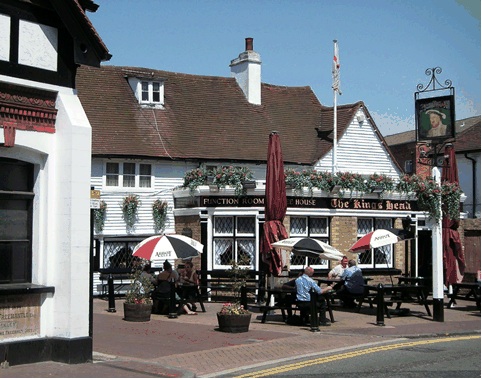
Then there was Anna-Belle. Son-of-a-bitch! Anna-Belle O’Malley! He hadn’t stopped thinking about her since the previous day in Old Bexley. Anna-Belle O’Malley, after all those years. What goes around comes around, he chuckled to himself. He hadn’t been down to the medieval village of Old Bexley in decades, but reckoned it was high time he made his peace with his kid brother, Malachy. Malachy could be a bit tetchy, he being of the quick to anger, slow to forgive type, and they’d almost come to blows the last time they met ten years ago, so you can understand Jonah being a bit wary. Which explains why, upon leaving the railway station in the village he’d decided to pop into the old King’s Head for a couple of pints, to steady his nerves.
It was just after midday. A laconic sun hung lazily in the sky and a chill wind was blowing up from the south. Anyway, Jonah pushed open the door to the saloon bar and there she was in her vintage Laura Ashley pinafore dress, sitting all alone like a displaced duchess, in the alcove by the fake leaded window, deeply engrossed in a paperback as thick as a brick. She had a gin and tonic on the go which looked as though she’d barely touched it. But maybe it’s not her first, Jonah thought, she’s never been averse to the odd tipple. He’d recognised her immediately. The unforgettable autumnal hues of her bubble-cut hair, cute curls framing a cute little face. And to cap it all, the old dear was even wearing a pair of sensible pumps, just visible under the table. Gone were the days, so it seemed, of stilettos that could pierce a man’s heart!
*
First time Jonah had ever really got to know Anna-Belle was about four decades ago in the Freemantle, a large function hall little more than a llama spit from the King’s Head. It was an eighteenth for one of Paddy Delaney’s girls, Julie or Josephine or Jennifer, or Jane. . . what the hell. . . and there she was, Anna-Belle O’Malley, herself just turned sweet sixteen. How well he remembered that do!
In those days Anna-Belle was one of God’s greatest creations, a little wisp of Jewish thrown in with the usual Anglo-Irish mix, had created something of a blueprint for female beauty. Petite at five foot two out of her plimsolls, she had the sort of endearingly deep ocean blue eyes you could drown in for hours, as long as there was oxygen in your tanks. And she was perky. Boy she had attitude and devilment all rolled into one: in short, she was fun!
That night there’d been a long line of lads snaking out the door waiting to say hello to her and get on her dance card, and her brother Jeremy was puffing and panting, barely able to keep order amongst them. But Jonah didn’t wait in line; he just sauntered up to her, cock-of-the-walk, took her pale lily-white hand into his own, and bent over and whispered “Pleasure,” in her ear. She gave him a cold, hard smile, whispered something like “bastard” under her breath and directed the daggers of her eyes at Jeremy, as if to say: “For the love of God, can you get rid of this creep!”
But she and Jonah, they’d had a history, a secret history. And that first meeting was not, truth be known, the first; nor was it the last, no sir. Now after all those years and the separate lives they’d led, there she was again. Anna-Belle O’Malley. Jonah ordered his pint and when it was ready he sidled over to her table with a sneaky grin on his face.
“Mind if I join you, ma’am?”
“’S a free country,” she said, not taking her eyes from her novel.
Jonah caught the title. She was reading War and Peace!
“You don’t remember me, do you?”
She raised her frosty eyes and examined his features closely, hesitated, and then it hit her.
“Jonah,” she said, “Jesus Christ, Jonah, what the. . . !”
And her mouth dropped and she said nothing else.
“Damn right,” he said, “been a long time, Anna-Belle. Too long?”
She caught the hint but did not react: picking up her glass, she took a gulp of her gin and tonic, spluttered some of it over her novel and set the glass down again, before slowly running her tongue over her lips. Jonah admired her small trembling hands and the manicured nails as she did so.
“Too long,” he said again. “So good to see you. How you been?”
“O,” she said cautiously, “I been. You?”
“O I been too. I been, all right. Plenty to tell if you have the time.”
And he paused and looked her over again. And they both just sat staring into each other’s eyes like two dredgers working the Thames and let the silence and dust of all those years wash over them.
“You’re looking so well,” Jonah said eventually. “By God, all those years and you’re looking so damn well.”
“Diet,” she said. “Melon and salad, and the odd bagel from time to time, can’t beat it. Plus I keep myself busy. Hard work, you ever heard of that?”
But for the merest flicker of a smile, Jonah let the shot pass over his bow without rising to the bait. Sharpest tack in the box as always, he thought to himself. Some things change, some people don’t. And she ain’t changed.
“Still teaching dance?”
“Aha.”
Jonah raised his glass in a toast.
“Well, here’s to you, babe. Anna-Belle O’Malley, son-of-a bitch. Here’s to you. No, here’s to us and to God knows what the future holds. Son-of-a-bitch!”
Editor’s note: This is not to be continued, under any circumstances.
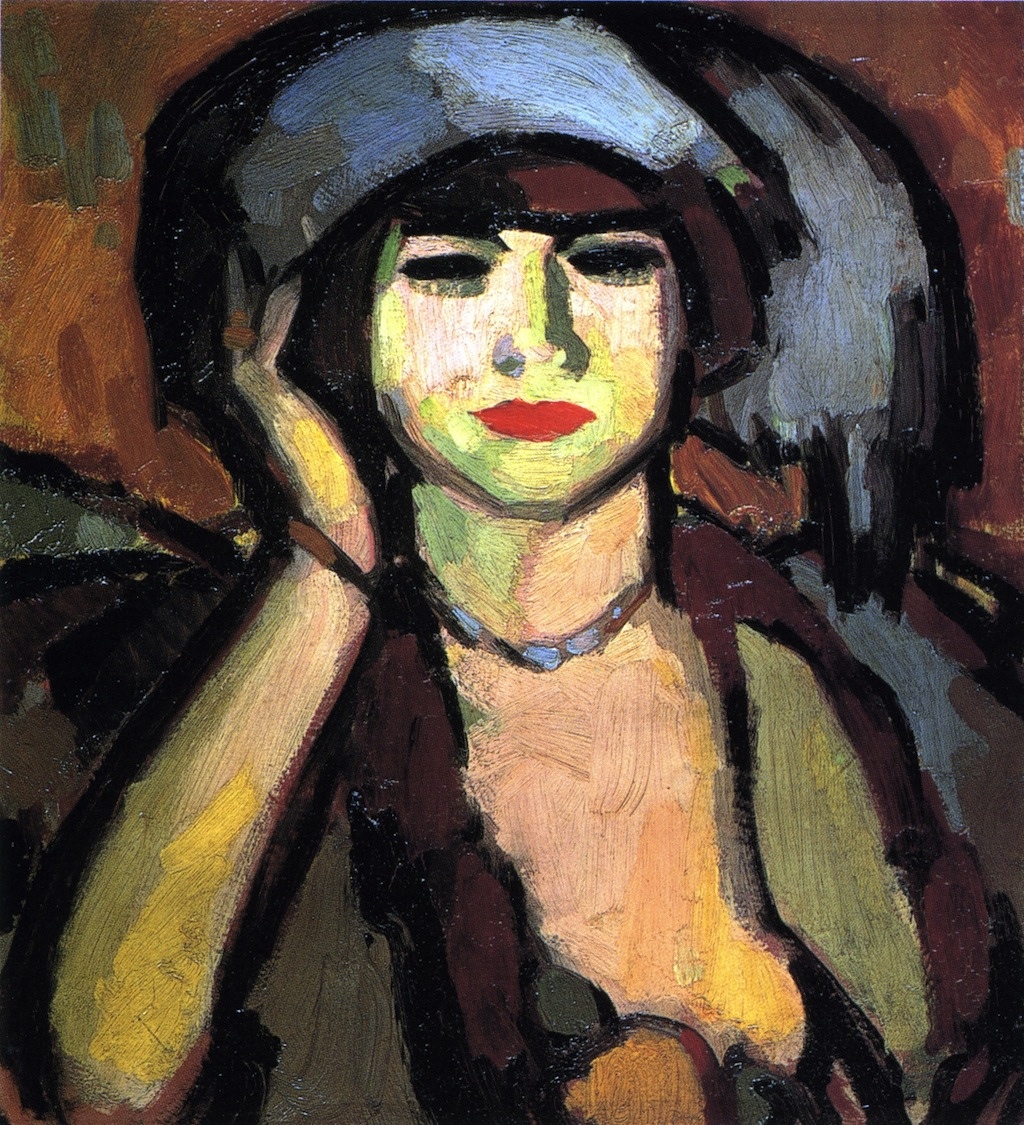
J. D. Fergusson, Blue Beads, Paris 1910 (oil on board)
J. D. Fergusson (1874–1961) was a Scottish landscape and figure painter and sculptor. Initially he entered Edinburgh University to study medicine but then decided to take up art. He was greatly influenced by the French painter, Manet, though this does not explain why he married a dancer, Margaret Morris: or maybe it does.
What fascinates me about this painting is the manner in which the artist has transformed the portrait of the woman into a landscape, with different sections of the figure being divided as though into different fields with different crops. Simultaneously, it has the effect of transforming the landscape into a female figure, thereby underlining the intimate relationship we all share with the land, the land that feeds us and which will welcome us back at the end of our lives.
Ashes to ashes, clay to clay: we are starlight and we are mineral earth, and we are the consciousness of creation. All of this Fergusson has rendered with the simplicity and the breathtaking beauty of his palette and brush strokes.
So much more could be said about the detail of this painting but sometimes less is more!
No photo can do justice to this marvellous work of art, so don’t delay. Hurry along to TATE BRITAIN in Pimlico at the earliest opportunity to see it for yourself! And yes, don’t ask, I’d love to have this masterpiece on my wall!
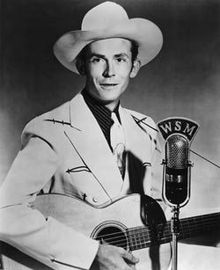
To the immortal words of Hank Williams’ unforgettable song, our old sea-dog Jonah decides he’s going to share one of his culinary secrets. How come these old timers in Central America, who don’t have two beans to rub together, live to the ripe old age of 90 or more? The answer is diet, and hard work. You all know the saying, “Hard work never killed anyone.” The fact is that hard work saves more lives than it kills, way more!
So what about diet? What do the peasants in Nicaragua and Costa Rica have for breakfast, lunch and dinner? The answer is gallo pinto: a basic mixture of rice and black beans fried together with a little garlic, onion, salt and pepper. Eat it with maize tortillas, an egg (fried or omelette), or maybe a little meat (not too much) or on its own with plenty of chile sauce and you’re away. Live forever!
So how’s it done?
You need to cook your rice and your beans separately and remember that for gallo pinto they will be mixed 50/50 so I won’t give precise weights. Once the beans are cooked you drain off the liquid and let the beans dry.
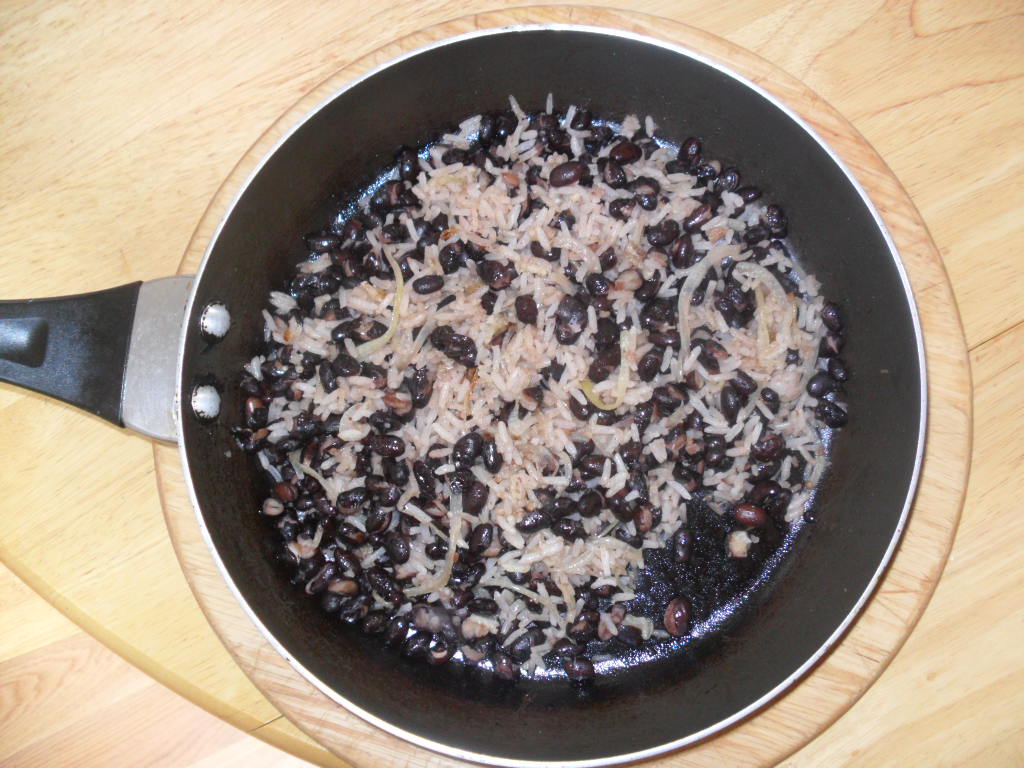
Then in a large frying pan you fry a little minced garlic with a little finely chopped onion in a generous dose of good oil (sunflower or extra virgin), adding a little salt and pepper to taste. Once the onions are soft you slowly add the beans on a moderate heat. After a minute or two, you add a similar portion of rice and with the heat still low you stir the contents of the pan, noting how the beans and the rice are getting drier all the time. As the moisture begins to evaporate, the rice will take on a reddish hue having absorbed some of the colour from the beans. What this translates into is flavour. You now need to reduce the heat as low as possible so that the mixture continues to dry out, taking care, however not to burn it. Believe me, the mixture of rice and beans in gallo pinto is a marriage made in heaven!
Gallo pinto is often served with sliced fried plantain (either sweet, when skin is yellow, or savoury, when skin is green). Eggs, meat, tortillas are all optional extras. The beauty of this dish, apart from its simplicity and divine taste, is that it delivers in a very simple format, all the protein and carbohydrate you’re going to need if you intend to do a hard day’s work. And there’s an added bonus. By taking your main protein shot from pulses rather than from meat, you’re actually helping to save the planet. So go for it!
gallo pinto Jonah made for lunch today
Ingredients Black beans Cooked rice Clove or two of minced garlic Half onion finely chopped Cooking oil Salt Pepper
Final point. Keep the leftover gallo pinto in an airtight container in the fridge. When next required gently warm through. You’ll find that with every warm-up, the mixture will get drier, the rice and beans will eventually become crunchy and you will cross the taste barrier into ecstasy. By the way gallo pinto means spotted rooster in Spanish.
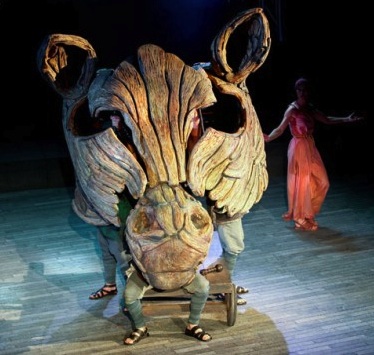
Off this evening to The Scoop open-air theatre, close to London Bridge, to see Lisa Kuma’s adaptation of three of Euripides’ plays, which she conflates into a single narrative, entitled Women of Troy. The story is familiar: Paris (son of Priam, ruler of Troy and his wife, Hecuba) abducts Helen, wife of Menelaus. Agamemnon, the Greek king and brother of Menelaus, raises an army and is ready to sail to Troy to rescue Helen but before the gods will grant wind for his sails, he is required to sacrifice his beloved daughter Iphigenia. So with the Greek fleet stalled in the harbour and the Greek army becoming increasingly restless, almost to the point of rebellion, Agamemnon beseeches his daughter Iphigenia to accept the glory of sacrifice for the good of her nation. After many tears, she finally concedes to her father’s wishes, much to the despair and anger of her mother Clytemnestra.
The first act ends with Iphigenia’s death. The second act begins with the Fall of Troy, showing the moment the Greek army emerges within the city walls from the belly of the wooden horse (pictured). Thereafter, the focus is on the fate of Helen, who has been released from supposed captivity, and the women of Troy.
For some reason, I found the performances of the actors playing the leading female characters considerably more convincing than those playing the principal male roles. Agamemnon, for example, supposedly the most powerful man in Greece, lacked any real presence and his phrasing seemed laboured and rather expressionless. Equally, there was little palpable anger in the performance of Menelaus, who had, after all, been cuckolded by his wife and made a laughing stock throughout the region. Achilles, too, failed to express any real passion. On the other hand, all the women were utterly engaging. It’s difficult to know who was responsible for this divergence since the challenges of performing in an open-air venue were the same for both sexes.
Despite this criticism, for those unfamiliar with the work of Euripides, the evening certainly represented a valiant and valuable introduction, and all the actors are to be applauded for that. Lisa Kuma’s text managed to maintain a fine balance between a colloquial tone that could be readily appreciated by a modern audience, and a more serious discourse that retained some of the dramatic poetry and power of the original lines. The performance was staged as part of the More LondonFreeFestival.
Cast
Achilles – Eddie Eyre
Agamemnon – Phil Willmott
Andromache – Jasmeen James
Clytemnestra – Penelope Day
Hecuba – Ursula Mohan
Helen – Emily Sitch
Iphigenia – Hannah Kerin
Menelaus – Joseph O’Malley
So Jonah the ancient mariner, who’s been marinating on dry land for the past two years, has his kid sister over for lunch and to give her a good “chin-up” talking to. Duck confit with salad (urrrrgh!). Salad’s on account of the extra kilos that living on dry land has saddled around his equator. Grin and bear, and no beer for a month, at least. He’s lost 2 kilos already, and dropped one belt size with just one more to go before bingo!
Anyway, being of a literary disposition, before the sister arrives he’s been reading Julius Caesar and he’s reached that famous line about the stars and thinks: “So, verrry interesting! Against the prevailing mood of the times, friend William did not believe in astrology either, and he was a genius.”
His reading at this point is interrupted by a knock at the door, and lo and behold, there she is, in all her glory. Turns out she’s on a calorie count too, and looking good, so they’re all square for lunch; and what ensues is a real heart to heart with a few detours into the memory lanes of happy days.
Following lunch there’s coffee, and more talk before he accompanies her down to the railway track. After waving goodbye, he takes a train in the opposite direction, heading for the partially walled medieval town of Dartford, famous for the old Wat Tyler pub (pictured above) and the 1381 Peasants’ Revolt. His mission there, you guessed, is to replenish his stock of sundry salad stuffs!
But isn’t life funny! As fate would have it, he no sooner steps onto the train and takes a seat when he spies with one little eye on the seat opposite him, a copy of the Metro free newspaper, open at the astrological page. Some bright spark has even gone to the trouble of taking a biro to draw a box around the day’s star for Sagittarius. Shakespeare’s immortal line comes roaring back into Jonah’s brain. “I don’t believe it,” he mutters under his breath, “I really don’t believe it!” Nevertheless, curiosity gets the better and he picks up the paper and reads the following:
A bona fide break is what you really need, Archer—not another cocktail party or night on the town. Today’s sleepy twelfth house moon forms a tough square with agitator Mars, interrupting your need for rest! Those tempting offers will keep rolling in, but if you keep saying “yes” you’ll simply be too burnt out to actually enjoy them! Respect your limits and take a rain check. You may also need to set a high-maintenance energy vampire straight today. Establishing and enforcing boundaries will be a sanity-saver. Trust us.
“Whoah,” Jonah wonders, scratching his head, “who the hell is us?” He has plans that evening to attend a performance of Euripedes’ Women of Troy at The Scoop open air theatre by London Bridge, in the company of the apostles Peter and Paul, and he’ll be damned if he’s going to miss it on account of a load of tosh! “Your need for a rest? Poppycock! Balderdash! Nonsense! Tripe!”








 johnjosephlyons