César Vallejo – three poems in translation

vallejoThese three poems by the Peruvian poet, César Vallejo (pictured), were among the first translations I undertook while I was at Oxford in 1969. A friend of Pablo Neruda, and a defender of the Republic during the Spanish Civil War, Vallejo was a very intense individual and as he developed his poetry over the years, that intensity began to manifest itself in a density of language that is both beautiful and challenging. Not all poetry yields its fruit on first reading. Thomas Merton, the famous Trappist monk, called Vallejo the greatest of all the Latin American poets. The youngest of eleven children, Vallejo lost his brother Miguel when he was quite young and later wrote a poem dedicated to the memory of the games they had often played together. Always was a most sensitive poet, Vallejo remained committed to the cause of ordinary working people throughout his life.

I am dedicating this post to the memory of Paul Kavanagh, a cousin of mine who died recently in Waterford, Ireland. As a young boy I would occasionally stay with his parents during the summer holidays, and Paul and I became very close friends. At that time my uncle owned a small bar on the Quay in Waterford and the family lived in the flat above. In the summer of 1963, the year John Kennedy was assassinated, I stayed with Paul and learnt so much from him. Among other things, I discovered the joys of fly fishing, and he taught me two essential skills for a young lad: how to whistle with my fingers in my mouth and how to cup my hands to make owl calls. I nearly drove my uncle and aunt mad with that. The same year, I bought two Beatles albums from Paul who wasn’t too impressed with their music. I still have the vinyl records.

My cousin also possessed an old steel-string guitar which I would pick up from time to time and strum away, pretending I could accompany any song on the radio. In reality I hadn’t a clue and it was probably totally out of tune and a further instrument of torture for my long-suffering uncle and aunt. Nevertheless, all good grist to me: and when I returned to London at the end of the holiday I acquired a guitar of my own and so began my own erratic journey as a musician.


For my brother Miguel

in memoriam

      Brother, I’m now on the bench at home
where you are so endlessly missed!
I remember we’d play at this time, and that mamá
would gently chide us: “Now, boys . . . ”

     Now I hide,
as before, during all these evening
prayers, and I hope you won’t find me.
In the living room, the hall, the corridors.
Then you hide, and I can’t find you.
I remember we laughed ourselves to death
in that game, brother.

      Miguel, you hid yourself
one night in August, as dawn broke;
but instead of laughing as you hid, you were sad.
And your twin heart from those dead and gone
afternoons tired of not finding you. And now
a shadow falls across the soul.

      Hey, brother, hurry up
and come out. Okay? Mamá will be worried.

*

The Black Heralds

      There are blows in life so hard. . . I don’t know!
Blows like the hatred of God; as though in the face of them
the undertow of all that has been suffered
simply welled up in the soul. . . I don’t know!

      There aren’t many, but some. . . They open dark furrows
in the fiercest face and in the strongest back.
They could be the colts of barbarous Attilas perhaps;
or the Black heralds of Death’s dispatch.

      They are the deep falls of the Christs of the soul,
of some adorable faith that destiny blasphemes.
These bloody blows are the sizzling
of some bread we’ve burnt in the oven mouth.

      And man. . . poor. . . poor man! He turns his eyes back as
when someone greets us with a slap on the shoulder
turns his mad eyes, and all that he’s been through
wells up, like a pool of blame in his gaze.

      There are blows in life, so hard. I don’t know!

*

And if after so many words

      And if after so many words,
the word does not survive!
If after the wings of birds,
the bird at rest does not survive!
It would be better, indeed,
for it to be gobbled up and be done.

      To be born to live out our death!
Rising up from the heavens to earth
through one’s own disasters
and to spy the moment one’s shadow shrouds one’s darkness!
It would be better, frankly,
for it to be gobbled up, and be damned!

      And if after so much history, we succumb,
no longer to eternity,
but from these simple things, such as being
at home or weighing things on our mind!
And if we then find,
suddenly, that we are living,
to judge from the height of the stars,
for the comb and the stains on a hanky!
It would be better, indeed,
for it to be gobbled up, of course!

      It might be said that we have
in one eye much suffering
and in the other, much suffering
and in both, when they focus, much suffering. . .
Well then. . . Of course! . . . Well then. . . not a word!
Andy Warhol and a can of worms

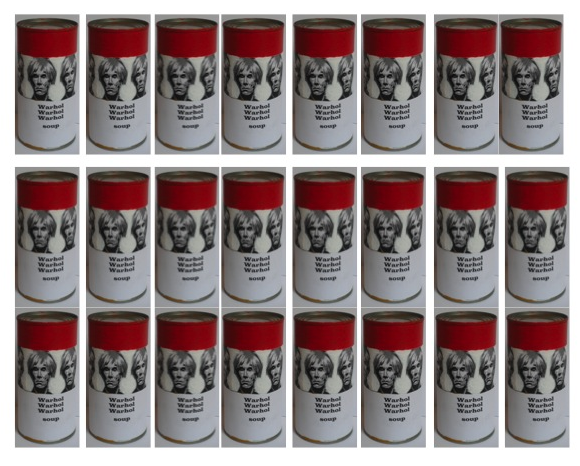
can_regimentWhen Andy Warhol produced what is probably his most famous painting, known as Campbell’s Soup Cans in 1962, many people were dismissive. This is not art, they said, this is copying, and he didn’t even paint, he just screen-printed the design. Where’s the skill? No, definitely not art!

But of course it was art and every bit as serious as the work of any other great artist, a Titian, for example, who in his mind sought to envisage the Nativity scene with Mary and Joseph and their newborn child, and to transfer that image onto canvas. Art is observation expressed through a medium, which might be words, or paint or musical notes, or mime, or whatever. In other words, art is consciousness transferred, so all art is, initially at least, conceptual. There can be good and bad art, serious or light art, but art is everywhere, everywhere that human consciousness exists.

But come on, you might say, where’s the art in reproducing an identical image of a can of soup? There are many possible responses to that. But the one that strikes me as the most plausible is that Warhol, in a humorous way, wanted to draw our attention to the fact that although nowadays we live in a highly designed world, our preoccupations differ very little from the preoccupations of our artist ancestors, those who decorated the walls of their cave in Altamira with images of the food they hunted for survival: an iconic deer or buffalo enclosed in its skin over the course of the millennia has become today’s ox-tail soup enclosed in a can. Technology does not destroy human appetites it merely alters the delivery of the product to be consumed. The modern mass production of images is made possible through technologies that can turn out millions of identical portraits of Marilyn Monroe or Marlon Brando, or of you and me. It was playing around with these ideas that I came up with the primitive design for what I call the Warhol Soup Can. Is it art? Course not. Just me having a bit of fun!

Emily Dickinson – a breath of fresh air

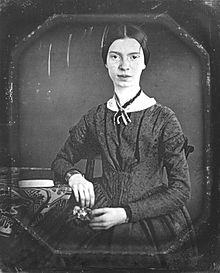
dickinsonIt is impossible to exaggerate the importance of the influence of Emily Dickinson’s poetry on subsequent generations of male and female poets writing in English or indeed any other language throughout the world. Although she wrote almost 2000 poems, only a handful were published in her lifetime. Scholars have since written extensively on the themes of her poetry: the beauty of flowers and nature, the inevitability of death, her Christian faith and what she called the undiscovered continent or the landscape of the spirit.

Her preoccupation with the mystery and complexity of human consciousness brings with it a desire to shape her poetry in a truly revolutionary manner. Her verse is renowned for its unconventional syntax, for the use of dashes and irregular capitalisation. It would be easy to dismiss this as an idiosyncratic fad: but that would be to ignore the true character of her genius. The syntax, the form of the poem on the page, represents a deliberate challenge to the status quo; and the freedom Dickinson demands in her verse is the freedom to breathe and to express her breath as she feels it. When contemporary readers of her poetry suggested she might make concessions by adding a few commas and full stops instead of her dashes, she was adamant that such a practice would destroy her poetry.

The poem below was written in homage to a lady who, in all her modesty, tore up the poetry rule book. It was a truly remarkable act of emancipation. As with earlier poems on this blog in homage to Marianne Moore and John Berryman, I sought to convey my admiration for Dickinson’s work by adopting, as far as I could, the vocabulary and the stylistic devices typified in her poetry. An impossible task! But this was done in the spirit of those artists who set up their easel in front of an old master in the National Gallery and seek to reproduce a painting in order to learn new techniques and appreciate the challenges faced by the original painter. A learning curve that can bring knowledge and skill, but alas, not genius.


Emily Dickinson

On the cusp of the Night –
Hands clasped as though
in Prayer – she observes
the last flicker of the Candle

Light’s demise – tinged
with the scent of Beeswax –
signals no Death
of the Imagination

Silence and Darkness:
these could be loved –
eternally – intimately
No human Consolation

between the cold white
Sheets – but Words warmed
on her Breath – mind Forms
of companionable Poetry

Early memory

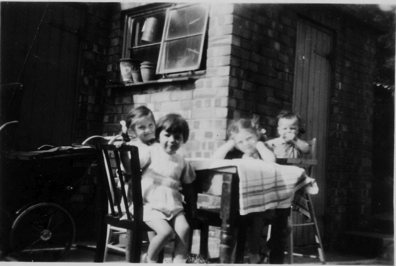
shedThe photo I always use as wallpaper on all my computer screens was taken by my father, one summer’s day when he decided we would all have a picnic outside instead of eating in the dining room. I’m sitting in a high chair close to a table where my three sisters are patiently waiting for their lunch. In the background, the old brick shed and the old pram which saw such good service, there being six of us children in total. I must have been eighteen months old at the time, as you can probably tell from my lack of hair. Looking a little fed up and probably hungry, Shevaun is sitting on the side of the table closest to me, and opposite her, smiling, are my two other sisters, Annette, the eldest, and Mary. Mary is in the foreground, closest of all of us to the photographer. She is wearing a short summer dress, undoubtedly home-made, and she has turned in her chair to look straight at my father. For me this picture is particularly poignant, given Mary’s eager posture: she is the only one of my siblings to have already died, and it is almost as though she is leaning slightly forward to say bravely, “I will go first into that unknown country.” I keep this wallpaper so that every day I will remember her and she will know she is loved and missed now as much as ever. Although my father always treated us equally, Mary, his youngest daughter, was probably the apple of his eye.

The photo is also important to me because it captures the first real and vivid memory of my childhood. My father was standing at the bottom of some steps, which led up to the space where he had laid out the table, and then to the right, the garden beyond. Behind him was the back door into the kitchen where my mother was preparing lunch. The table had been made by my father. He found the legs somewhere and a large rectangular piece of flat wood to make a top; you can tell this simply by looking, because the colour of the surface is different from the stained legs. There is a cloth on the table, which heightens the suggestion of a picnic. We rarely ate outdoors, but this was an exceptionally warm day. So there is novelty in the situation, an improvised gesture of parental creativity which was typical of my father, his trademark in fact.

On that day I clearly remember my father disappearing after telling my mother he wanted to take a picture, and when I heard this I began to get upset. I’m sure I bawled out something like: “No time for photos, I want my dinner.” But probably my words were far less articulate than that and more strident. My right hand is hidden by Shevaun’s head but in it I was holding my spoon and I kept banging the spoon on the tray of the high-chair as I shouted out, demanding that my dinner be served. We always used the word dinner for lunch when we were small. My father returned shortly after, brandishing his Kodak, and with a broad grin, told me to calm down and to sit still for the photo. “It’ll only take a minute, John. Lunch won’t be long.” I was not easily appeased in those days, I remember, not where food was concerned.

But that cherished minute has long gone! Only the photo remains.


The politics of poetry

katrinaThe poem below was written in response to the Katrina disaster of 2005. Poetry, as Keats famously pointed out, is about beauty and truth, in other words it is about life in all its aspects because there is no area of life where beauty and truth are irrelevant. All that we value in our lives is concerned with beauty and truth. That includes the relationship we have with our loved ones, with our fellow citizens and the world’s wider population. We are all in this together and we have rights and responsibilities as individuals under the charter of the United Nations.

So how should a poet engage with the world, a poet obsessed with love and beauty? The answer, I believe, is so simple, as William Burroughs would say: the poet is no different from anyone else, the poet should be engaged with his immediate circle and his wider world. Beauty and truth are synonyms. Lies are ugly. Poetry celebrates beauty and denounces ugliness and does so by employing the stylistic tricks of its trade, or should I say, of the medium, just as journalists do theirs, film makers theirs, artists theirs, musicians theirs. Politicians also have the tricks of their trade, and we should be wise to them. Always! Beauty is truth, truth beauty, that is all you need to know!


Paradise Lost

Your words,
       Mr President, have grown charcoal-
               brittle, they stain your lips
       as you speak them, and bring no
               comfort to those who hear;

let us
       at the very least, carbon-date
               your thoughts, your notion
       of what is right and wrong,
               your black-and-white

world,
       we who have not drowned
               but who looked on in horror
       as you abandoned a people
               who were surplus to

requirements!
       Where were you when the saints
               came marching in and the waters
       rose and the wind howled and
               the levees which had kept

despair
       at bay were finally breached?
               A serpent appeared in the rose
       garden and said DO NOTHING
               as your daddy did, surrender

dignity,
       surrender truth and, as your
               daddy had done, botox
       the lies until you can smile
               in the face of death,

turn up
       your nose at the stench of decay,
               turn a blind eye on the strangers
       upon whose kindness your office
               once depended. Democracy is in

the eye
       of the beholder, but the dead are
               disenfranchised. Katrina Katrina
       to the tune of an old blues song, on
               a blue piano, until the end of time.

6 September 2005

Clarice Lispector – the soul of sensibility

claricelispectorOne of the joys of learning to speak Portuguese was to be able to read the wonderful books written by Clarice Lispector, Brazil’s greatest novelist. Her writing displays a hyper-sensibility akin to that of Franz Kafka: she notices every detail, she feels everything, but she does not judge her characters and she never slips into sentimentality. She is her own person and for all the tribulations and trials she writes about, she is affirmative. She would concur with a character in one of the novels by the Colombian, Gabriel García Márquez, “Life is the best thing that’s been invented.”

Born in the Ukraine in 1920, Clarice was taken to live in Brazil at the age of two months and ultimately became a Brazilian citizen. She studied law and worked as a journalist in Rio de Janeiro where she began to write fiction. She was also a very popular newspaper columnist and it is in these columns that many of her observations first appeared. She died in 1977.


♦ In another life I once had, aged fifteen, I entered a bookstore, which seemed the world where I would like to live. Suddenly, one of the books I opened contained sentences that were so different that I just stood there, captivated, reading away. Thrilled, I thought, but this book is me! Only after did I discover that the author was considered to be one of the finest writers of her generation: Katherine Mansfield.

♦ I only write when I want, I’m an amateur and I want to remain amateur. A professional is someone who has an obligation to himself or to another to write. But me, I make a point of not being a professional, to preserve my freedom.

♦ To eradicate your own defects can be dangerous. You never know which is the defect holding up the whole building.

♦ There are times in life when we miss someone so much that what we most want is to drag that person out of our dreams and hug them.

♦ Surrender, as I have surrendered. Dive into what you don’t know just as I have done. Don’t try to understand. Living surpasses all understanding.

♦ But there’s life, which is to be lived intensely, there’s love. Love which should be lived to the very last drop. Fearlessly. It won’t kill you.


The Passion According to G.H., is perhaps Clarice Lispector’s most widely read novel. It is a highly rewarding if not a particularly easy read.

The summary on Amazon reads thus: G.H., a well-to-do Rio sculptress, enters the room of her maid, which is as clear and white ‘as in an insane asylum from which dangerous objects have been removed’. There she sees a cockroach – black, dusty, prehistoric – crawling out of the wardrobe and, panicking, slams the door on it. Her irresistible fascination with the dying insect provokes a spiritual crisis, in which she questions her place in the universe and her very identity, propelling her towards an act of shocking transgression. Clarice Lispector’s spare, deeply disturbing yet luminous novel.


Colonia del Sacramento, Uruguay – two poems

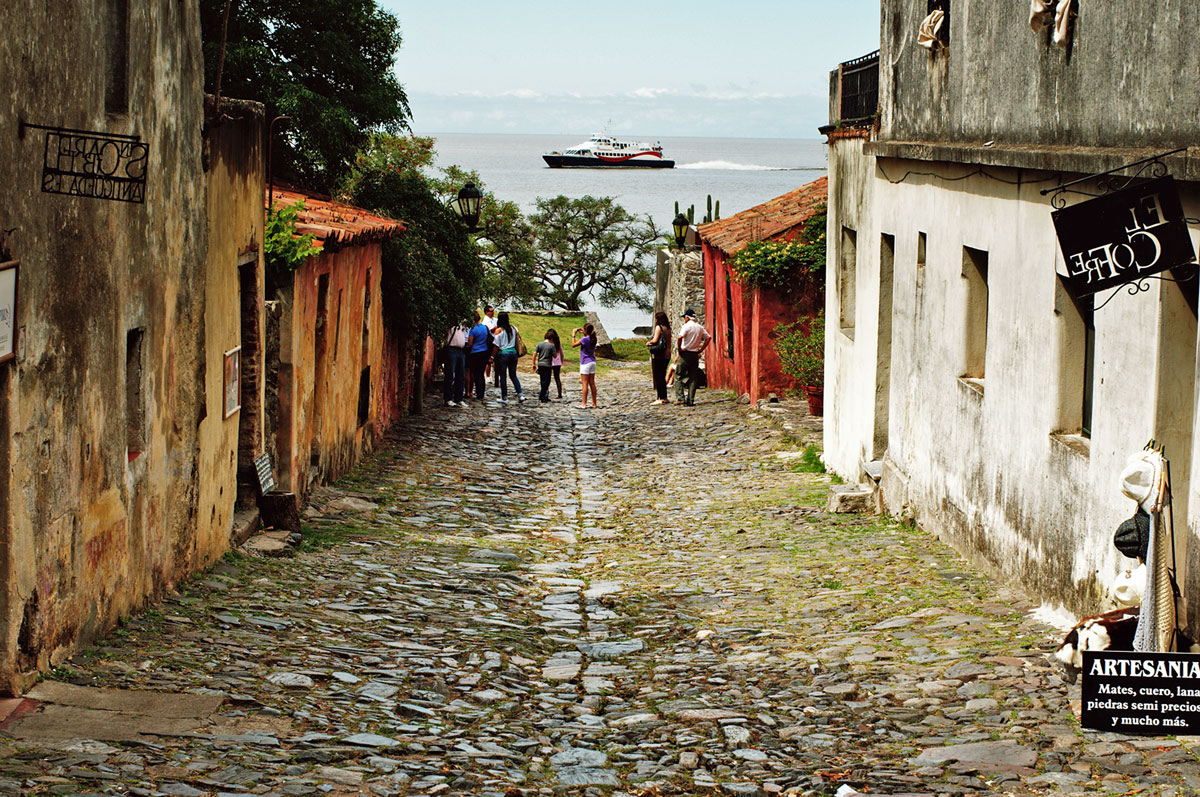
ColoniaSacramentoWhile living in Brazil, I spent several vacations in Argentina, and on every occasion I crossed the River Plate by boat from Buenos Aires to the beautiful town of Colonia del Sacramento in southwestern Uruguay.

Founded by the Portuguese in 1680, the settlement’s strategic location meant that it was much prized by the Spanish as well as the Portuguese and so it passed back and forth from crown to crown until finally in 1809 it was included as a permanent municipality within the newly independent Uruguay.

Its architecture is a mixture of Spanish colonial style and rural Portuguese streets which run down to the shore of the River Plate. The remnants of many buildings from the colonial era have survived, but what lends Colonia its particular mystique is the spiritual silence which dominates the historical quarter of the town. The town’s relative isolation and the lack of vehicles circulating in its narrow, cobblestoned streets set it apart from the bustle of modern life, and its proximity to the river means that it enjoys wonderfully fresh air all year round.
colonia 3
Trinities in Colonia del Sacramento

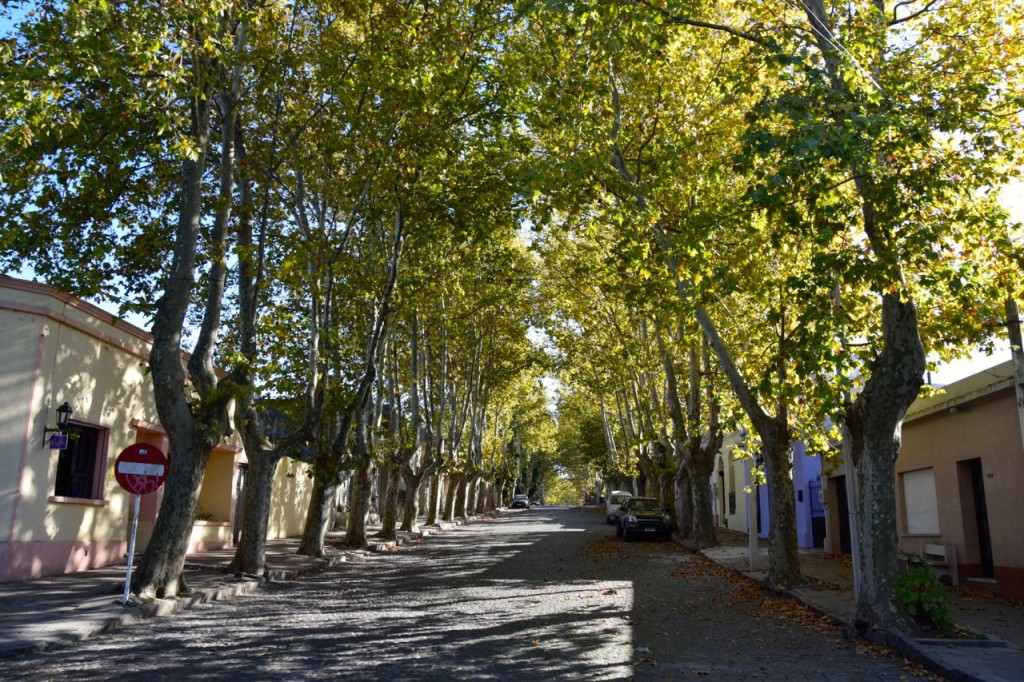
There are long straight streets lined on either sideColonia-Del-Sacramento-Plaza-Trees-1024x682
with majestic lime trees. A raw soul-searching wind
blows up from the south across
the vast empty expanse of the River Plate. It rakes
an empty hand through the withered leaves piled
in the gutters. This is autumn. A single grey squirrel
scavenges for food across the lawns of the town square.
Centuries ago, these trees were planted and pruned
in an inspired act of faith. Three sturdy limbs emerge
from each trunk reaching heavenwards in supplication:
give us this day our daily bread. Some brittle rusty leaves
still cling to the branches; they shiver and scratch hopelessly
in the breeze. So much silence now. Soon the last leaves
will fall. These were the prayers of yesterday, of yesteryear.
So much silence now. The last leaves will soon fall.
No bird song will be heard. So much silence.

*

Still-life in Colonia del Sacramento

There is a stillness and a silence in these streets,
some of which are paved with wedge stones quarried
from the river shore, with a gully running down the middle
–in the Portuguese manner– to gutter away the excess rain.
Here and there separating one backyard from another,
a free-standing dry stone wall, the thin broad slabs
cut and laid so long ago by anonymous hands.
Lawns are trimmed to the point of manicure,
and vibrant clusters of white and lilac hydrangea
soak up the gentle afternoon sun. Under the sycamore
shade we sit and observe small pockets of time
ferried in by visitors who appear to survive on
their own oxygen. The Governor’s house near
the main square has been reduced to its foundations;
the once magnificent Convent of San Francisco
is in ruins; the Viceroy’s residence is just a roofless,
empty shell. Colonia, on the banks of the world’s
widest river, has become a monument to human
mortality, drawing no distinction between the beauty
of life and its own conserved and perpetuated death.

The pity of war

soldatBoth my grandfathers fought in the First World War and both were wounded. My paternal grandfather from Dublin, who served in the Royal Horse Artillery, received a bullet wound in the leg during a campaign on the Western Front. Apart from piercing the flesh it did no lasting damage. My maternal grandfather from Cork, who served in an Irish regiment, was much more seriously wounded on the beaches of Gallipoli. He had one lung removed in a field hospital by the water’s edge before being evacuated. When he died in 1969, the registrar of births and deaths in Tralee, Co. Kerry, made a point of recording the cause of death as heart disease and pulmonary pneumonia exacerbated by a wound received during World War One. I can remember as a child putting my tiny fist into the hollow of my grandfather’s back where the lung had been cut out.

The recent centenary of the Gallipoli fiasco prompted me to write the poem below, based on the death of a French soldier, Eugène-Emmanuel Lemercier. I first came across the name of Lemercier in the Collected Poems of Wallace Stevens, who dedicated a sequence of poems to the fallen French artist. My poem draws on that sequence and also on the letters that Lemercier wrote to his mother from the Western Front.

La mort d’un soldat

Si tu voyais la sécurité des petits animaux des bois—souris, mulots! L’autre jour, dans notre abri de feuillage, je suivais les évolutions de ces petites bêtes. Elles étaient jolies comme une estampe japonaise, avec l’intérieur de leurs oreilles rose comme un coquillage.
If you could know what security the field-mice enjoy ! The other day, from my leafy shelter, I watched the evolutions of these small animals. They were as pretty as a Japanese print, their ears pink as shells.
Lettres d’un soldat, Eugène-Emmanuel Lemercier (1886-1915)

On a ridge outside
       the village of Les Éparges
            a French combatant
a former art student
                      and an orphan
raised by mother
           and grandmother
                      sits in his dug-out
clutching his rifle
           to his chest
                      The dugout is camouflaged
           with leafy branches torn
                      from the surrounding bushes
This is early March
           1915
                      and many men have died
in this most murderous
           of theatres
                      though many more
are yet to die
           He sits in his dugout
                      and admires the clear
blue sky overhead

The war has been silent
           these past two days
                      : the calm before the storm
           Through the foliage
he notices
                      two field mice at play
how pretty they are
           in their rough and tumble
                      the interior of their ears
the delicate sea shell pink
           of a Japanese watercolour
                      In one of his letters home
he writes
           of the beauty
                      of these mice

The driving rain
           the drip  drip   drip
                      of willows in the rain
The silence of the birds
           that wait out the rain
                      sheltering
in the willow leaves
           The mice that scamper
                      for cover
their small pale ears
           glistening
                      in the rain
At night
           a full moon looms
                      above the enemy lines
A soldier’s death
           is close to nature
                      he notes
A month later
           he is dead

Shortly before he fell
           /during another lull
                      in the fighting/
he reported hearing
           the call of cranes
                      returning home
at sunset
           His body
                      was never found