Broad Street in Reading town centre standing beside a tall tree draped with fairy lights a busker in his fifties stocky and with a short beard is playing his guitar to a backing track with bass and drums a version of the Jimmy Hendrix take on a Bob Dylan classic
It’s the last Sunday before Christmas the sky is overcast but only a fine drizzle is falling shoppers are hurrying from one store to another in a barely controlled frenzy But the guitar playing is brilliant and when the man begins to sing his voice is powerful and in key an excellent all-round performance
Sitting in a chair just behind the singer and holding an iPad or some other tablet a stocky woman in her fifties is absorbed in a world of her own in whatever she’s watching or playing but there’s a young boy aged about ten in a wheelchair and he’s dancing and waving his arms with a huge smile energetically reacting to the music he has glasses and there are gaps in his teeth but he’s soaking up the song with pure delight living totally in the moment a perfect audience
At night the grass verges leading up to the clubhouse are littered with white rabbits Caught in the car headlights their bodies glow with innocence and those that are playing continue to play and those that are sitting shooting the breeze watching the world go by continue to sit unperturbed by the motorized human traffic
Beyond the hedge is the golf course and the rabbits continually pass back and forth Who knows what goes through their minds in the course of an evening when they have the run of the eighteen mysterious holes the eighteen holes down which not a single rabbit is slim enough to fit The foibles of humanity they think – or perhaps not perhaps they think nothing at all and take the world as they find it placid laid-back fluffy creatures beloved of children and without a single axe to grind
A large blackbird perches on the chimney pot of a house across the road I notice the clouds racing in the turbulent grey sky
The bird is motionless perhaps in a trance as it waits for the next gust of wind : and then it comes I can hear the rush of air blasting against the roof shaking the rafters
The bird turns its head backwards hesitates takes a leap and veers 180 degrees flying straight into the face of the wind before turning back another 180 degrees and mounting the back of this swell surfing it
all the way down and out of sight
In the slow-dawning day I think of you lying there in your dream-fast sleep I think of your hair spread across the pillow the rise and fall of your breast the innocence of your limbs that languish in rest I think of love and the fortune it brings to our lives the tender give and take the strokes of affection in the words exchanged the muscles that we engage to smile and visually embrace each other
A poem needs so little to grow on the page or a virtual poem held in the mind and perhaps forgotten in an instant but vital nevertheless in that split second of existence
Are roses and rocks and stone the only reality ? I think not In the darkness the mind has mountains we stagger around arms outstretched anxious not to stumble we cling to each other whisper words of comfort reach for the nearest available light that will bring us back to our bodies back to ourselves
In the slow-dawning day a shadowless moon seen through my window and countless homes shrouded in darkness shrouded in dreams Life that teems with life currently at rest virtual life about to be called into action and all in the name of love survival of the species Listen and you may hear the dim-coned bells filling the mid-winter air with the transparencies of sound – make no mistake : time and love go hand in glove are partners and are of the essence and are inseparable
Poetry has innumerable registers and as many audiences. Yesterday I wrote a poem for a class I give to an adolescent with special needs. My student faces a number of challenges, but he is very intelligent and is interested in everything. He also has a gift with words. We have been reading the poetry of Emily Dickinson, William Carlos Williams and Stevie Smith, and part of every class involves a short piece of writing, often in the form of poetry. The poem below was written to demonstrate how the simple repetition of a phrase can give form to a poem: each line was also intended to stimulate a response that would lead to a piece of writing by my student. Before settling down to work, however, he spontaneously spoke the line “Why is the sun so beautiful?” and he went on to describe what he felt about the sun. I told him that that first line in particular, with its combined exclamation and question mark, could easily be the first line of a poem by Emily Dickinson, and congratulated him. Poetry as an educational medium can help to unlock the emotions and liberate the powers of expression. It has this effect on school children and on adults alike.Poetry rules, okay!
Some things
Some things are important Some things are not
Some things I remember Some things I forgot
Some things make me happy Some things make me sad
Some things really please me Some things drive me mad
Some things are really boring Some things are really fun
Some things are best in winter Some things really need the sun
Some things are quite alarming Some things are really cool
Some things I do at weekends Some things I do at school
Some things are good for eating Some things are good to drink
Some things are really easy Some things they make you think
Some things are worth the trouble Some things I couldn’t care
Some things I think of trying Some things I wouldn’t dare
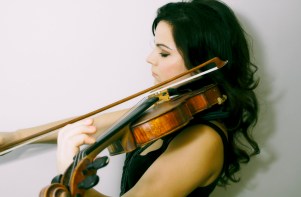
The poem below was written shortly after midnight. I had just returned home from an evening spent with my good friend, the writer, Molly Rosenberg, herself an occasional contributor to these pages. Molly and I met in Peter Jones and dined in the Brasserie there before heading off to the Cadogan Hall to see Steeleye Span in concert. And what a wonderful performance it was: beautiful songs, beautifully sung and the musicians totally in command of their instruments. Notable in the band was the young violinist, Jessie May Smart who played with outstanding verve and expression, adding a rich harmonic layer to the music. At the end of the show, Molly and I, together with Janet – Jessie’s mother – had the pleasure of meeting the members of the band for a glass of wine, and the young violinist proved to be as charming as she is beautiful and talented.
All this by way of explanation: having arrived home late, but not wishing to fail in my commitment to my daily blog, before turning in to my bed, I decided to write and post a new poem using an idea that I had been mulling over recently and no connection with the evening’s performance. Upon waking this morning, somewhat bleary-eyed and a little later than usual, I reread the poem and made a number of alterations. These impromptu poems I post are a work in progress, that’s all.
Love is no abstraction
Who is to say that the stars are abstractions because they seem to be so far away ? Yet they are no more distant than the light in your eyes they are there
in the effervescence of your smile there in every ginger step you take along with every gasp of breath
We are pervaded by starlight we consume it night and day in every possible shape and form and it is there in the ardours of our love in the sparks of ignition that fire our bodies and precipitate our kisses There’s simply no escape from starlight simply nowhere to go
in the cosmos to get away from it
And so too to tender love ! You talk of love but love that’s not total is not love at all : love is binary – yes or no but never partial nor ever maybe nor ever open to negotiation Love cannot lose an eye or a limb and still be love – it is indivisible it is whole or it is nothing at all it is absolute or it is meaningless and it is what drives life forward it is the human expression of sunlight and in its absence lives wither and die It certainly is no abstraction : look around
The sun dragging its heels a reluctant lover loath to leave the bed on this cool December day stillness in the house reality at bay a lone bird somewhere faraway tuning its pipes warming up its vocals The silhouette of trees seen through the window motionless bare branches Foxes have called in the night and neighbourhood cats have frisked each other under a lacklustre moon
There was a girl in my dream her soft supple fragrant body stretched out on the cool white sheet beside me and in my dream I reached out to touch her and now she lurks on the edge of every shadow a pool of innocence in her warm hazel eyes insatiable longing in mine
The stark beauty of early December down by the river at Windsor nature all but in disarray confounded by the mild air the barren trees barely moving in this gentle twilight breeze and upon the brimming water the brilliance of these creatures gliding past me close to the bank their elongated necks thrust forward lowly as they scan the dark waters for what lies beneath
There is no clamour nor fuss as they go about their business foraging for what might see them through the long night and gently they sway their heads from side to side missing nothing as they drift homeward
There is a time for majesty but this is a time when such decorum is no longer required they have touched the hearts of all who saw them earlier in their full regalia when they beat their wings to demonstrate their power over all that took to the river
Lovers strolling hand in hand by the water’s edge take delight in the candescent purity of their unruffled plumage and the quiet dignity in their mysterious eyes lovers who would soon be home to their bed dreams nourished by this scene in the fading light
Jonah, our intrepid and occasionally illustrious blogsworth, is a restless old soul, always anxious for new experiences, especially ones that might yield fresh material for the blog. So a couple of Sundays ago, with a weather-eye on the weather, he hopped onto a train in Paddington which in due course carried him back to his old alma mater amid the dreaming spires of Oxford. There was a chill nip in the air, but Jonah remained undeterred, and for most of the day the rain held off.
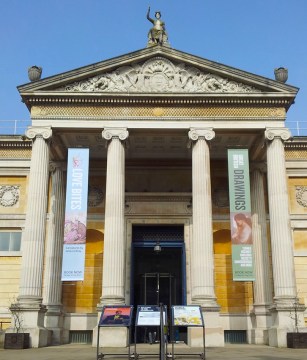
First port of call in that learned city, was the old Ashmolean Museum in Beaumont Street, opposite the Randolph Hotel and adjacent to the notorious Taylorian Institute [where Jonah had in his salad days skipped many a Modern Languages lectures, enough said]. Meanwhile, the Ashmolean, home to the University’s extensive collections of art and archaeology, was founded in 1683 and was the world’s first university museum. Its first building was erected in 1678–1683 to house the cabinet of curiosities that Elias Ashmole donated to the University in 1677.
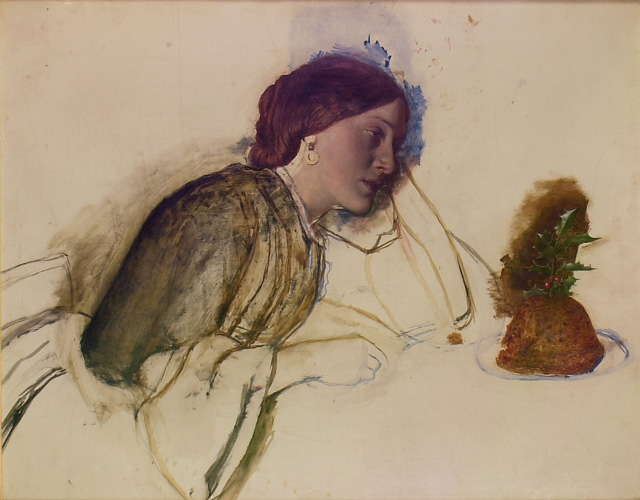
The poor Actress’s Christmas Dinner, by Robert Braithwaite Martineau (1860)
On this occasion, Jonah’s focus was on the museum’s collection of 19th century paintings and for today’s post he has chosen to feature something seasonal: The poor Actress’s Christmas Dinner, by Robert Braithwaite Martineau (1826–1869), which dates from around 1860. The artist initially trained as a lawyer but later entered the Royal Academy where he was awarded a silver medal. He studied under the Pre-Raphaelite artist William Holman Hunt and once shared a studio with him. The painting in question, although unfinished, provides poignant example of mid-Victorian pathos. The stylised, melancholy portrait of the actress is beautifully executed, although she appears to be marooned in the emptiness of the canvas. It is pointless to speculate why Martineau abandoned this particular study, but it does indicate something of the manner in which the artist intended to build up his composition, working from the centre outwards.
After a major redevelopment, the Ashmolean Museum reopened in 2009. In November 2011, new galleries focusing on Egypt and Nubia were also unveiled. The Ashmolean’s collections are extraordinarily diverse, representing most of the world’s great civilisations, with objects dating from 8000 BC to the present day. Among its many riches the Ashmolean houses the world’s greatest collection of Raphael drawings, the most important collection of Egyptian pre-Dynastic sculpture and ceramics outside Cairo, the only great Minoan collection in Britain, outstanding Anglo-Saxon treasures, and the foremost collection of modern Chinese painting in the Western world. If you are ever in Oxford, a visit to the Ashmolean is a must. For a full programme of events and exhibitions see http://www.ashmolean.org
Gentle love will see us through the harsh dark days of winter the warmth of your voice the light of your eyes these are not clichés they are what sustains the soul in the withering wind and the biting frost
Gone are the swallows gone are the marigolds and all things are in flux The rocks and stones will pass the rivers will run down stars will burn to a cinder for nothing lasts forever not even time — time will pass leaving only love love is all that endures
So in the cradle of your arms I will nestle until the ice of winter melts until summer suns rekindle the earth’s fires I will bed down in your embrace and sing of love’s sweet sorrows of all that was lost and of all that was won
 johnjosephlyons