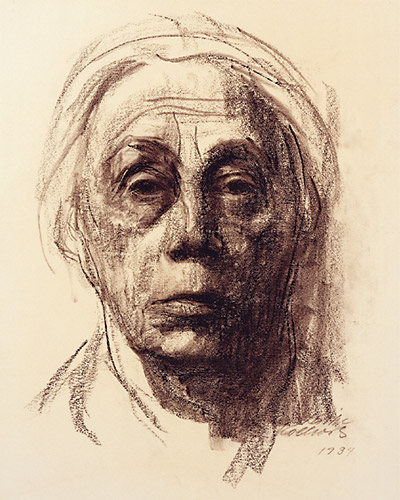
To read Muriel Rukeyser’s poem dedicated to Kollwitz, click here.
To read Muriel Rukeyser’s poem dedicated to Kollwitz, click here.
It’s burlesque
a light show
everything you want to see
before your very eyes
but hidden behind the flourish
of coloured fans
painting is about nudity
revelation
the laying bare
of physical perception
its beauty lies in its truth
how the light unravels
as the knots of the spectrum
are untied and the gown
of discretion slips
to the floor
painters pore
over their canvases
drooling fingertips delighting
in the rough textures
and smooth lines—
it turns them on :
beneath the pigments
the breasts buttocks thighs
and a desire to penetrate
to have knowledge
of the flesh and blood
Tancredi’s composition
is an enticing tease
that no retina can resist
John Lyons
For the picture. . . Or scroll down to 21 February. . . .
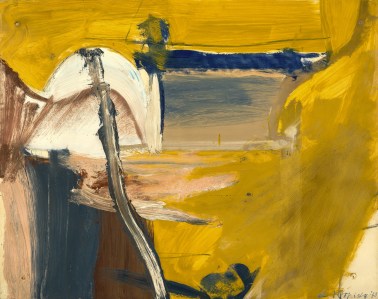
Do you see what I see
notes for a landscape
a shore and a beach
and a river and a sky
a path to enlightenment
a horizon viewed
from a cliff top
waves perceptible
in the brushstrokes
mimicking the tensions
in the earth’s crust
and in all our relationships
abstract cartography
of the soul
it took a human body
to paint this
to select the colours
and to control the brush
it took human energy
to express this to execute this
rather than accept
the docility of a pacified
environment in which nature
sits tamely on a canvas
I came here scriptless
Willem and I searched high
and low for love
I am an accident of birth
whatever is concealed
in this composition
will be revealed in due course
at its heart is the illumination
of sunlight and a brightness
that never fades
the joy we associate
with the loving application
of human vitality
everywhere apparent
the long sinews
of genitive muscle
it could be a walk
on a Sunday afternoon
or a three-penny opera
in which we all appear
and notice a perfectly positioned
pinmark in each of the corners
no abstract could ever be
so inexhaustibly
calculated which is why
I am not a painter
John Lyons
Painting observed on 10 February 2017 during a visit to the Peggy Guggenheim Collection in Venice. Click here for an appraisal of this work.
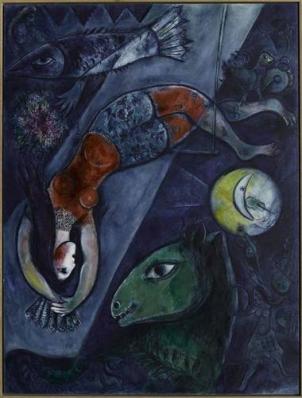
Chagall’s blue
sea of aching origin
transmigration
of genes
across Europe
across continents
flight of all things
in constant flux
Swirl of blue vortex
earthwomb
from which all life
emerges
fiery cadmium placenta
a canvas dripping
with minerals
Mother and child
in the hills above Nice
a brush with destiny
instrumental colour
the hands from which
melody flows
Pegasus dashing
across the seasky
repeated layers of love
tenderly applied
the groomed bride
floating within her sex
circles of satisfaction
zones of curved comfort
joy inviolate
against the terror
of time’s crude cross
John Lyons
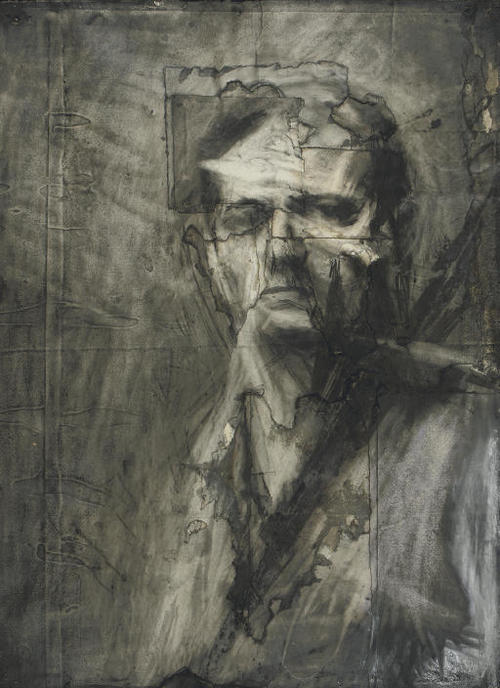
An artist sees
and listens
and listening sees
the unseen
and vision becomes speech
and speech becomes
lines and strokes and swathes
of chalk and charcoal
delicately smudged
with the tip of the finger
turning the darkness into light
and listening all the time
to what is seen and
seeing all the time
what is heard
applying the alphabets
of sound and shape
dividing the darkness
with fragments of light
seizing the energies
of expression and posture
driven by the instinctive
desire to uncover the truthness
the emotional hardcore truth
that lies behind the mask
of careless inattention
or superficial appraisal :
more than in dialogue
with the subject
the artist teases identity
out into the open
with gentle interrogations
striving constantly to achieve
an ultimate rendering
not an essence
not a resumé
not a replica
neither a duplicate
simply a completeness
of visual presence
that stands and speaks
for itself
John Lyons
The Frank Auerbach Exhibition at Tate Britain in Pimlico, runs until 13 March 2016. Unmissable.
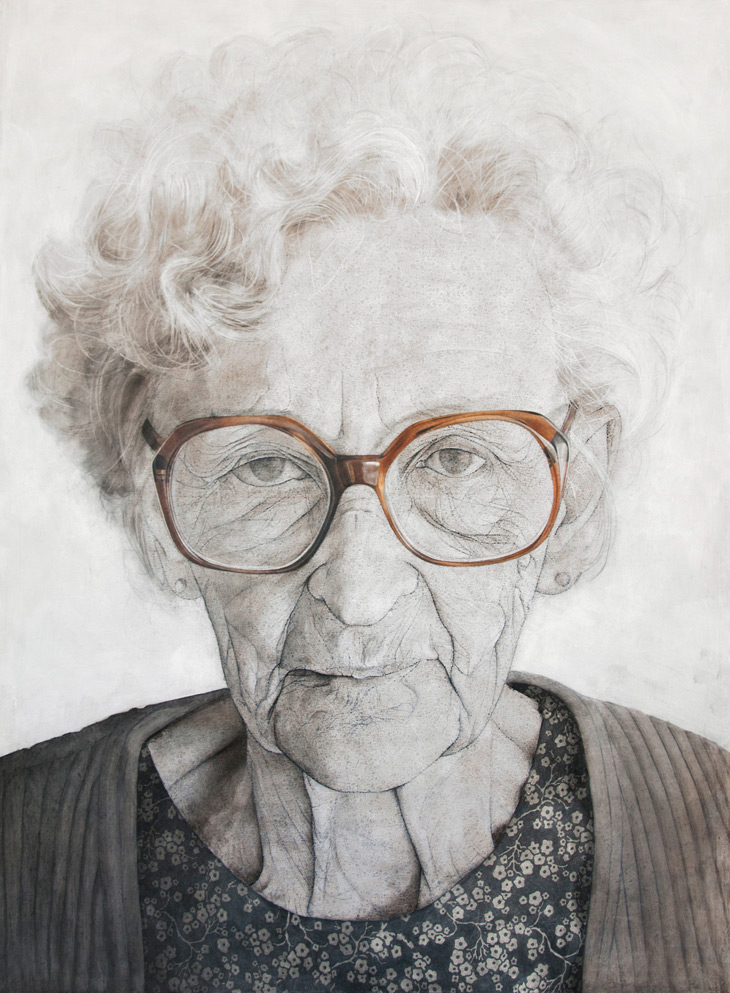
So on Sunday, before the rain and wind sets in, Jonah heads up to the King’s Road, to the Saatchi Gallery, located in part of the barracks where the Grand Old Duke of York kept his ten thousand men. The sound of marching has long faded, and all is quiet but for the gentle footfall of Londoners and tourists on gravel as they make their way in to see Champagne Life, the latest exhibition, which runs until 9 March. And believe me, this presentation of artwork by female artists from around the world is well worth seeing. There are a couple of inspired exhibits by Alice Anderson whom we visited at the end of last year in the Wellcome Foundation up in Euston. Equally, the refreshingly intriguing canvases by Florida-born Suzanne McClelland, are not to be missed.
Then there is the Serbian artist, Jelena Bulajic. Born in Vrbas, Serbia, in 1990, Bulajic lives between London and Serbia. The selection of her portraits in mixed media on canvas are truly mesmerising. According to the gallery blurb:
The human face, with all its softness, contortions, wrinkles and sags, is the subject matter of Jelena Bulajics’ minutely accurate paintings. Each canvas is filled with the faces of people she spots in the street, or encounters in daily life, whose character, look, or empathy catch her interest.
What is staggering about Bujalic’s work is its gigantic scale. The portrait illustrated, for example, measures 2.7 x 2 metres, and yet the detail is absolutely minute and meticulous. Saatchi’s policy of not roping off exhibits or placing them under glass allows visitors to get really close to paintings and appreciate the beauty of the artists’ techniques, which in the case of Bulajic, is of a standard of execution that Titian might have envied. Sensational.
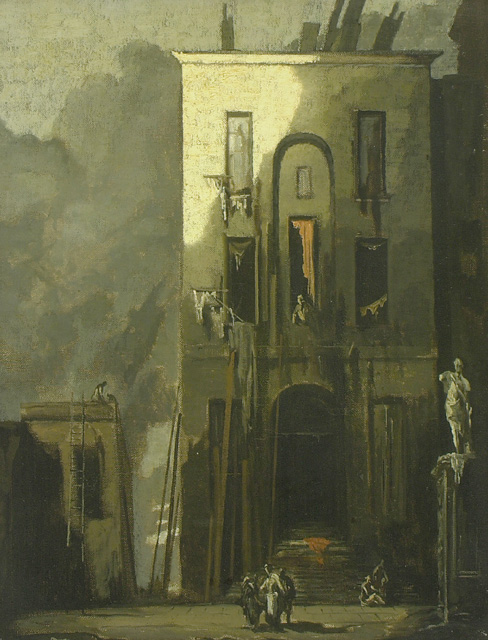
James Ferrier Pryde (1866-1941) was a Scottish artist and sometime actor. His principal occupation was the design of theatrical sets and posters. In 1930 he designed the sets for Paul Robeson’s Othello at the Savoy Theatre
However, Pryde is best remembered for a series of highly personal paintings of architectural subjects. During the First World War, these became increasingly sombre, dwelling on the theme of ruin and decay. ‘The Slum’, completed in February 1916, is one of the most monumental of these studies and evokes the grim tenement buildings of the Edinburgh of Pryde’s childhood.
What I admire in this portrait is the deep sense of irony which Prude infuses into his subject. The setting may well be Edinburgh but the gaunt building has echoes of Canaletto’s Venice, albeit the backstreets close to the Rialto. Notice the classical clothing of the figures featured in the painting. Pryde’s painting telescopes history in order to underline the degree of decadence, as if to say ‘this is how far we have come in the journey down to the pit of human indignity’. A once proud nation has been reduced to its knees, every detail is ragged and torn and misery drips from the buildings. The billowing shadows in the background are perhaps from the War raging somewhere off in the distance, but in the midst of the carnage on the battlefield we are not to forget the urban carnage of slum housing and what was in effect a war on the poor and dispossessed. The social and political climate that led to Easter 1916, I would suggest, is an unwritten part of the larger context, and Pryde, through his art, reaffirms the importance of artists as the antennae of their generation.
This magnificent canvas can be viewed at the Ashmolean Museum of Art and Archaeology in Oxford.
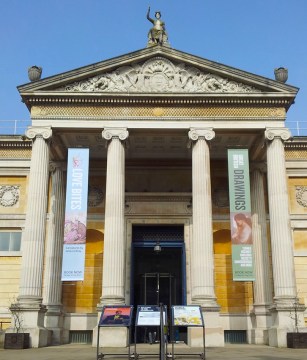
Jonah, our intrepid and occasionally illustrious blogsworth, is a restless old soul, always anxious for new experiences, especially ones that might yield fresh material for the blog. So a couple of Sundays ago, with a weather-eye on the weather, he hopped onto a train in Paddington which in due course carried him back to his old alma mater amid the dreaming spires of Oxford. There was a chill nip in the air, but Jonah remained undeterred, and for most of the day the rain held off.
First port of call in that learned city, was the old Ashmolean Museum in Beaumont Street, opposite the Randolph Hotel and adjacent to the notorious Taylorian Institute [where Jonah had in his salad days skipped many a Modern Languages lectures, enough said]. Meanwhile, the Ashmolean, home to the University’s extensive collections of art and archaeology, was founded in 1683 and was the world’s first university museum. Its first building was erected in 1678–1683 to house the cabinet of curiosities that Elias Ashmole donated to the University in 1677.
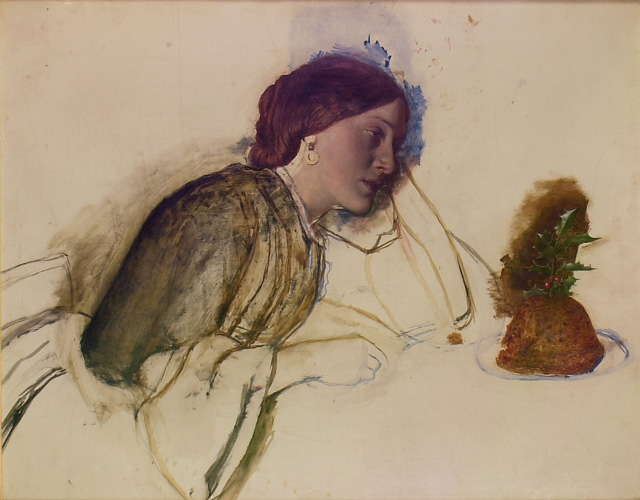
On this occasion, Jonah’s focus was on the museum’s collection of 19th century paintings and for today’s post he has chosen to feature something seasonal: The poor Actress’s Christmas Dinner, by Robert Braithwaite Martineau (1826–1869), which dates from around 1860. The artist initially trained as a lawyer but later entered the Royal Academy where he was awarded a silver medal. He studied under the Pre-Raphaelite artist William Holman Hunt and once shared a studio with him. The painting in question, although unfinished, provides poignant example of mid-Victorian pathos. The stylised, melancholy portrait of the actress is beautifully executed, although she appears to be marooned in the emptiness of the canvas. It is pointless to speculate why Martineau abandoned this particular study, but it does indicate something of the manner in which the artist intended to build up his composition, working from the centre outwards.
After a major redevelopment, the Ashmolean Museum reopened in 2009. In November 2011, new galleries focusing on Egypt and Nubia were also unveiled. The Ashmolean’s collections are extraordinarily diverse, representing most of the world’s great civilisations, with objects dating from 8000 BC to the present day. Among its many riches the Ashmolean houses the world’s greatest collection of Raphael drawings, the most important collection of Egyptian pre-Dynastic sculpture and ceramics outside Cairo, the only great Minoan collection in Britain, outstanding Anglo-Saxon treasures, and the foremost collection of modern Chinese painting in the Western world. If you are ever in Oxford, a visit to the Ashmolean is a must. For a full programme of events and exhibitions see http://www.ashmolean.org
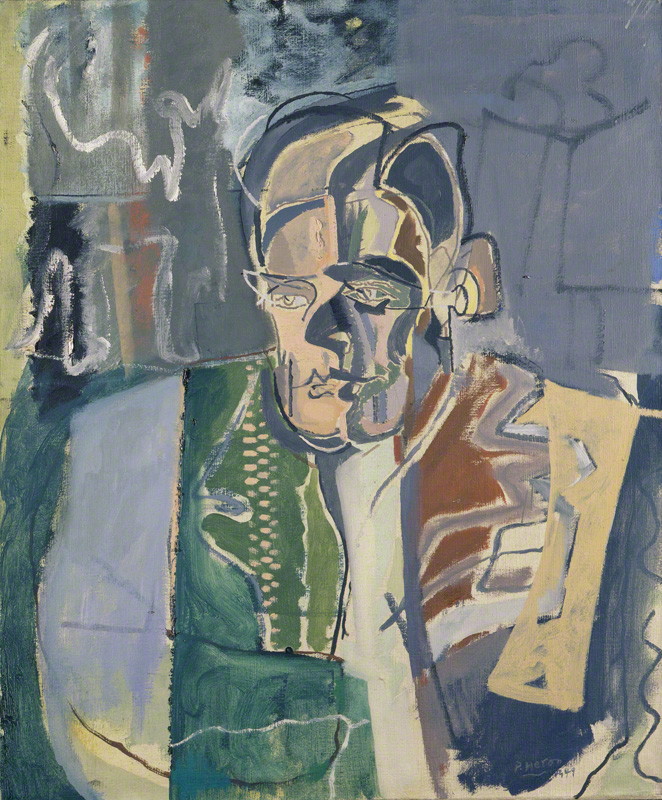
Confirmation – as if it were needed – that painters will render not only what they see but also what they know and feel about a subject. Patrick Heron’s study of T S Eliot – on display at the National Portrait Gallery on Charing Cross Road – is absolutely informed by a reading of the poet’s work and, certainly to some extent, his life.
Painted in 1949, a year after Eliot, the author of The Wasteland (1922) and The Four Quartets (1943) had been awarded the Nobel prize for Literature, Heron’s canvas seeks to convey the complexity of Eliot’s character, including as it does, two primary facets: a formal portrait with the poet sitting face forward, with a simultaneous profile, in the manner of Braque.
Eliot typically dressed in suits, yet Heron subtly deconstructs his appearance by using colour to undermine the formality, and by including elements such as the zip completely out of place, not to mention the discreet crucifix on his chest. The composition of the portrait is absolutely traditional, but the traditional silhouette is broken up into a fluid mixture of geometrical and non-geometrical segments in such a way as to challenge and subvert the rather stuffy personna that Eliot tended to project. And Eliot, in his poetry and in his life too, essentially was the embodiment of a conundrum: a paradox, a highly conservative revolutionary, whose key modernist works radically altered the course of twentieth century poetry.
Below I have quoted the very revealing opening lines of Eliot’s poem, “Ash Wednesday” which was first published in 1930.This poem was written to mark Eliot’s conversion to the Anglican faith. But notice how, into this brilliantly executed portrait, Patrick Heron has incorporated grey ashen tones in the defining lines, in the background and in splashes on the poet’s jacket: greys that contrast with the different shades of green which appear like bold fresh pastures. In the top right-hand corner of the canvas there is the suggested form of a book or pages of text on display, and this would seem to hint at the typical eagle lectern of the Anglican church, which in turn could equally well suggest a phoenix rising from the ashes.
Because I do not hope to turn again
Because I do not hope
Because I do not hope to turn
Desiring this man’s gift and that man’s scope
I no longer strive to strive towards such things
(Why should the aged eagle stretch its wings?)
Why should I mourn
The vanished power of the usual reign?
T. S. Eliot
Born in 1920, Patrick Heron trained at the Slade School from 1937 to 1939. His career was interrupted by the war. One of the most profound influences on his painting was the work of George Braque, which he first came to know during an exhibition of Braque’s art at the Tate Gallery in 1946. In the mid-fifties he became interested in abstract painting. He died in 1999.
Please note: The text below is a revised version of the post which appeared earlier today.
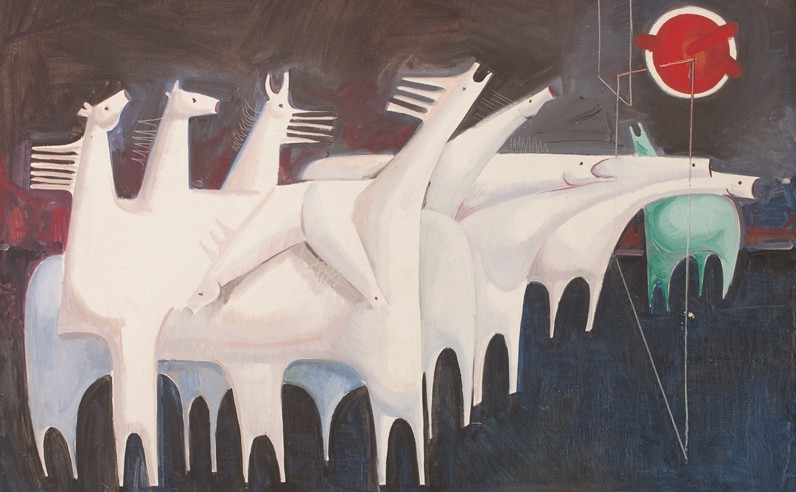
Iraqi artist Kadhim Hayder’s stunning canvas (pictured above) is currently on display at the Whitechapel Gallery, as part of an exhibition of Arab art on loan to the gallery from the Barjeel Art Foundation until 6 December.
In a spacious, well-lit room, full of striking paintings, all vying for attention, Hayder’s stylized horses really catch the eye. Two things struck me when I first saw this picture. The first is that Hayder’s war weary horses are every bit as iconic as the more widely known emblematic peace dove, and arguably the horses are more eloquent, captured as they are literally in conversation.
Over and above the most immediate element, namely the candid purity of these creatures, I find the composition particularly striking: here we are presented with a group of ten white horses in poses that suggest not only exhaustion but also the virtues of trust, affection and mutual support. An eleventh horse, of a different shade, would appear to be outside the group seeking admission. The fierce red warrior sun is clearly an element that alludes to battle, but these are not war horses, and in this harsh landscape they are clearly longing for rest and for peace. The respite from fighting allows them to engage in that most human activity: conversation, dialogue.
The second thought that struck me was the extent to which art transcends frontiers and ideologies, and the particulars of historical time to create, as it were, a universal plane or dimension of expression in which every single work produced contributes to a single, artistic, life-affirming communion, one of abiding relevance to our shared humanity. This community has a universal language of values which reflects the essential aspirations of humanity: love and solidarity along with truth and beauty. It is for this reason that artistic products do not date, or why, in a nutshell, all art is contemporary.
Jonathan Swift refers to Thomas More’s Utopia (1516) in his 1727 preface to Gulliver’s Travels, and I would suggest that no reader of Swift’s dystopia could fail to see in Hayder’s painting something of the wisdom of the Irishman’s Houyhnhnms – the race of intelligent horses described in the last part of his satire.
Piling on the irony in his preface, Swift writes that even from the most degenerate specimens of these Houyhnhnms, he still had much to learn from their virtues. And in describing the time he spent in Houyhnhnmland under the wise tutelage of one of their elders, he says:
Yahoo as I am, it is well known through all Houyhnhnmland, that, by the instructions and example of my illustrious master, I was able in the compass of two years (although I confess with the utmost difficulty) to remove that infernal habit of lying, shuffling, deceiving, and equivocating, so deeply rooted in the very souls of all my species; especially the Europeans.
In authentic art, the thrust for truth and beauty is everywhere apparent, and although Swift’s satire was directed at the political classes of his day, it transcends its historical context and is as relevant now as ever: and I would argue that the same could be applied to Kadim Hayder’s beautifully expressive canvas.
There are, of course, many other fascinating paintings in this exhibition at the Whitechapel Gallery, so well worth the visit if you have the time. See http://www.whitechapelgallery.org/
After studying art in Baghdad in the 1950s, Kadhim Hayder (1932-85) pursued theatre design and graphics at the Royal School of Art and Graphics in London. He returned to Iraq in 1962, founding the department of design at the Institute of Fine Arts and chairing its visual arts department.
 johnjosephlyons