Resolution

Like my poetry, I am a work in progress, as I believe we all are. We all hanker after times and places of innocence and yet we would never exchange the present for the past, go back to our childhoods. Whether or not we make resolutions at the start of a new year is immaterial: we are all constantly evolving and adapting to change. In our hearts we long for growth, for improvement, for greater understanding of ourselves, of our relationships, and of the world around us. Each day is a draft, an attempt, and maturity teaches us at least to accept that among the successes, the minor gains, there will be failures, perhaps even dead-ends that force us to rethink everything, to begin again. Setbacks. The occasional achievement. So it is with writing. There are good days, and days where the writing simply does not flow, or if it does, it flows too easily and in hindsight amounts to nothing.

Reading the letters of Samuel Beckett has been salutary and illuminating. So much of Beckett’s writing is soliloquy. In the novel, The Unnamable, in his theatre Krapp’s Last Tape, the sole soul on the stage or on the page, life’s essential drama, to be or not to be, and Beckett’s Hamlet finally responds in the novel: “. . . where I am, I don’t know, I’ll never know, in the silence you don’t know, you must go on, I can’t go on, I’ll go on.” Resolution.


Resolution

To avoid further calamity
         to recapture the innocence
of time and place
         that I knew as a child
there on the heath
         amid the sand dunes
and the gorse
         the sun scorching my face
breath fast and furious
         up hill and down dale on a bicycle
the yellow-brick road of youth
         innocence of the earth
of the seasons
         of the rise and fall of nature
to be finally in tune with myself
         in control of my idiom
and with some understanding
         of the enigma of my being
among all other beings
         Yes I am guilty of days
months and years
         but the rain
the fierce morning rain
         that shattered my sleep
has absolved me
         I mourn nothing
not even the passage of time
         nor the process of aging
I am the only secret
         I will take to the grave
but I am content
         and I live in hope
                  always

John Lyons


Circus

Below is a poem written in 1968, while I was still at school. I’m using this today due to problems with the WordPress site which is preventing me from uploading images at present. The post intended for today was a brief commentary on Patrick Heron’s portrait of the poet, T.S. Eliot.

Circus

A thousand ostriches stare at the ceiling
A guest Jamaican spider hangs from his net
Woven at a height to top all heights
The cackling dies down and only the sound
Of crunched sugar corn nibbles at the silence
The pat of the drum breaks into a gallop
The ants below in the sawdust hold hands
The little flies forget their grievances
And pray crossing their wings anxiously

The spotlight spins wildly and drags the beam
Up to where the nonchalant performer
Spits into six of his legs and then waves
To a group of relatives sitting way below
As he now begins the eight-legged hop
People faint at liberty throughout the enclosure
He slowly swings from one leg to another
One two three four he stops smiles
Scratches his back five six he slips
And tumbles down like a feather into the arena
Some scream some cry and some just marvel
At the grace and control as he fell earthwards

The rusty tinkle of coins is heard
As clean hankies are pulled from pockets
To soak up the tears
                                     A doctor arrives
The spider is dead go home that’s all today

Back with more thrills next week says the ringmaster

No one remembers our Jamaican friend any more
And his black widow just spins and spins
Day in day out slip one

John Lyons

November First 2015

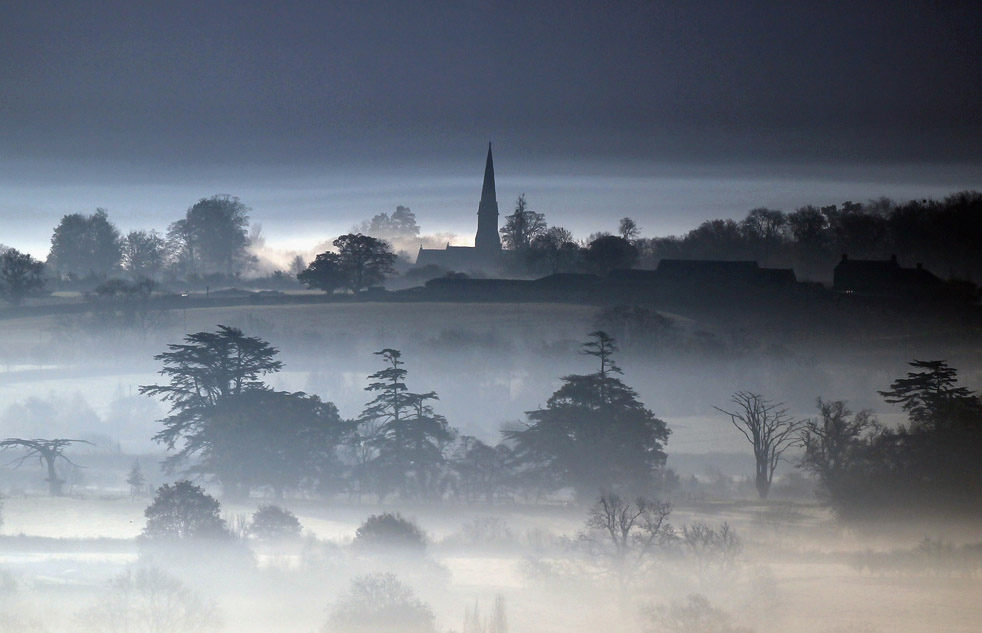
mistNovember First 2015

The mist has reduced
the distant the streets
to dark silhouettes
I hear a crow cawing
but can see nothing
: the world for a moment
has lost its sense of direction
some of the garden bushes
have yet to be stripped
of their bright orange berries
pigeons have been gorging
on them all week
mist-coloured pigeons
now busy mating
under the camouflage
     This Sunday rises late
from its bed
but the voices of children
with plans and schemes
are heard urging
their parents to action
     Under the shroud of mist
lovers lie loving
in their beds
and the silence
turns operatic
there is so much to do
in the world
and so little time
and yet they lie
loving as though
there is no tomorrow
but there is no tomorrow
     Cars thread through the mist
even as airports close
passengers held in suspension
circling the metropolis
wondering whether they will
ever touch land again
hovering above their lives
but unable to lift a finger
to change a thing
     Sunday has become lost
in this mist and plans
have been revised
curtailed or postponed
as life enters
the hesitance mode
and everyone is suddenly
unsure of themselves
and looking for guidance
aching for leadership
and for an answer
to several mundanities
     For some the bed
is the resolution
when all else fails
the bed is a blanket
like the mist
one on top of the other
lovingly like lovers
     Excuses for inaction
are there at the window
or dripping from trees
that peer from the greyness
gaunt shadows
of their former selves
     For the moment
for this precise moment
this Sunday is going
nowhere fast
this November first
in other words
is fast becoming
a month of Sundays
     For the time being
in these hyperactive
times in which we live
the message for the time
being is to do nothing

John Lyons


Kestrel

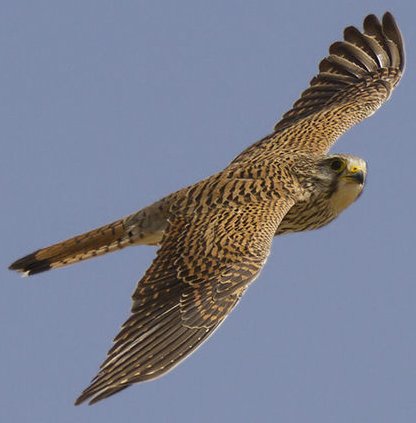
Kestrel2So much of nature is driven by instinct, and no more apparent is this than in species that prey on other species. An ocelot, for example, will hunt in the rainforest for mice, agoutis, monkeys, opossums, armadillos, anteaters, snakes or turtles. But it may also fall victim to a larger predator, a jaguar for example. In one way or another all life feeds on life: organic creatures require organic sustenance! It is a fascinating sight to see a kestrel hovering in the air as it fixes its gaze on a rodent down below, only to plummet seconds later to make the kill.

Instinct, however, is not to be confused with human passion, the passion that can lead to love at first sight (or vice-versa), that can lead to an all-consuming hunger that may override good sense and ignore any social or financial considerations as it homes in on the object of its desire.


Kestrel

The single kestrel
                   that hangs in the air
enthrals the eye
                   the sheer beauty
of it plumage
                   the pin-point accuracy
of its eye
                   the effortless power
in its talons
                   as it seizes its prey
in one fell swoop

Is love
                   any less dead eye
any less ferocious
                   in clinging on
to the object of affection
                   the warm flesh
of the beloved ?

Did Orpheus not descend
                   into the very mouth
of hell
                   to retrieve her ?
Immaculate love
                   wipes the slate
kick-starts a new millennium
                   a re-enactment
of first things
                   first kiss first taste
first immersion
                   in the warm
beating blood and fibre
                   of another

John Lyons


Women of Troy

scoopOff this evening to The Scoop open-air theatre, close to London Bridge, to see Lisa Kuma’s adaptation of three of Euripides’ plays, which she conflates into a single narrative, entitled Women of Troy. The story is familiar: Paris (son of Priam, ruler of Troy and his wife, Hecuba) abducts Helen, wife of Menelaus. Agamemnon, the Greek king and brother of Menelaus, raises an army and is ready to sail to Troy to rescue Helen but before the gods will grant wind for his sails, he is required to sacrifice his beloved daughter Iphigenia. So with the Greek fleet stalled in the harbour and the Greek army becoming increasingly restless, almost to the point of rebellion, Agamemnon beseeches his daughter Iphigenia to accept the glory of sacrifice for the good of her nation. After many tears, she finally concedes to her father’s wishes, much to the despair and anger of her mother Clytemnestra.

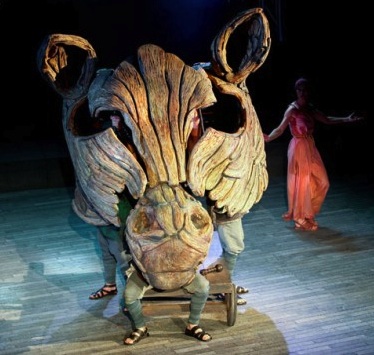
Trojan horseThe first act ends with Iphigenia’s death. The second act begins with the Fall of Troy, showing the moment the Greek army emerges within the city walls from the belly of the wooden horse (pictured). Thereafter, the focus is on the fate of Helen, who has been released from supposed captivity, and the women of Troy.

For some reason, I found the performances of the actors playing the leading female characters considerably more convincing than those playing the principal male roles. Agamemnon, for example, supposedly the most powerful man in Greece, lacked any real presence and his phrasing seemed laboured and rather expressionless. Equally, there was little palpable anger in the performance of Menelaus, who had, after all, been cuckolded by his wife and made a laughing stock throughout the region. Achilles, too, failed to express any real passion. On the other hand, all the women were utterly engaging. It’s difficult to know who was responsible for this divergence since the challenges of performing in an open-air venue were the same for both sexes.

Despite this criticism, for those unfamiliar with the work of Euripides, the evening certainly represented a valiant and valuable introduction, and all the actors are to be applauded for that. Lisa Kuma’s text managed to maintain a fine balance between a colloquial tone that could be readily appreciated by a modern audience, and a more serious discourse that retained some of the dramatic poetry and power of the original lines. The performance was staged as part of the More London Free Festival.


Cast
Achilles – Eddie Eyre
Agamemnon – Phil Willmott
Andromache – Jasmeen James
Clytemnestra – Penelope Day
Hecuba – Ursula Mohan
Helen – Emily Sitch
Iphigenia – Hannah Kerin
Menelaus – Joseph O’Malley

Tonight you will be with me in Paradise

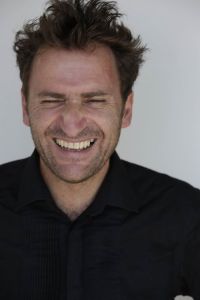
wade_blogNo, not the words spoken by Christ to the good thief as they were crucified side by side on Calvary. Tonight you will be with me in Paradise, if you accept the invitation, on a Wednesday evening around 8 p.m. to travel to the Paradise pub on Kilburn Lane, Kensal Green, just 100 yards up from the Ladbroke Grove – Harrow Road junction. It’s here that Wade Bayliss (pictured left) hosts the Island Experiment, London’s premier open mic venue.

Wade, a singer, musician and filmmaker, describes himself as a non-trepreneur, but he’s someone who makes things happen. He runs events, he’s working with the London Coffee Festival at the moment, and he plays and sings with the Island Experiment band and he’s been hosting open mics in the capital for seven years, the last two at Paradise, a venue he inaugurated. Every Wednesday evening musicians from far and wide come together at the Island Experiment and perform two or three songs, usually their own compositions, to a large, highly appreciative audience. What sets this open mic evening apart and makes it so special is the care and respect with which Wade and his co-host Wills treat the musicians who are performing. It doesn’t matter whether the individual is a complete novice or a hardened professional, every performer is introduced with great courtesy and every musical contribution is valued and warmly received.

So it being Wednesday evening, as it was last night, I pick up my Gibson acoustic and head off to Paradise. Prior to going on stage, however, I take the opportunity to talk to Wade, anxious to learn a little more about what drove him to set up The Island Experiment at Paradise. He’s an unassuming man, but he replies quite forcefully: “In a city so dominated by the banking economy, which is driving rents up and forcing more and more artists to abandon their art, because of the need to take full time employment just to survive, Londoners need the sort of opportunity provided by the Island Experiment at Paradise. It’s so easy for musicians to fall out of their musicality and when that happens it’s a great personal loss and a loss for us all.” Then he’s off, a bundle of energy, bounding onto the stage to introduce a new act or to thank a performer who has just finished. Incidentally, he has his own Jimmy Page story, so ask him when you go there!

The venue itself is an upstairs function room in the Victorian pub which has retained almost all of its old world charm. There’s a good-sized stage and a sound system which is always expertly managed; and at the back of the room a bar. The walls, with their ageing wallpaper, are oddly decorated with forty or more framed pictures of the Sacred Heart, of St Teresa of Avila or Lisieux, and many other devout images, which combined with the low lighting creates an atmosphere worthy of a true musical sanctuary, but believe me, the place can rock and it can roll depending on who is performing.

ZoZo_Blog1Before I go on stage I sit and listen to the gentle but firm voice of ZoZo (pictured right), a 23 year-old student at the Institute of Contemporary Music Performance who accompanies herself on guitar for two of her own songs. In the third year of her song writing degree, she has already established a calm stage presence which is bolstered by her highly attractive face paint. Later she tells me that she also has a penchant for wearing odd shoes. Born in Scotland and brought up in Spain, ZoZo speaks Spanish and Catalan and if you want to catch her, she’s usually at Paradise a couple of Wednesdays per month, and she is a genuine talent.
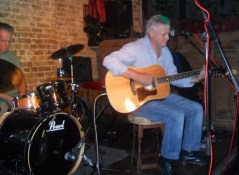
John_paradiseFollowing ZoZo, I get up on stage and sing two of my own compositions, for the second of which I’m backed by the excellent house band comprising Nick Harrison on drums, Tommy on lead guitar, and Patrick on bass. A wonderful, uplifting experience! These guys are so good and so modest!

One final observation: if you want to witness a truly multicultural environment, come to Paradise. The rich ethnic diversity of North Kensington is present in all its glory, and it is a tribute to Wade and Wills and to all who contribute to the evening that absolute interracial harmony prevails. They deserve a bloody award for the marvellous example they set!

So, if you’re looking for a really good night’s entertainment and you like live music, then make a point of visiting The Island Experiment at Paradise with your partner or friends or simply on your own: you will not regret it, I guarantee!

If you want to contact Wade, you can do so at wade_bayliss@hotmail.com. You can also learn more about ZoZo at www.zozoofficial.com.

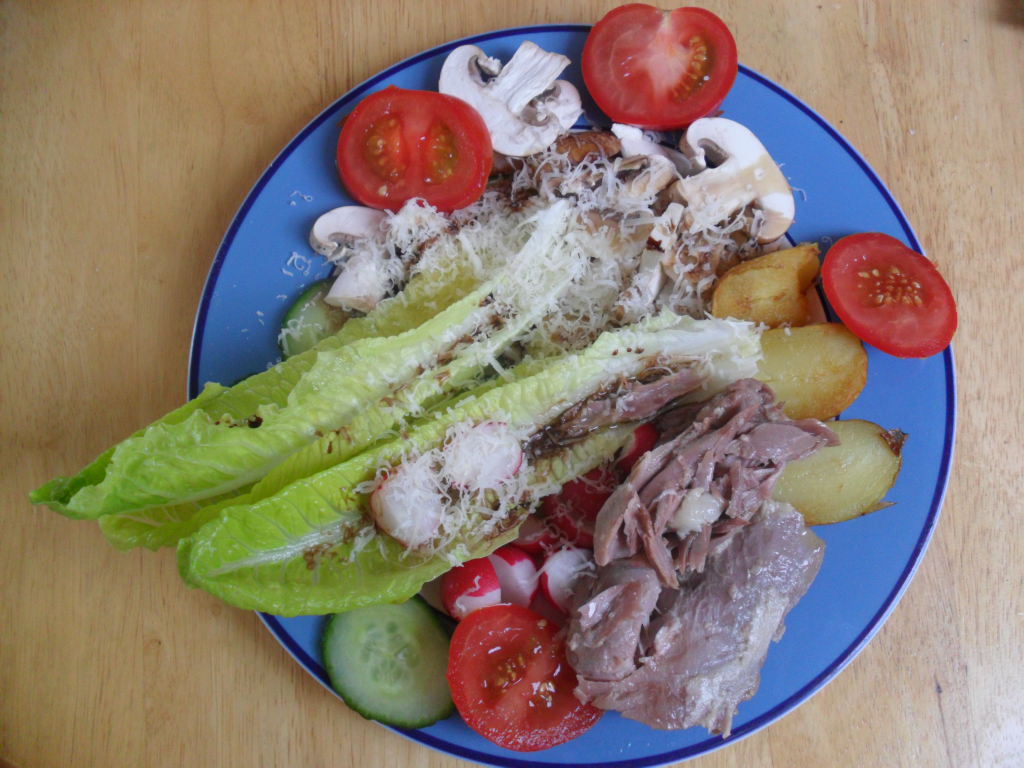
So, is he a healthy eater? Lunch on a plate!

See for yourselves! On the plate (as illustrated):salad

1.5 new potatoes
5 fresh radishes
3.5 cm of cucumber, sliced
3 chestnut mushrooms, raw and thinly sliced
1 salad tomato
6 small Romaine lettuce leaves
1 confit duck leg, skinned and boned
All this topped with finely grated Manchego cheese, and drizzled with a fine balsamic vinegar and Spanish extra virgin olive oil.
Salt and pepper.

So what do you think? Our blogsworth has always found that when the heart is under tremendous emotional stress (you have no idea!), the heart requires the utmost dietary care, and he applies this knowledge meticulously.

Keep on pumping!

Click on image for mouth-watering enlargement!

Julio Cortázar, a poem from Salvo el crepúsculo [But for the twilight] (1984)

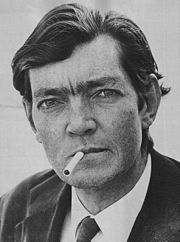
CortázarKnown as one of the most accomplished prose writers of the so-called Latin American Boom in fiction, Julio Cortázar was also a consummate poet. The poem translated below is taken from the last of his works to be published during his lifetime. Born in the Argentinian embassy in Brussels in 1926, Cortázar lived for most of his adult life in Paris, though he never lost his close identification with his homeland nor with Latin America in general. Famous for his wit and humour in his novels and short stories, Cortázar’s lyrical voice is endlessly inventive.

If I have to live

If I have to live without you, let it be hard and bloody,
the soup cold, my shoes tattered, or that in the midst of opulence
let the dry branch of the cough rise up, barking out to me
your misshapen name, a foam of vowels, tearing at my sheets
with its fingers, so that nothing brings me peace.
Not even from that will I learn to love you more,
but cast out from happiness
I’ll know how much joy you once gave me just by being near.
I believe I understand this, but I’m wrong:
it will require frost on the lintel
for the person sheltering in the doorway to understand
the light in the dining room, the milk-white tablecloths and the smell
of the bread thrusting its brown hand through the slit.

So far from you now
as one eye from the other,
from this assumed adversity
the look you deserve will finally be born.

Carlos Martínez Rivas

CMRI first met the Nicaraguan poet Carlos Martínez Rivas in San José, Costa Rica, in January 1977. I had just arrived in the country from Nicaragua where I had spent some weeks in the commune run by Ernesto Cardenal on the island of Solentiname in the south of Lake Nicaragua.

Carlos was staying as an unpaid guest at the Sheraton Hotel. He had little money but his prestige as a poet was such that the hotel chain felt honoured to house him.

I showed Carlos some of the poetry I had been writing in English and we became friends immediately. It was mid-morning and Carlos wanted to give me a copy of the only book of poetry he ever published, La insurrección solitaria [The solitary insurrection] but since he had no copies he invited me to accompany him on the long walk from his hotel to the offices of EDUCA, the university publisher located on the campus of the University of Costa Rica. It was a long walk under a gorgeous blue sky and Carlos was delightful company. His only advice to a young poet was to always carry a pen and notebook. He asked after many of his friends whom I had just met in Nicaragua. He had an acute intelligence and piercing blue eyes which were nevertheless very gentle when he spoke of people.

When we got to the offices of EDUCA, Carlos asked for a copy of his book in which he then wrote a long dedication to me to record our meeting. I felt very honoured to be addressed as a poet by such a brilliant master. The greatest, ultimately unrequited love of Carlos’s life had been the Costa Rican poet, Eunice Odio, and many of the poems in his book were inspired directly or indirectly by her, in particular a poem entitled “La puesta en el sepulcro” [The placing of Christ in the sepulchre].

I saw Carlos on several occasions during the week I spent in San José. And in 1983, while attending a solidarity conference in Managua, I called in at his house and invited him out to a restaurant. He was still a penniless poet and his home was quite spartan. There was a large trunk in the living room which when he lifted the lid revealed a mass of papers: there was all his unpublished poetry, virtually a lifetime’s work.

At the restaurant Carlos insisted on ordering the cheapest meal, a spaghetti with a basic sauce, but he thoroughly enjoyed himself with our conversation and with flirting with all the young waitresses who clearly adored him. On this occasion he also dedicated a new edition of his only book to me and I have kept both copies with pride.


Cecília Meireles

meireles

For the Brazilian poet, Cecília Meireles, the writing of poetry was not so much a vocation or a trade nor even a compulsion. Her poetic voice was as much a part of her nature as singing is to the cicada. Recognised as one of the most important poets writing in Portuguese, she also painted and was an inspiring teacher

Acceptance

It’s easier to rest your ears amongst the clouds
and hear the passing of the stars
than to press them to the ground and catch the sound of your steps.

It’s easier, too, to cast your eyes upon the ocean
and to observe, there in the depths, the silent birth of shapes,
than to hope to appear to be creating with simple gestures
signs of eternal hope.

Neither the stars, nor sea-shapes, nor you, interest me any more.

Over time I’ve developed my song:
I don’t envy the cicadas: I too shall die from singing.

*
Motive

I sing because the instant exists
and my life’s complete.
I’m neither happy nor sad:
I’m a poet.

A sibling to all things fleeting,
I feel neither pleasure nor torment.
I drift through nights and days
on the wind.

Whether I destroy or construct,
whether I’ll last or fall apart
— I don’t, I don’t know. I don’t know
whether I’m here to stay or passing through.

I know I sing. And song is everything.
The rhythmic wing pulses with eternal blood.
And one day I know I’ll be mute:
— nothing more.

Cecília Meireles (1901-1964)