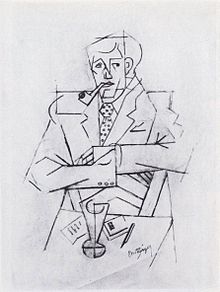
Gustave Metzger – Homage to the Starving Poet

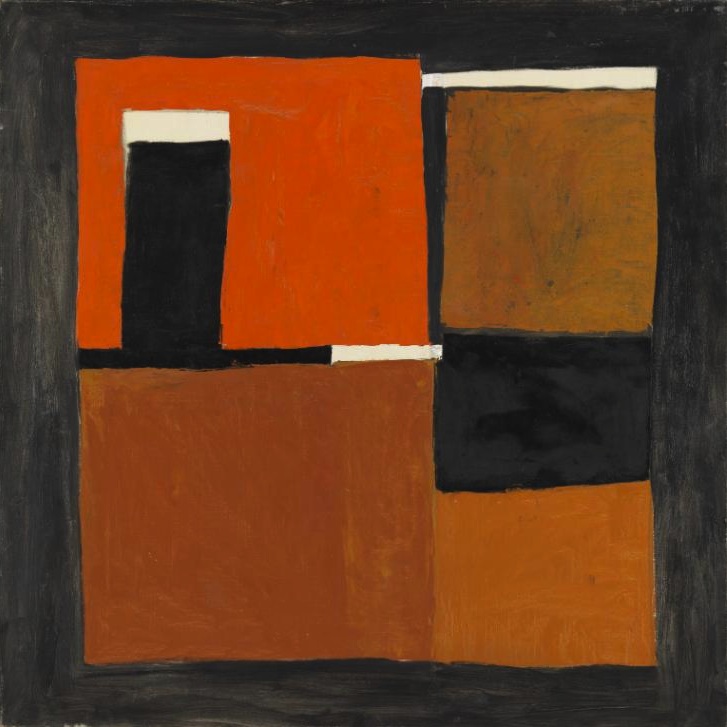
Homage to the Starving Poet, 1951 (oil on canvas)

Homage to the Starving Poet 1951 Gustav Metzger born 1926 Lent from a private collection 2015 http://www.tate.org.uk/art/work/L03660


Gustav Metzger was born in 1926 in Nuremberg. His parents were orthodox Jews, and nearly all his relatives were murdered by the Nazis during the Second World War. He was saved by the Refugee Children Movement in 1939 and brought to England. Twenty years later he gave his first individual exhibition entitled Three Paintings by G. Metzger in a London café. Metzger performed his famous Liquid Crystal Projections in the 1960s at concerts of the bands The Cream and The Move in London. His lectures inspired Pete Townshend to smash his guitar on stage. Yoko Ono is among his admirers.

Gustav_MetzgerA founder member of the Committee of 100, led by the philosopher Bertrand Russell, and which was dedicated to opposing nuclear war and weapons of mass destruction, Metzger took part in demonstrations and was on one occasion sent to prison in Staffordshire for one month. He has cited William Blake as a life-long influence on his art.

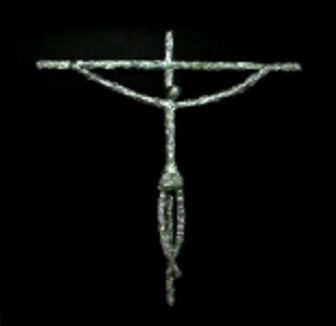
Although dedicated to ‘the starving poet’, the three disintegrating figures in Metzger’s deliberately sub-fusc triangular composition (reproduced above) were perhaps inspired by the Crucifixion scene in the Isenheim Altarpiece, painted by the German Renaissance painter, Matthias Grünewald (1470–1528).

I could be wrong, but why leave it to me? Why not head along to Tate Britain in Pimlico and see for yourself!

Jonah hits memory lane

Trials and tribulations

You might think it’s easy running a daily blog, but spare a thought. Some poor devil has to find new material every 24 hours to fill the void. So the blog duty editor is on call Friday night and there’s nothing for the Saturday edition. He’s searched the files high and low and there’s nothing he can use. But just as he’s about to despair, in a cupboard close to where they keep the bleach and other cleaning fluids, he comes across a plastic bag full of mouldy old papers and he takes a look and he discovers a couple of typed sheets with the heading “Jonah hits memory lane”. Someone has used a red felt tip pen to scrawl B-I-N in huge letters across both pages. Nevertheless, he starts to read the piece and only a few seconds in, thinks to himself, God, this is real drivel, I’ll never get away with putting this online, the boss’ll sack me the moment he sobers up on Monday morning. Still, beggars can’t be choosers, so he puts the sheets to one side and continues to hunt for material. About three hours later, he’s still looking and getting more and more exasperated; he’s found absolutely nothing and what’s left of his mind has gone completely blank. He picks up the Jonah story and thinks, Well maybe a change would be good for me. New job, new faces. . . you never know! And he takes the plunge! But you have been warned and you may well want to skip this post.


Jonah hits memory lane

JonahWhale
Jonah gets his comeuppance

Jonah is sitting at a desk in the Humanities 1 Reading Room of the British Library, gazing at the spring sunshine streaming through the dusty transom windows and scratching his head. At fifty-eight he still has a good head of hair, but if he keeps on scratching he’s going to wear a patch in it. Next to his beaten-up laptop is a copy of Murphy, Samuel Beckett’s first novel, published in 1938. To his right, an elderly Indian woman has just put down a book called Astrology, why I believe. Jonah smiles to himself. Personally he’s not a believer. Coming up on the train from Dartford, out of idle curiosity he’d looked at the stars in the Metro free newspaper. Jonah is a Sagittarian by birth, a merchant seaman (retired) by trade, an agnostic by nature, and spent almost half his adult life overseas. But he’s been back in London for the past eighteen months having barely survived his most recent shipwreck off the coast of Brazil.

Just outside London Bridge Station he’d noticed that someone had painted #surviville in huge bright green letters on the walls of a rooftop, and that was just about how he felt now he was back in London, a survivor. However, his stars for that day couldn’t have been more confusing. His horoscope read as follows:

You may be suffering from some major delusion, so watch your step and if the going gets too rough, seek professional help pronto. On the other hand you could be on the brink of a financial or emotional breakthrough, so whatever project you have on the go, money or romance, don’t give up too soon, hang in there at least till the fat lady starts to sing.

Fat lady, indeed, Jonah muttered to himself. He’d never liked opera, never would! Without ceremony, he’d screwed the newspaper up into a ball and tossed it into the bin.

*

Then there was Anna-Belle. Son-of-a-bitch! Anna-Belle O’Malley! He hadn’t stopped thinking about her since the previous day in Old Bexley. Anna-Belle O’Malley, after all those years. What goes around comes around, he chuckled to himself. He hadn’t been down to the medieval village of Old Bexley in decades, but reckoned it was high time he made his peace with his kid brother, Malachy. Malachy could be a bit tetchy, he being of the quick to anger, slow to forgive type, and they’d almost come to blows the last time they met ten years ago, so you can understand Jonah being a bit wary. Which explains why, upon leaving the railway station in the village he’d decided to pop into the old King’s Head for a couple of pints, to steady his nerves.

pub_kings_head_bexleyIt was just after midday. A laconic sun hung lazily in the sky and a chill wind was blowing up from the south. Anyway, Jonah pushed open the door to the saloon bar and there she was in her vintage Laura Ashley pinafore dress, sitting all alone like a displaced duchess, in the alcove by the fake leaded window, deeply engrossed in a paperback as thick as a brick. She had a gin and tonic on the go which looked as though she’d barely touched it. But maybe it’s not her first, Jonah thought, she’s never been averse to the odd tipple. He’d recognised her immediately. The unforgettable autumnal hues of her bubble-cut hair, cute curls framing a cute little face. And to cap it all, the old dear was even wearing a pair of sensible pumps, just visible under the table. Gone were the days, so it seemed, of stilettos that could pierce a man’s heart!

*

First time Jonah had ever really got to know Anna-Belle was about four decades ago in the Freemantle, a large function hall little more than a llama spit from the King’s Head. It was an eighteenth for one of Paddy Delaney’s girls, Julie or Josephine or Jennifer, or Jane. . . what the hell. . . and there she was, Anna-Belle O’Malley, herself just turned sweet sixteen. How well he remembered that do!

In those days Anna-Belle was one of God’s greatest creations, a little wisp of Jewish thrown in with the usual Anglo-Irish mix, had created something of a blueprint for female beauty. Petite at five foot two out of her plimsolls, she had the sort of endearingly deep ocean blue eyes you could drown in for hours, as long as there was oxygen in your tanks. And she was perky. Boy she had attitude and devilment all rolled into one: in short, she was fun!

That night there’d been a long line of lads snaking out the door waiting to say hello to her and get on her dance card, and her brother Jeremy was puffing and panting, barely able to keep order amongst them. But Jonah didn’t wait in line; he just sauntered up to her, cock-of-the-walk, took her pale lily-white hand into his own, and bent over and whispered “Pleasure,” in her ear. She gave him a cold, hard smile, whispered something like “bastard” under her breath and directed the daggers of her eyes at Jeremy, as if to say: “For the love of God, can you get rid of this creep!”

But she and Jonah, they’d had a history, a secret history. And that first meeting was not, truth be known, the first; nor was it the last, no sir. Now after all those years and the separate lives they’d led, there she was again. Anna-Belle O’Malley. Jonah ordered his pint and when it was ready he sidled over to her table with a sneaky grin on his face.

“Mind if I join you, ma’am?”
“’S a free country,” she said, not taking her eyes from her novel.
Jonah caught the title. She was reading War and Peace!
“You don’t remember me, do you?”
She raised her frosty eyes and examined his features closely, hesitated, and then it hit her.
“Jonah,” she said, “Jesus Christ, Jonah, what the. . . !”
And her mouth dropped and she said nothing else.
“Damn right,” he said, “been a long time, Anna-Belle. Too long?”
She caught the hint but did not react: picking up her glass, she took a gulp of her gin and tonic, spluttered some of it over her novel and set the glass down again, before slowly running her tongue over her lips. Jonah admired her small trembling hands and the manicured nails as she did so.
“Too long,” he said again. “So good to see you. How you been?”
“O,” she said cautiously, “I been. You?”
“O I been too. I been, all right. Plenty to tell if you have the time.”
And he paused and looked her over again. And they both just sat staring into each other’s eyes like two dredgers working the Thames and let the silence and dust of all those years wash over them.
“You’re looking so well,” Jonah said eventually. “By God, all those years and you’re looking so damn well.”
“Diet,” she said. “Melon and salad, and the odd bagel from time to time, can’t beat it. Plus I keep myself busy. Hard work, you ever heard of that?”
But for the merest flicker of a smile, Jonah let the shot pass over his bow without rising to the bait. Sharpest tack in the box as always, he thought to himself. Some things change, some people don’t. And she ain’t changed.
“Still teaching dance?”
“Aha.”
Jonah raised his glass in a toast.
“Well, here’s to you, babe. Anna-Belle O’Malley, son-of-a bitch. Here’s to you. No, here’s to us and to God knows what the future holds. Son-of-a-bitch!”

Editor’s note: This is not to be continued, under any circumstances.

Blue Beads at Tate Britain

J. D. Fergusson, Blue Beads, Paris 1910 (oil on board)

Fergusson_Blue-Beads


J. D. Fergusson (1874–1961) was a Scottish landscape and figure painter and sculptor. Initially he entered Edinburgh University to study medicine but then decided to take up art. He was greatly influenced by the French painter, Manet, though this does not explain why he married a dancer, Margaret Morris: or maybe it does.

What fascinates me about this painting is the manner in which the artist has transformed the portrait of the woman into a landscape, with different sections of the figure being divided as though into different fields with different crops. Simultaneously, it has the effect of transforming the landscape into a female figure, thereby underlining the intimate relationship we all share with the land, the land that feeds us and which will welcome us back at the end of our lives.

Ashes to ashes, clay to clay: we are starlight and we are mineral earth, and we are the consciousness of creation. All of this Fergusson has rendered with the simplicity and the breathtaking beauty of his palette and brush strokes.

So much more could be said about the detail of this painting but sometimes less is more!


No photo can do justice to this marvellous work of art, so don’t delay. Hurry along to TATE BRITAIN in Pimlico at the earliest opportunity to see it for yourself! And yes, don’t ask, I’d love to have this masterpiece on my wall!


Hey good looking, what you got cooking. . . ?

How about cooking something up for me?
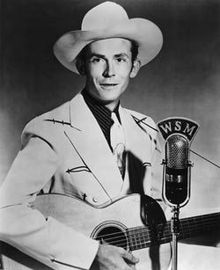
Hank Williams
Hank Williams

To the immortal words of Hank Williams’ unforgettable song, our old sea-dog Jonah decides he’s going to share one of his culinary secrets. How come these old timers in Central America, who don’t have two beans to rub together, live to the ripe old age of 90 or more? The answer is diet, and hard work. You all know the saying, “Hard work never killed anyone.” The fact is that hard work saves more lives than it kills, way more!

So what about diet? What do the peasants in Nicaragua and Costa Rica have for breakfast, lunch and dinner? The answer is gallo pinto: a basic mixture of rice and black beans fried together with a little garlic, onion, salt and pepper. Eat it with maize tortillas, an egg (fried or omelette), or maybe a little meat (not too much) or on its own with plenty of chile sauce and you’re away. Live forever!

So how’s it done?

You need to cook your rice and your beans separately and remember that for gallo pinto they will be mixed 50/50 so I won’t give precise weights. Once the beans are cooked you drain off the liquid and let the beans dry.

Then in a large frying pan you fry a little minced garlic with a little finely chopped onion in a generous dose of good oil (sunflower or extra virgin), adding a little salt and pepper to taste. Once the onions are soft you slowly add the beans on a moderate heat. After a minute or two, you add a similar portion of rice and with the heat still low you stir the contents of the pan, noting how the beans and the rice are getting drier all the time. As the moisture begins to evaporate, the rice will take on a reddish hue having absorbed some of the colour from the beans. What this translates into is flavour. You now need to reduce the heat as low as possible so that the mixture continues to dry out, taking care, however not to burn it. Believe me, the mixture of rice and beans in gallo pinto is a marriage made in heaven!

Gallo pinto is often served with sliced fried plantain (either sweet, when skin is yellow, or savoury, when skin is green). Eggs, meat, tortillas are all optional extras. The beauty of this dish, apart from its simplicity and divine taste, is that it delivers in a very simple format, all the protein and carbohydrate you’re going to need if you intend to do a hard day’s work. And there’s an added bonus. By taking your main protein shot from pulses rather than from meat, you’re actually helping to save the planet. So go for it!
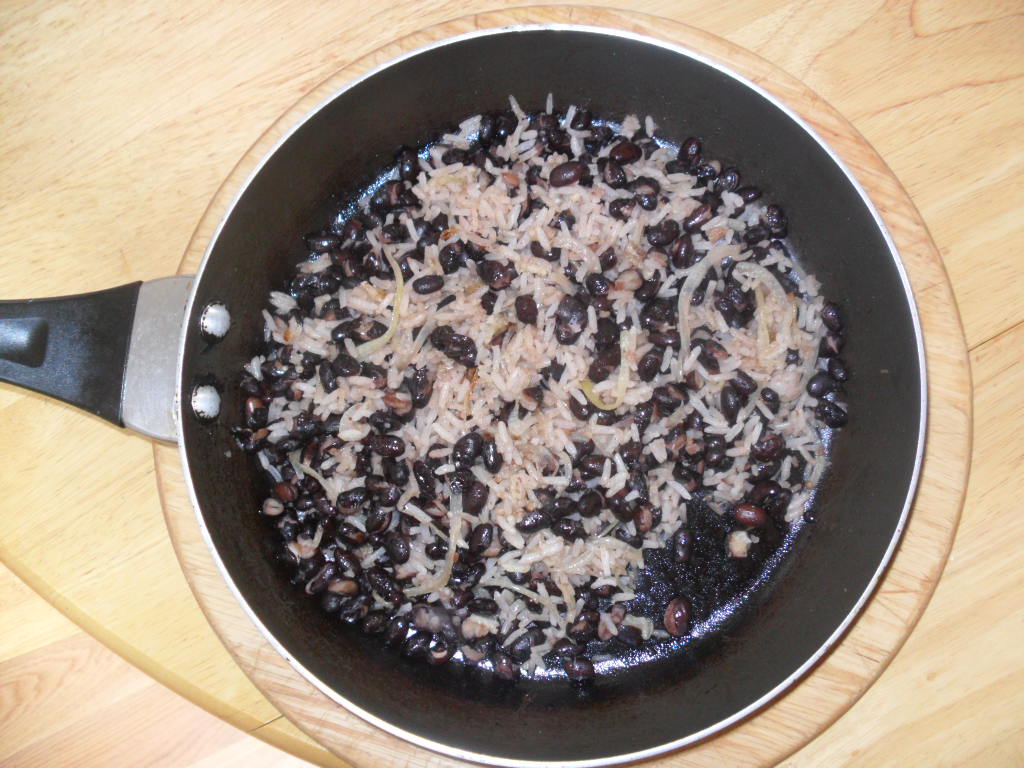

gallo pinto
gallo pinto Jonah made for lunch today

Ingredients
Black beans
Cooked rice
Clove or two of minced garlic
Half onion finely chopped
Cooking oil
Salt
Pepper

Final point. Keep the leftover gallo pinto in an airtight container in the fridge. When next required gently warm through. You’ll find that with every warm-up, the mixture will get drier, the rice and beans will eventually become crunchy and you will cross the taste barrier into ecstasy. By the way gallo pinto means spotted rooster in Spanish.

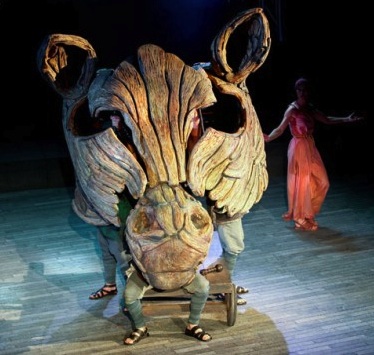
Women of Troy

scoopOff this evening to The Scoop open-air theatre, close to London Bridge, to see Lisa Kuma’s adaptation of three of Euripides’ plays, which she conflates into a single narrative, entitled Women of Troy. The story is familiar: Paris (son of Priam, ruler of Troy and his wife, Hecuba) abducts Helen, wife of Menelaus. Agamemnon, the Greek king and brother of Menelaus, raises an army and is ready to sail to Troy to rescue Helen but before the gods will grant wind for his sails, he is required to sacrifice his beloved daughter Iphigenia. So with the Greek fleet stalled in the harbour and the Greek army becoming increasingly restless, almost to the point of rebellion, Agamemnon beseeches his daughter Iphigenia to accept the glory of sacrifice for the good of her nation. After many tears, she finally concedes to her father’s wishes, much to the despair and anger of her mother Clytemnestra.

Trojan horseThe first act ends with Iphigenia’s death. The second act begins with the Fall of Troy, showing the moment the Greek army emerges within the city walls from the belly of the wooden horse (pictured). Thereafter, the focus is on the fate of Helen, who has been released from supposed captivity, and the women of Troy.

For some reason, I found the performances of the actors playing the leading female characters considerably more convincing than those playing the principal male roles. Agamemnon, for example, supposedly the most powerful man in Greece, lacked any real presence and his phrasing seemed laboured and rather expressionless. Equally, there was little palpable anger in the performance of Menelaus, who had, after all, been cuckolded by his wife and made a laughing stock throughout the region. Achilles, too, failed to express any real passion. On the other hand, all the women were utterly engaging. It’s difficult to know who was responsible for this divergence since the challenges of performing in an open-air venue were the same for both sexes.

Despite this criticism, for those unfamiliar with the work of Euripides, the evening certainly represented a valiant and valuable introduction, and all the actors are to be applauded for that. Lisa Kuma’s text managed to maintain a fine balance between a colloquial tone that could be readily appreciated by a modern audience, and a more serious discourse that retained some of the dramatic poetry and power of the original lines. The performance was staged as part of the More London Free Festival.


Cast
Achilles – Eddie Eyre
Agamemnon – Phil Willmott
Andromache – Jasmeen James
Clytemnestra – Penelope Day
Hecuba – Ursula Mohan
Helen – Emily Sitch
Iphigenia – Hannah Kerin
Menelaus – Joseph O’Malley

The fault, dear Brutus, is not in our stars. . .

Wat_Tyler_pubSo Jonah the ancient mariner, who’s been marinating on dry land for the past two years, has his kid sister over for lunch and to give her a good “chin-up” talking to. Duck confit with salad (urrrrgh!). Salad’s on account of the extra kilos that living on dry land has saddled around his equator. Grin and bear, and no beer for a month, at least. He’s lost 2 kilos already, and dropped one belt size with just one more to go before bingo!

Anyway, being of a literary disposition, before the sister arrives he’s been reading Julius Caesar and he’s reached that famous line about the stars and thinks: “So, verrry interesting! Against the prevailing mood of the times, friend William did not believe in astrology either, and he was a genius.”

His reading at this point is interrupted by a knock at the door, and lo and behold, there she is, in all her glory. Turns out she’s on a calorie count too, and looking good, so they’re all square for lunch; and what ensues is a real heart to heart with a few detours into the memory lanes of happy days.

Following lunch there’s coffee, and more talk before he accompanies her down to the railway track. After waving goodbye, he takes a train in the opposite direction, heading for the partially walled medieval town of Dartford, famous for the old Wat Tyler pub (pictured above) and the 1381 Peasants’ Revolt. His mission there, you guessed, is to replenish his stock of sundry salad stuffs!

But isn’t life funny! As fate would have it, he no sooner steps onto the train and takes a seat when he spies with one little eye on the seat opposite him, a copy of the Metro free newspaper, open at the astrological page. Some bright spark has even gone to the trouble of taking a biro to draw a box around the day’s star for Sagittarius. Shakespeare’s immortal line comes roaring back into Jonah’s brain. “I don’t believe it,” he mutters under his breath, “I really don’t believe it!” Nevertheless, curiosity gets the better and he picks up the paper and reads the following:


sagitA bona fide break is what you really need, Archer—not another cocktail party or night on the town. Today’s sleepy twelfth house moon forms a tough square with agitator Mars, interrupting your need for rest! Those tempting offers will keep rolling in, but if you keep saying “yes” you’ll simply be too burnt out to actually enjoy them! Respect your limits and take a rain check. You may also need to set a high-maintenance energy vampire straight today. Establishing and enforcing boundaries will be a sanity-saver. Trust us.

“Whoah,” Jonah wonders, scratching his head, “who the hell is us?” He has plans that evening to attend a performance of Euripedes’ Women of Troy at The Scoop open air theatre by London Bridge, in the company of the apostles Peter and Paul, and he’ll be damned if he’s going to miss it on account of a load of tosh! “Your need for a rest? Poppycock! Balderdash! Nonsense! Tripe!”

Tonight you will be with me in Paradise

wade_blogNo, not the words spoken by Christ to the good thief as they were crucified side by side on Calvary. Tonight you will be with me in Paradise, if you accept the invitation, on a Wednesday evening around 8 p.m. to travel to the Paradise pub on Kilburn Lane, Kensal Green, just 100 yards up from the Ladbroke Grove – Harrow Road junction. It’s here that Wade Bayliss (pictured left) hosts the Island Experiment, London’s premier open mic venue.

Wade, a singer, musician and filmmaker, describes himself as a non-trepreneur, but he’s someone who makes things happen. He runs events, he’s working with the London Coffee Festival at the moment, and he plays and sings with the Island Experiment band and he’s been hosting open mics in the capital for seven years, the last two at Paradise, a venue he inaugurated. Every Wednesday evening musicians from far and wide come together at the Island Experiment and perform two or three songs, usually their own compositions, to a large, highly appreciative audience. What sets this open mic evening apart and makes it so special is the care and respect with which Wade and his co-host Wills treat the musicians who are performing. It doesn’t matter whether the individual is a complete novice or a hardened professional, every performer is introduced with great courtesy and every musical contribution is valued and warmly received.

So it being Wednesday evening, as it was last night, I pick up my Gibson acoustic and head off to Paradise. Prior to going on stage, however, I take the opportunity to talk to Wade, anxious to learn a little more about what drove him to set up The Island Experiment at Paradise. He’s an unassuming man, but he replies quite forcefully: “In a city so dominated by the banking economy, which is driving rents up and forcing more and more artists to abandon their art, because of the need to take full time employment just to survive, Londoners need the sort of opportunity provided by the Island Experiment at Paradise. It’s so easy for musicians to fall out of their musicality and when that happens it’s a great personal loss and a loss for us all.” Then he’s off, a bundle of energy, bounding onto the stage to introduce a new act or to thank a performer who has just finished. Incidentally, he has his own Jimmy Page story, so ask him when you go there!

The venue itself is an upstairs function room in the Victorian pub which has retained almost all of its old world charm. There’s a good-sized stage and a sound system which is always expertly managed; and at the back of the room a bar. The walls, with their ageing wallpaper, are oddly decorated with forty or more framed pictures of the Sacred Heart, of St Teresa of Avila or Lisieux, and many other devout images, which combined with the low lighting creates an atmosphere worthy of a true musical sanctuary, but believe me, the place can rock and it can roll depending on who is performing.

ZoZo_Blog1Before I go on stage I sit and listen to the gentle but firm voice of ZoZo (pictured right), a 23 year-old student at the Institute of Contemporary Music Performance who accompanies herself on guitar for two of her own songs. In the third year of her song writing degree, she has already established a calm stage presence which is bolstered by her highly attractive face paint. Later she tells me that she also has a penchant for wearing odd shoes. Born in Scotland and brought up in Spain, ZoZo speaks Spanish and Catalan and if you want to catch her, she’s usually at Paradise a couple of Wednesdays per month, and she is a genuine talent.

John_paradiseFollowing ZoZo, I get up on stage and sing two of my own compositions, for the second of which I’m backed by the excellent house band comprising Nick Harrison on drums, Tommy on lead guitar, and Patrick on bass. A wonderful, uplifting experience! These guys are so good and so modest!

One final observation: if you want to witness a truly multicultural environment, come to Paradise. The rich ethnic diversity of North Kensington is present in all its glory, and it is a tribute to Wade and Wills and to all who contribute to the evening that absolute interracial harmony prevails. They deserve a bloody award for the marvellous example they set!

So, if you’re looking for a really good night’s entertainment and you like live music, then make a point of visiting The Island Experiment at Paradise with your partner or friends or simply on your own: you will not regret it, I guarantee!

If you want to contact Wade, you can do so at wade_bayliss@hotmail.com. You can also learn more about ZoZo at www.zozoofficial.com.

So is it a blog or a blag?

William Scott, Orange, Black and White Composition, 1953 (oil on canvas)

OBW_Scott

Bit of both, really. See I’m no art expert, have no training in the field and know little more than the next man or woman. But I use my eyes and I like to look. So what do my eyes tell me about William Scott’s Orange, Black and White Composition which hangs in the Tate Britain gallery in Pimlico? Well, loads. Firstly there are no squiggles, it’s all straight lines, all geometric but in a haphazard way: the square angles are not perfect 90 degrees and the lines are not drawn with a ruler. As there is nothing curved, nothing circular, the initial impression is one of hardness rather than softness.

And what about the restricted palette, just three colours? What does the lack of bright colours, the lack of pastels, for example, what does that tell us? In fact the colours are all muddy, earthy, iron and coal sort of colours.

Do we have to like a painting in order to appreciate it? I think not. We can find it interesting; we can enter into a dialogue with it, but not necessarily find it beautiful. However, it may tell us more about ourselves than we imagine if we look hard enough, and its beauty may slowly emerge. If we dismiss it out of hand that may be our loss. First of all the painting is a product and represents the cumulative effect of many decisions, many thought processes and yes, many emotions. It’s too easy to say, “Don’t like it,” when it hangs in a gallery crowded with other paintings that on the surface are far more attractive.

Whenever we see a frame we peer into its contents as though it were a window or mirror. Not all mirrors have shiny silvery surfaces. Hamlet, for example, holds a mirror up to his soul when he asks the old chestnut, and we call that a soliloquy, but in the plastic arts, paintings are soliloquies too! It’s all questions, questions, questions, and sometimes, but rarely. . . answers. Art is consciousness directed into an expressive form, shape, contour; it is a process of inclusion and exclusion, of affirmation, and a rejection of denial. Scott’s composition is essentially a frame with a view and with no view, a view of no view; it is opaque, there’s nothing to see, except perhaps what we see within ourselves as we observe it. Nothing really representational. It is abstract but the shapes are real and familiar. Personally, I find the painting endearing, the textures and the planes are an invitation that draws me in, perhaps to an inner landscape: hardness gives way to softness, and the simplicity with which he handles three colours is, to me, a virtuoso performance. So there!

Said enough? On your bike, sonny Jim? Stick to what you supposedly know? Blaggard?


scott_portraitWilliam Scott (1913-1989) one of seven children, was born in the Scottish port of Greenock. In her brief study of Scott’s art, Sarah Whitfield writes: ‘His parents lived in a small flat at the top of the tall granite tenement near the quay. And it was there he spent his early childhood. He never forgot the grim aspect of those impoverished surroundings. Scott himself wrote: “There were lots of bridges and tunnels, stations and steps, stone bridges you went over and iron bridges you went under – bits of ground between streets that had never been built on growing nettles.”’ When he was eleven years old the family moved to Enniskillen in Co. Fermanagh, by the banks of Lough Erne.

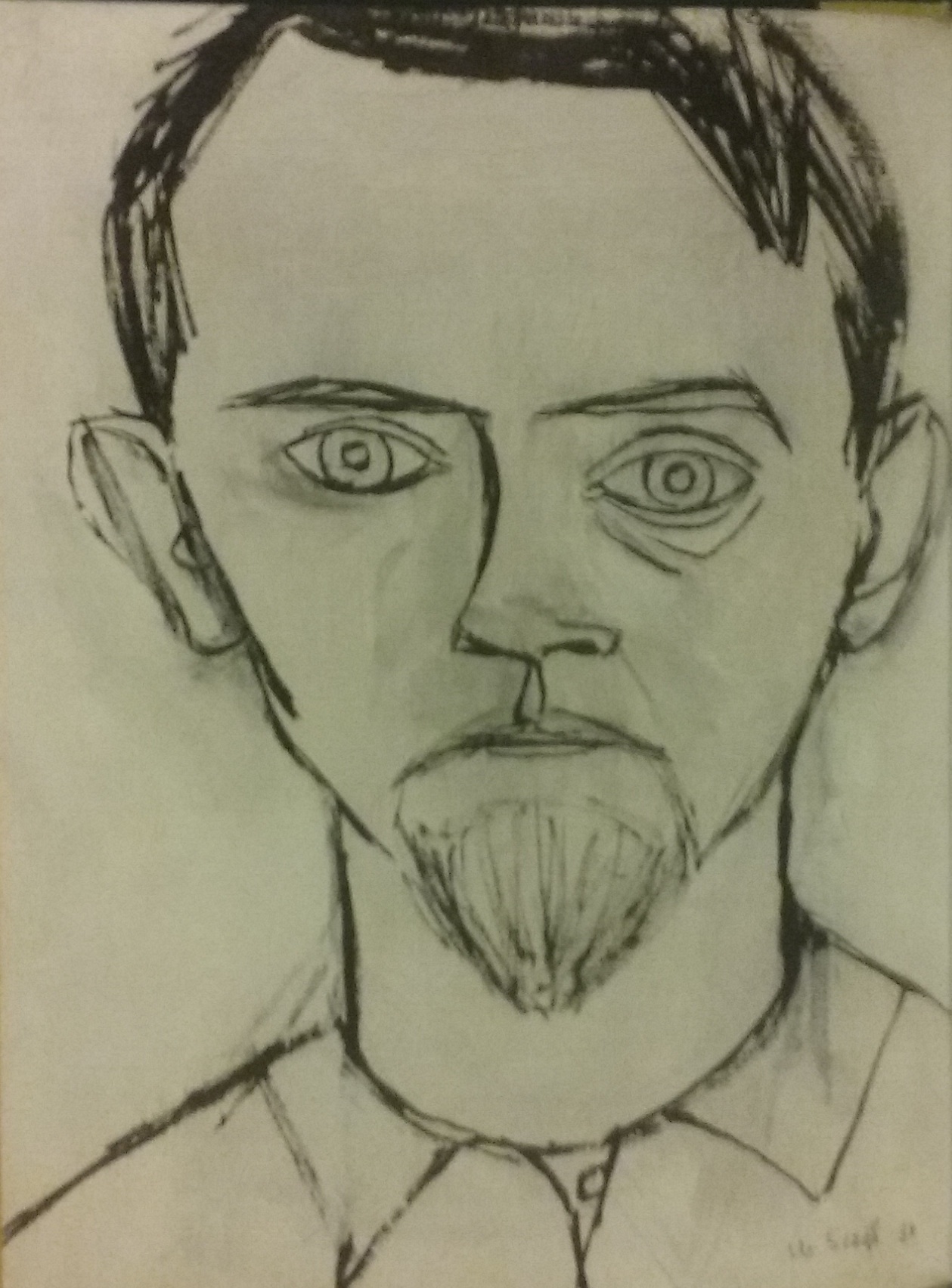
In the mid 1950s, Scott (pictured right in his self-portrait) criticized hard-edged abstract art as ‘too smartly done, too beautifully done, too tasteful, too perfect. . . so well done one loses a sense of humanity about it.’ He also spoke of his belief in ‘the beauty of things badly done’. Whitfield again: ‘His disregard for perfection also allowed him to stay nearer to the messy vitality of life, to keep hold of the struggle and tension that had gone into the making of a composition.’

A trip to the dentist – and all that involves

bomb damage

I breeze into the Science Museum this morning at around 10.30 and a pretty girl in a blue blouse at the desk where they ask you if you want to make a donation asks me if I’d like to make a donation. I reply, without breaking my stride or slowing in the slightest “Not at the moment.” And I walk on into the heart of the museum, have a quick look at some steam engines and space rockets and then ask one of the staff for directions to the nearest male toilet.

Much relieved, I then exit the museum and make my way to Imperial College Dental Centre, which as anyone who knows will know is round the corner from the museum in Prince’s Gate. Check in there, fill in the form and discover I’m thirty minutes too early for my appointment. So I head back out and re-enter the Science Museum.

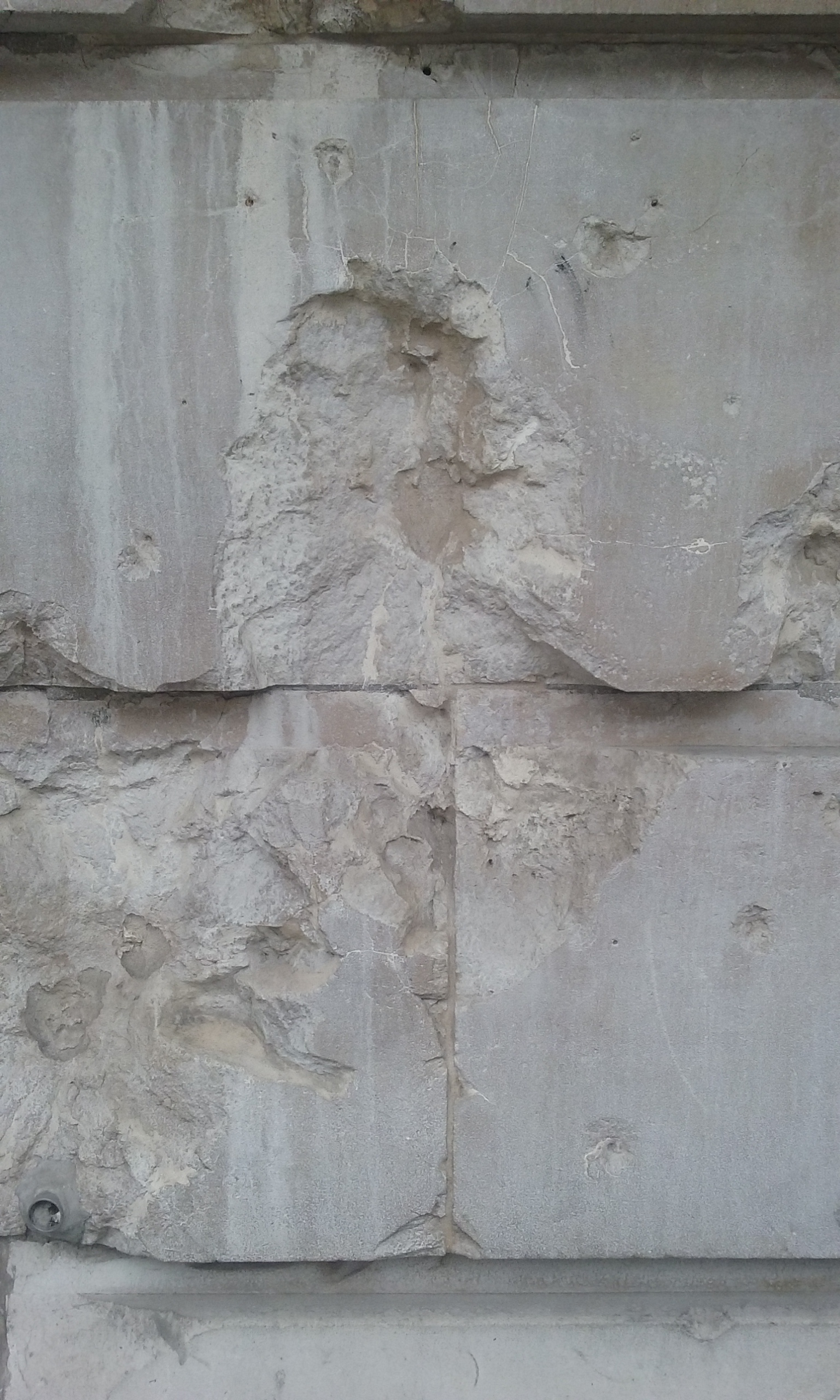
On the main door I ask if anyone knows about bomb damage to the building during WW2. I’m advised to ask at Information, so I go back inside and there’s a huge queue, which I jump, and there’s the same girl, 5’ 2”, bright red hair, big smile, possibly 27, and she asks me to wait. I say, “I’m not in line because I’ve been sent to ask a question at Information.” She looks at me and says “You’re that guy who just breezed past me earlier this morning without stopping. I thought you must be someone important.” I smile at her as if to say “Dead right, sister, I’m a man on a mission,” and I ask where she’s from. “Italy,” she says proudly and with an even bigger smile. “What’s your name?” I say and she says “Katia.” “Very nice,” I say, and smile back at her before moving on through to Information where I ask my question about bomb damage, and still no one knows the answer, but I’m advised to return in 30 minutes. “Right,” I say, and I return to Katia, interrupt her talking to a couple with young children, give her another smile and say “I’m a scientist. I’m looking for information and I’ll be back.” She says “Great.”

So off back to the dental surgery, and as this is my first visit I’m surprised to see that the dentist treating me is called Dr John. I say, “That’s my name too, what a coincidence.” But as both she and her assistant have pronounced my surname, Lyons, as though I was French and from Lyon I am slightly taken aback. Nevertheless, this is South Kensington so I don’t get annoyed but I ask if they were born in this country. The dentist, yes, her assistant, a blonde girl turns out is from Lithuania. So I say to the dentist, “She’s excused, but really, you should have known, it’s not that difficult.” “Yes, but we treat a lot of French people here,” she says. Smiles all round. The dentist is very pretty, auburn hair, about 27 years old, and 5’ 2” in height. Her assistant about the same. I think to myself, “What is this? How come they’re all 5’ 2” today?”

Long story short. X-ray fine, teeth fine, just a little cleaning with the ultrasound and I’m out of there. And back to the Science Museum. But now I’m out of luck. Katia is no longer at her position, she’s on her break. I was going to ask if I could take a photo of that smile to share with my readers. But there you go!

JacksThen on to information. New people, but no one knows anything about bomb damage. So out I go again. On the street outside two more employees of the museum, one, a young woman, Jane, deputy assistant manager, brown hair, about 5’ 2” and a very pleasant British smile, and Jack (pictured) a young man who is around my height. Couldn’t have been kinder the pair of them. So I ask them same question. They know nothing about bomb damage to the Science Museum. But Jack raises a forefinger and points south, down towards the Victoria and Albert Museum and says: “If you’re looking for signs of bomb damage, that’s the place.” I take his picture, thank him and head off to the V & A, pausing en route to take photos of the really extensive scars to this national institution caused by our German neighbours (I know it’s over, no hard feelings).

I then walk round to the main entrance and approach Information. Helen is on the desk. White blouse, short silver hair, blue nails, petite, 5’2”, around 27 years old and very cute: no wedding ring, and a huge smile and British, very helpful, shows me the page on the Internet relating to bomb damage and together we locate when it happened. November 1940. Another woman on the desk adds that the museum made a policy decision not to repair the marks left by the shrapnel. “Quite right too,” I say. “It’s a museum. Should have a sense of history.”

KIds_drawingBefore I leave, I pop outside into the museum garden and there’s a very pretty young woman, olive skin, long brown hair and big smile. White blouse, black apron and black jeans. She’s in charge of the paper and pens for the children who want to draw a picture of the museum. “Where you from,” I ask. “Portugal,” she says. “You live here?” “No, but I come in the summer to work in London.” “Eu falo português,” I tell her. “Oh you speak Brazilian Portuguese.” Her name is Rosa and yes, she’s 5’ 2”. She asks me if I want to draw a picture. “No, but I’ll take a photo of some of the art work if you don’t mind. “Be my guest,” she says. And that’s it. The lengths I go to!

Footnote: Saw Jimmy Page from Led Zeppelin on the steps to the men’s facilities in Victoria Station on Sunday: he descending, me ascending the stairway. We were wearing almost identical black leather jackets. He clocked mine, I clocked his, but not a word was spoken.

Heron


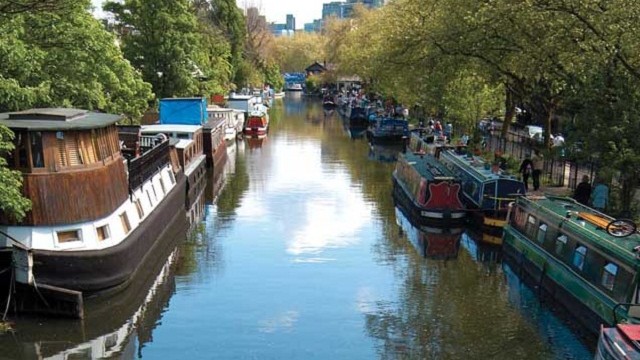
little veniceOne of the joys of life, when I lived in North Kensington in the 1980s, was to be near the Grand Union Canal. I would usually join the path close to Kensal Green cemetery, and walk under the bridge by Portobello Dock and continue on down to Westbourne Park. Occasionally I would push on as far as Little Venice (pictured) in Paddington, where the waterway becomes the Regent Canal. For those who don’t know it, Little Venice is an utterly charming oasis of tranquility: here you will see all the prettiest, best-kept barges, many of them teeming with fresh flowers.

The heron mentioned in The Cross (the story posted earlier today) is the same bird that features in the poem below. I saw the heron sitting in the undergrowth on the north side of the canal, that is, the side opposite the towpath, close to the cemetery wall. What struck me most at the time was how rare it is to see ageing wildlife. I know that cats when they are about to die often run away or go into hiding so that they can end their days discreetly and in dignity. On the day in question, the sadness of this bird’s fate really touched me and I felt that the least I could do was to make a space for it in my poetry. In later years, I must confess, I have also worried that the heron might have been an omen. I hope not!


Heronheron

That heron I saw
        on the canal bank
half-hidden in the bushes
        standing in nettles,
all confidence gone
        looking old and bedraggled,
it’s long slender legs
        begrimed, its feathers
clogged with oil
        doubtless released
from a careless barge.
        And yet
you don’t expect
        to see a heron
looking old
        and defeated,
once vigorous wings
        as though clipped.
It barely raised
        its head
as I passed,
        its opaque eyes
half-heartedly scanning
        the opaque,
stagnant waters
        for some
lithe living form
        to devour.
A crestfallen heron
        as though lost
as though displaced
        as though homeless,
a heron fallen
        on hard times
in old age,
        a creature of
beauty trashed
        by time and
circumstance.

None of these things
        is to be expected
in a heron.

John Lyons
1995