A solitude of the self living on unmarked time adjusting to the differences of temper and belief these are the colours of spring the intensity of yellow daffodils blue skies and robins returning day after day to sing their song
here where our ancestors cast no shadow and love is a memory in the making I remember the geraniums on the sill of the shed window I remember the towers we climbed hand in hand and the moon that spread its light upon the surface of the lake I remember the colour of love in your eyes such beauty that I will never forget
How many dawns how many bridges draped in mist how many gulls gliding namelessly through the air how many thoughts and hopes and expectations as the sun rises into a panoramic crimson sky
Soon cinematic streets will fill with purpose the bustle of daily life the wheeling and dealing of commerce and work as across London Bridge a speechless caravan of souls drifts towards offices set in towering structures of steel and glass and from their windows the idly occupied will gaze down into the streets and dream of love as the hours leak away How many dawns how many bridges
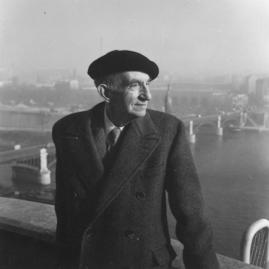
Jules Supervielle (1884-1960) was born into a French-Basque family living in Uruguay. Aged ten, he was sent to Paris, where he completed his education at the Sorbonne. For the rest of his life, he divided his time between Uruguay and France. He was friends with André Gide, Paul Valéry and Jacques Rivière, and in 1923, he met the Austrian poet, Rainer Maria Rilke, a crucial influence on his later work. The poem below is a fragment from La fable du monde, published in 1938. See also “I dream you from afar.”
Nocturne in broad daylight
The slowness around me Casts its net over the furniture Imprisoning the light And familiar objects. And Time, its legs crossed, Looks me in the eye And sometimes it stands up To examine me a little closer, Then it goes back to its place Like a satisfied prince. And here in my whole body The Feeling of Life, Red and white ants Composing a human being. And Space revolves around me In which everyone finds their place From the high stars To those who observe them. And every day that I endure Under my shadowy thoughts I live among these figures Layered around me Like between Pyramids.
Jules Supervielle
(translated by John Lyons)
Nocturne en plein jour
La Lenteur autour de moi Met son filet sur les meubles Emprisonnant la lumière Et les objets familiers. Et le Temps, jambes croisées, Me regarde dans les yeux Et quelquefois il se dresse Pour me voir d’un peu plus près, Puis il retourne à sa place Comme un prince satisfait. Et voici dans tout mon corps Le Sentiment de la Vie, Blanches et rouges fourmis Composant un être humain. Et l’Espace tourne autour de moi Où chacun trouve sa place Depuis les hautes étoiles Jusqu’à ceux qui les regardent. Et chaque jour que j’endure Sous mes ombreuses pensées Je vis parmi ces figures Comme entre des Pyramides Autour de moi étagées.
This has been a beautiful day unbroken sunshine and young families strolling in the park and down by the river and everyone subdued and yet determined to enjoy every minute
I walked past the magnolia with its splendid votive blooms and once again heard the woodpecker tapping to its own code a day not to be deconstructed but to be lived for the moment
I thought of Apollinaire standing on the Mirabeau Bridge watching as the waters passed beneath him I thought of Frank O’Hara never one to be lost for words I thought of all the love that passes by and of the love that alone endures
Purity of breath stripped of time stripped of place no here or now no looking on being not in the moment rather being the moment free from past free from future intensity of the moment that destroys time lovers locked in an eternal embrace the fox has no plans lives on the edge of its instincts knows no failure bids nothing farewell
so too the angels who move silently among us pure light unseen pure uncorrupted life boundless unfathomable life the unfolding flower that never fades
The foxes have gone to ground in the silence in the stillness they know that something is seriously wrong with the world
No more sunbathing on sheds roofs no more slinking from garden to garden no more wandering the streets after dark no more chattering in the early hours
the foxes are self-isolating mothers are confining their litters to the lair they can sense that something serious is afoot
Never has space flight of birds flight of angels aerial distance the poet’s mind eyed from a castle or from a tower in Sligo
the act ever incomplete the arrow speeding through the air how thoughts soar carried on the wind a child’s kite with unending string
never has space and within it love the heartfelt impulse flight of fancy eclipsing all fear never has space known such a time inwardly outwardly as now and then
John Lyons
Die Poetik des Traums
Hat nie Platz Flug der Vögel Flug der Engel Luftentfernung der Geist des Dichters von einer Burg aus gesehen oder von einem Turm in Sligo
die Tat immer unvollständig Der Pfeil beschleunigt durch die Luft wie Gedanken steigen im Wind getragen Drachen eines Kindes mit endloser Schnur
hat nie Platz und Liebe darin der warme Impuls Flug der Fantasie alle Angst in den Schatten stellen hat nie Platz eine solche Zeit bekannt innerlich außenlich wie jetzt und dann
Only those who have already raised the lyre among the shades can foresee the infinite praise. Only those who consumed poppies with the dead, will not lose the least of their notes. Our reflection in the pond may often blur: know the picture. Only twixt the twin realms will our voice turn gentle and everlasting
Rainer Maria Rilke
(translation by John Lyons)
Sonnett 9
Nur wer die Leier schon hob
auch unter Schatten,
darf das unendliche Lob
ahnend erstatten.
Nur wer mit Toten vom Mohn aß, von dem ihren, wird nicht den leisesten Ton wieder verlieren.
Mag auch die Spieglung im Teich oft uns verschwimmen: Wisse das Bild.
Erst in dem Doppelbereich werden die Stimmen ewig und mild.
 johnjosephlyons