Barbara Hepworth by Barbara Hepworth

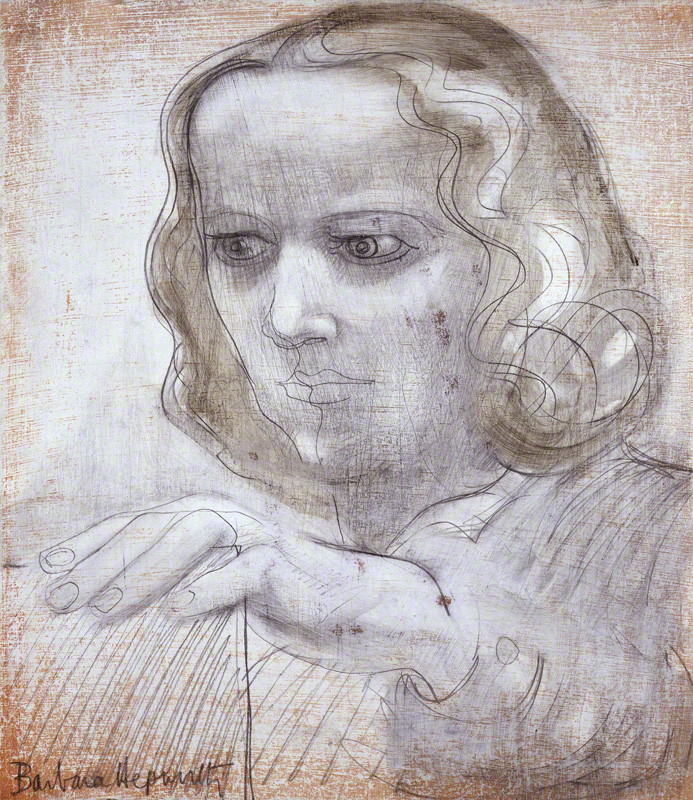
by Dame Barbara Hepworth, oil and pencil on board, 1950
Barbara Hepworth, Self-portrait, 1950 (oil and pencil on board)

For those who enjoyed the recent Dame Barbara Hepworth retrospective at Tate Britain, here is a self-portrait which she produced in 1950, done in oil and pencil on board.

The beauty of this portrait lies in its simplicity. In what is little more than an elaborate sketch, Hepworth has rendered a representation of herself as sculptor, her eye focused on her hand which is resting on a block of material, possibly of marble, and she has such an intense gaze that we can imagine that she is trying to discover the shape which is hidden within the material, or perhaps trying to decide whether the idea or shape she has in her mind will find its form within the medium she is touching. Touch to her was paramount, as she stated:

“I think every sculpture must be touched, it’s part of the way you make it and it’s really our first sensibility, it is the sense of feeling, it is first one we have when we’re born. I think every person looking at a sculpture should use his own body. You can’t look at a sculpture if you are going to stand stiff as a ram rod and stare at it, with a sculpture you must walk around it, bend toward it, touch it and walk away from it.”

The sketch itself can be seen as a preliminary study for a sculpture, the theme of which, is not so much the individual person but the art itself, the vocation of sculptor. The form is stripped down to the essentials as it would or could be if rendered in stone or bronze.

It is not an abstract but it does demonstrate how the great abstracts were produced through a process of reduction, of paring away of unnecessary detail to maximize the impact of the essential shape, which is to say, the essential space that the sculpture displaces. The portrait captures the texture and smoothness of stone and at the same time proposes an eventual transfer of energy, of breath from one medium to another, a process which lies at the heart of all artistic activity.


Barbara Hepworth was born in Wakefield, Yorkshire in 1903. She was a leading modernist figure in the international art scene throughout a career spanning five decades until her death in 1975. The self-portrait can be seen at the National Portrait Galley off Charing Cross Road.
Ceri Richards – Self-portrait (1934)

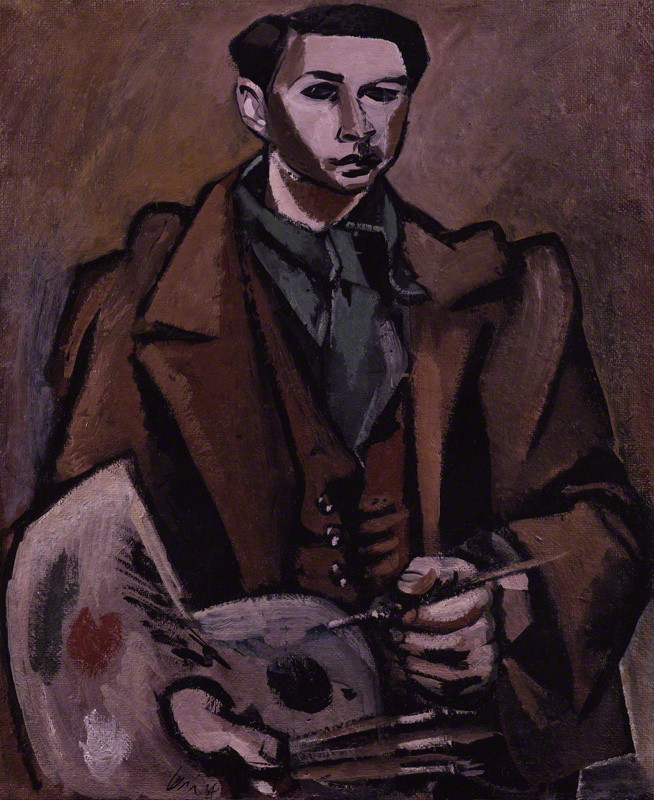
by Ceri Richards, oil on composition board, 1934
Ceri Richards, Self-portrait (oil on composition board) 1934

Ceri Richards (1903-1971) was born in a small village near Swansea. He and his younger brother and sister were brought up in a highly cultured, working-class environment. His mother came from a family of craftsmen; and his father, who worked in a tinplate foundry, was active in the local church, wrote poetry in Welsh and English, and for many years conducted the Dunvant Excelsior Male Voice Choir. The children were all taught to play the piano, and became familiar with the works of Bach and Handel. In later years music would be an important stimulus to Richards’s painting – as would his youthful sensitivity to the landscapes of Gower and the cycles of nature. Richards trained initially at the Swansea School of Art before completing his studies at the Royal College of Art, (where in later years he became a teacher).

In this beautiful self-portrait from 1934, the influence of the surrealists is quite apparent, particularly that of Picasso. Nevertheless, the portrait remains very much rooted in Richards’s Welsh background, with the dark earthiness of the colours capturing the tone of the valleys where the artist grew up. It is very much the ‘portrait of the artist as a young artist,’ but an artist emerging from a very specific landscape, which the rugged shapes and the simplicity of the composition evoke so well. It is an action painting in the sense that the subject is proudly presenting the tools of his trade, the palette and brushes which he carries as emblems. The thick black lines enhance the notion that the artist is an accumulation of elements, yet the eye is drawn to the bright complexion and the affirmative expression which underline the pride Richards took in his work and his vocation. This self-portrait is quite simply his coat of arms.

Richards wrote: “One can generally say that all artists — poets, musicians, painters, are creating in their own idioms, metaphors for the nature of existence, for the secrets of our time. We are all moved by the beauty and revelation in their utterances — we notice the direction and beauty of the paths they indicate for us, and move towards them”.

The beauty to which Richards refers is intrinsic in every detail of this self-portrait which so clearly and affectionately references his roots in the Welsh valleys —which he appears to be wearing about his shoulders— and his belief in the rugged powers of art. Former pupils have described Richards as a cheerful, boisterous teacher, and these traits come through in this marvellous celebratory painting which is there to be admired any day of the week in the National Portrait Gallery on Charing Cross Road.


In the midst of a great forest

morales2
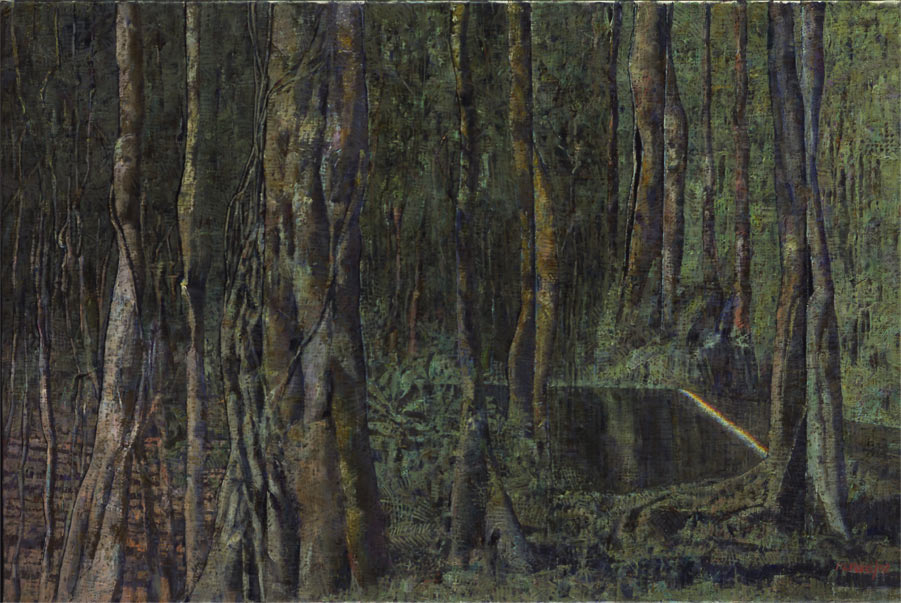
Armando Morales, oil on canvas (click to enlarge)

Armando Morales (1927–2011) was an internationally renowned Nicaraguan artist, a contemporary and friend of the poets, Ernesto Cardenal and Carlos Martínez Rivas.

Morales was famous for his voluptuous still lives, in particular, sensual studies of apples and pears that evoked the softness of human skin. He later moved on to the painting of the female form, and in 1971, at the Galeria Bonino in New York, he showed a series of stunning nudes in which the fine detail of every muscle, of every inch of skin, reveals an unsurpassed sensuality.

I visited Armando at his studio in Vauxhall many years ago during a brief period he spent in London. On that day he was preparing a huge canvas, and in the course of our conversation many times he climbed a ladder to access the top of the canvas. In one hand he held a magnifying glass and in the other a razor blade, poring over the surface in search of the most minute imperfections, meticulous to a fault.

I have chosen his beautiful woodland study to illustrate the poem below, the title of which is based on the opening line of Dante’s Inferno.


In the midst of a great forest

What treasures I have amassed
        are immune to fire and theft
though I have indeed known loss
        loss of the body and loss of the soul
and live now in a quiet space
        catching the drift of birdsong
of the splenetic spider that plays
        upon its frosty web
I can resist all things
        better than my own changeability
I breathe the air
        but do not breathe it all
I am not proud
        and know my place :
the moth and the fish-eggs
        are in their place too
so too the bright suns
        and the wide golden moon
that shone last night
        so too the phantom dawn
that creeps through the mist
        to smother dreams
What is palpable
        is in its place
What is impalpable
        is in its place
Whether we fall by ambition
        blood or lust
like diamonds we are cut 
         with our own dust
I seek the grail of laughter
        a life that will turn
upon the axle of devotion
        a kiss not singed
by the eventual flame

These are the lanes of death
        where our footfall falls
Here love is a moment
        and pain another
and our mutual friends
        are ash and dust
moth and termite
        here time runs amok
wields a thirsty blade
        cuts to the very bone

John Lyons


Portrait of A S Byatt by Patrick Heron

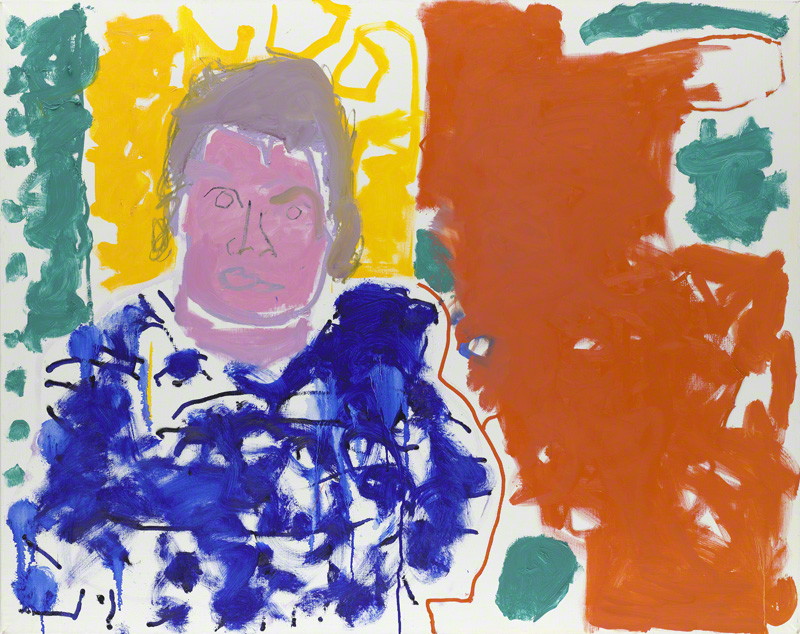
A.S. Byatt (Portrait of A S Byatt : Red, Yellow, Green and Blue : 24 September 1997)

by Patrick Heron, oil on canvas, 1997


The 1997 portrait of A S Byatt, by Patrick Heron, in oils on canvas, captures all the exuberance of the novelist in primary colours. It is a triumph of art over photography, in the sense that the sketching of the writer’s figure tells us more about her than any photograph could ever hope to do. Her vibrant personality, her larger than life appearance, her vivaciousness are all there, beautifully expressed. Picture her there in a room, in person: one could not fail to notice her dominating presence. But it is a domination without threat, the domination of an enthusiast for her profession, for her own art. Portraits in the Victorian mould can so often be almost photographic, the painter striving for perfection, every hair in place, every tiny detail forensically included. Imagine the consternation of these artists were they to see Patrick Heron’s rendering of A S Byatt. How can so much be achieved by apparently so little? How can such bold strokes and seemingly haphazard splashes of paint create such a profound. living, breathing representation of the sitter’s persona? 

Portraits may be simple representations – or on occasions, deliberate misrepresentations: they can be masks or disguises or false projections, telling us nothing of the real person. Like the portrait of Dorian Grey, they may cover a multitude of sins. That is not the case with Patrick Heron’s masterpiece. It is full of narrative detail, in the dress, in the tilt of the head, in the loudness of the primary colours, a veritable short story in itself. And one would never tire of this painting as one might of a photograph of the novelist. Hung upon any wall, this rendition would dominate the room, just as the author does wherever she  goes.

Let us suppose for a moment that the gallery curator decided to hang this work in a completely different room, for example, among the somewhat stuffy (in comparison, and no offence) 19th century portraits: what an effect that would have as you walked in and were greeted by Patrick Heron’s astonishing burst of colour! Time to rock the conventions and shuffle things around? The day may come!

If you haven’t seen this painting for yourself, I would strongly recommend a quick visit to the National Portrait Gallery in Charing Cross Road to judge for yourself. I guarantee you will not be disappointed!

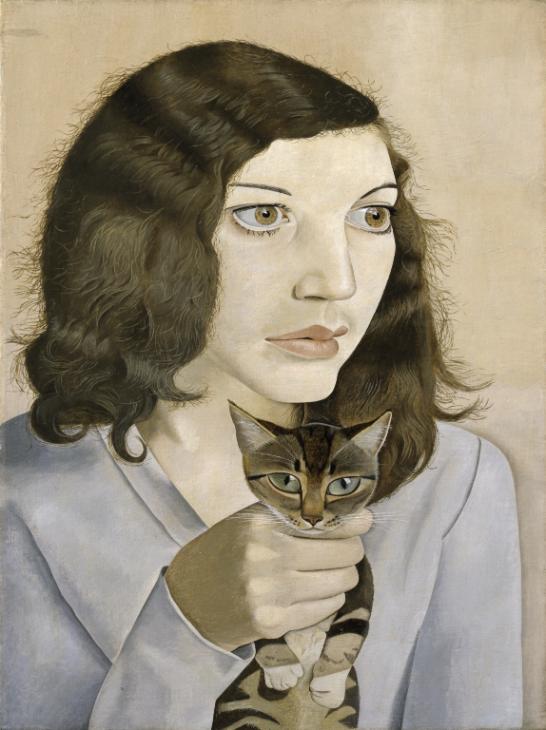
Lucian Freud – Girl with a Kitten

Girl with a Kitten 1947 Lucian Freud 1922-2011 Bequeathed by Simon Sainsbury 2006, accessioned 2008 http://www.tate.org.uk/art/work/T12617
Lucian Freud, Girl with a Kitten (oil on canvas) 1947

Art is analysis and projection. Art is perspective and choices. Art is narrative. Art is conscious and unconscious. Lucian Freud, grandson of the pioneer of psychoanalysis, paints a portrait of his wife, Kathleen Garman entitled Girl with a Kitten. She herself is the daughter of an artist, Jacob Epstein. Freud plays on her name: she is Kitty, and so he poses her with a cat. She appears to be throttling the cat, but it is the artist writing the narrative and so he is the one choosing to throttle the cat, yet when we examine the painting closely there are details to suggest that the cat is a paragon and the wife may be the aggressor: compare the eyes, compare the perfection of the cat’s hair to the wilder hair of the wife, compare the colours, the deathly pale of the wife, the warmth of the cat. So who is who in this relationship? Who the innocent, who the guilty party?

The entire portrait is chilling, the palette is icy. This is not a flattering portrait and one wonders how the wife would have felt when she saw the finished product. She is not a wife in possession or in repose, and if there is sentiment, it is certainly not sentimental. The bland background and the softness of her blouse heighten the intensity of her glaring faraway eyes. Her knuckles are tense with adrenalin. This is a portrait of a tempestuous relationship between the woman and the cat (or between man and wife). But the narrative is unresolved, as in a dream or a nightmare. The elements are disturbing and that too is a function of art, to unsettle, to challenge, to undermine the conventions, to go against the grain, to stick it in the eyes and mind of the observer.

As with so many canvases, the wealth of detail has to be examined in person. A reproduction can never do justice to textures, so there really is no alternative to paying a visit to Tate Britain in Pimlico to see this masterpiece for yourself.

Lucian Freud, grandson of the psychoanalyst Sigmund Freud, was born in Berlin in 1922 and came to Britain in 1933. In 1946–7 he travelled to Paris and Greece. On his return to London in February 1947, he began a relationship with Kitty Garman, the eldest daughter of the sculptor Jacob Epstein and the model and collector Kathleen Garman. The subsequent marriage between Freud and Kitty was short-lived – they wed in the spring of 1948 and divorced in 1952 after having two daughters. Girl with a Kitten is one of eight portraits that Freud made of his first wife.


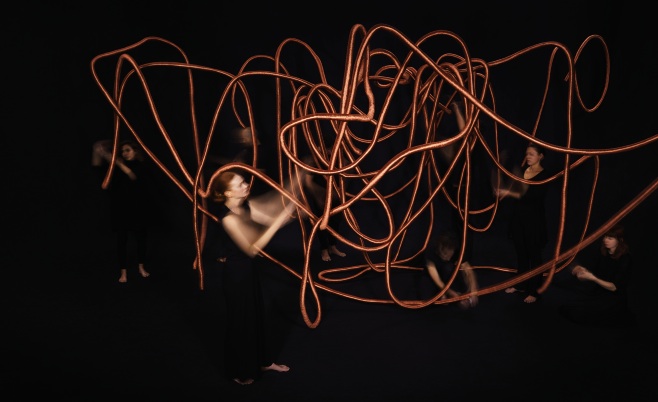
Alice Anderson – the Midas touch

The Midas touch of Alice Anderson

ropes
Alice Anderson “Ropes”

If you haven’t seen it already, there’s still time to catch the free exhibition of sculptures by Alice Anderson at the Wellcome Collection in Euston Road, (diagonally opposite Euston Station), before it closes on 18 October.

According to the publicity handout:

Alice Anderson asks you to take a journey into memory. Displayed together for the first time is a series of sculptures which prompt you to rediscover things you thought you already knew. A computer, a record-player, sketch-books, a bicycle, even a staircase have been transformed into luminous half-recognisable shapes through a process the artist refers to as “mummification”. This process actually involves the objects being bound with very fine copper thread so that they are, theoretically preserved for all time.

The exhibition experience is broken down into a series of themed rooms. In the first room, called Studio, you are invited to contribute to a sculpture by becoming part of Anderson’s studio. Here you can participate in the transformation of a ‘naked’ object by weaving copper thread around a 1967 Ford Mustang. The space where this occurs has minimal lighting to heighten the impact of the glowing copper thread and the effect is absolutely breathtaking.

Alice-Anderson-Turntable
Turntable

And as you move through the different spaces of the exhibition you are bombarded with a series of everyday objects similarly wrapped in the copper thread. The range of objects mummified includes a plasma tv screen, a guitar, a bicycle, keys, a telescope, a turntable, eye glasses, a smoking pipe, a telephone, coat hangers, a stethoscope, tools including screwdrivers and hammers, a basketball, a boomerang, a set of drums, ladders, shelves, geometrical shapes, and so on, and the cumulative effect is spectacular.

Two sculptures in particular caught my imagination: the first was a staircase wrapped in the luminous thread, and such was the scintillating play of light that it appeared to be a staircase to heaven. The second sculpture (illustrated at the top of the page) was a huge, twisting and turning cable of copper rope suspended from the ceiling in one room creating a beautiful abstract space that visitors are able to walk through and therefore observe the rope from every dimension.

alice_anderson_
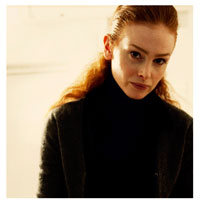
Alice Anderson

Like with so much conceptual art, Alice Anderson is inviting us to take a fresh look at everyday objects we take for granted by reducing them to their essential shapes. However, the fact that they are bound in a glowing precious metal inevitably enhances their worth—especially given the market price of copper today—and the overall effect is as though Miss Anderson has transformed the objects into gold with her Midas touch. I would add incidentally, that it is probably no coincidence that the artist’s own hair is copper-coloured. Make of that what you will!

Alice Anderson lives and works in London. She studied at the École Nationale Supérieure des Beaux- Arts de Paris and at Goldsmiths College London. See http://www.alice-anderson.org/travfactory.html


Never been to the Wellcome Collection? If that’s the case, make a note. It’s a fabulous exhibition space, and the museum’s permanent collection is full of informative displays. The building itself is worth a drop-in visit, and on the day I was there the cafeteria and bookshop were buzzing. On top of all this, the venue has a broad programme of events embracing the arts and sciences, the majority of which are free. Details available from http://wellcomecollection.org/.


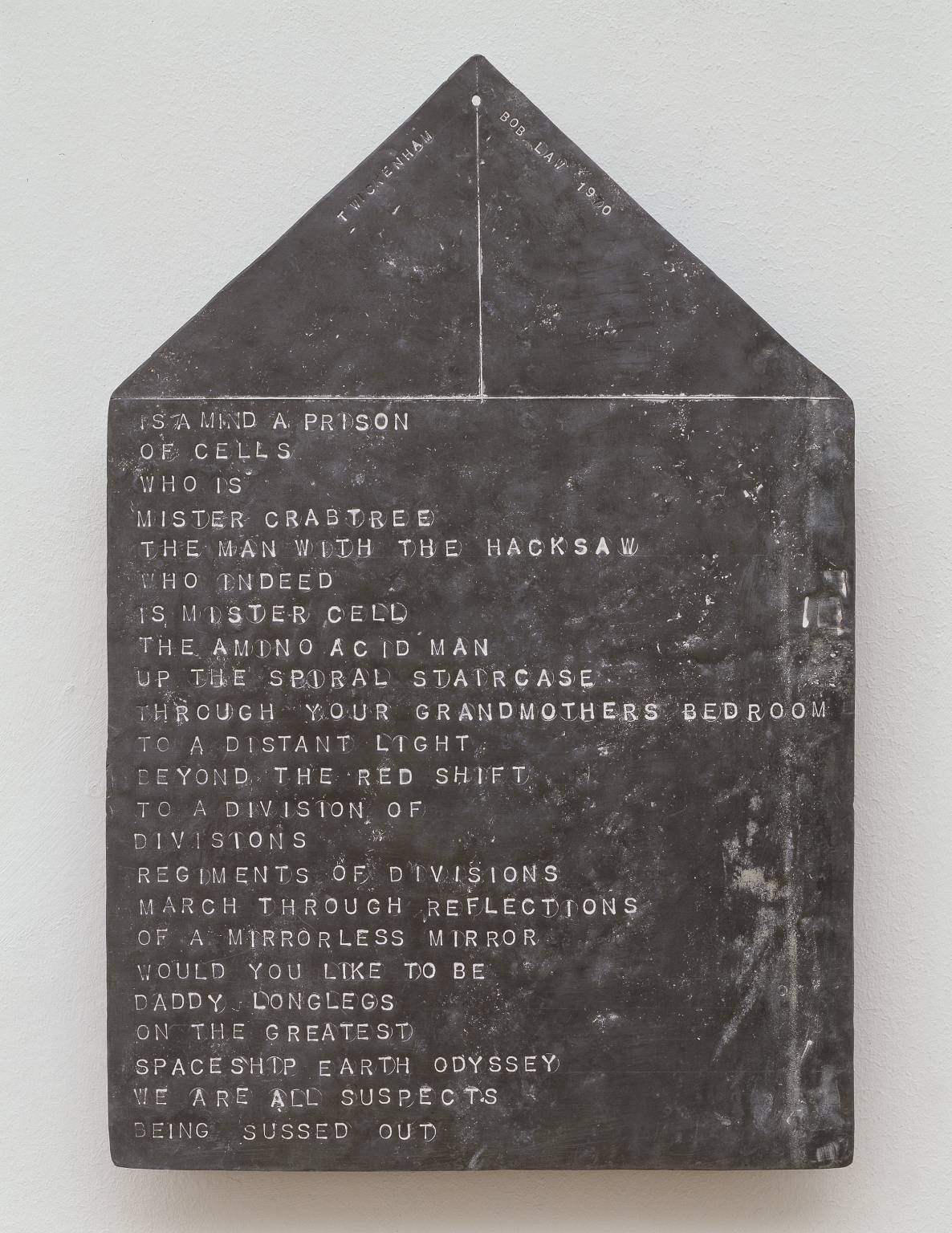
Is a mind a prison?

Is a mind a prison, by Bob Law (1970)

Is a Mind a Prison 1970 Bob Law 1934-2004 Purchased 2006 http://www.tate.org.uk/art/work/T12178
Is a Mind a Prison, Bob Law (1970)

One of the most curious artworks on display at Tate Britain, is a two-dimensional sculpture by Bob Law (1934–2004) entitled “Is a mind a prison”. This piece is an obelisk-shaped tablet of lead, upon which some seemingly incoherent lines of poetry have been etched. The title of the work is a question, which in itself is unusual in the world of art: despite the fact that one of the fundamental aspects of art is the asking of questions, most paintings and sculptures have simple affirmative titles. Bob Law’s obelisk is also simple in form: it could represent a chapel, or perhaps even a spaceship, one of the notions clearly indicated in the poetic text. If we examine the geometrical shape of the lead tablet it is basically a rectangle topped by two equilateral triangles which suggest a roof structure. The words on the tablet are imprisoned within the space, just as the words in our minds are locked in. Cell within cell.

We are all on a journey, all travelling through space aboard planet earth, and in the course of our journey we will all be confronted with a series of adventures, highs and lows, as though the gods have taken offence and set out to make our homecoming as difficult as possible, just as they did for Odysseus in Homer’s poem.

Bob Law’s reference to redshift is to the cosmological effect caused by the expansion of the universe whereby light sources moving away from the observer are red in contrast to light sources that approach the observer which are blue. Expansion is process. Expansion within the space of our minds within cosmic space. Would you like to be the daddy longlegs, the kingpin, the big daddy on this trip at the end of which we will all be judged for our actions? And so on. . . .

Bob Law was known as one of the founding fathers of minimalism. However, this piece demonstrates that a minimalist technique can be highly expressive. Minimum of resources for maximum effect, Samuel Beckett might have written. Here the combination of sculpture and poetry challenges the observer to stop and to think about structures, about cells contained within cells and questions contained within questions, one art form contained within another.

On the afternoon that this piece caught my eye as I strolled through the beautiful, spacious, well-lit galleries of Tate Britain, and perhaps because of its location by a doorway, it reminded me very much of one of the Stations of the Cross that can be seen in so many churches. This in turn made me think that art galleries do, in fact, have a strong spiritual dimension, not so much because their spaces can replicate churches, but rather that underpinning the work of all the artists on display is the common link of spirituality, albeit manifest in disparate forms. Their work makes contemplatives of us, urging us to meditate on the nature of the human condition. What is it to be human, what is beauty, what in the world around us is worthy of note, what values best define the essence of human goodness, what content and what colours and shapes should be used to celebrate life even as we question its purpose?

All of which explains why the appreciation of art is so liberating and uplifting and why it is so important to incorporate it in the educational process for our young children. But it also has to be appreciated, where possible, in situ. So get down to Tate Britain in Pimlico as soon as you can and when you’re there, take your time, it’s all you have.


Film Star – John Latham

Film Star 1960 John Latham 1921- 2006 Purchased 1966 http://www.tate.org.uk/art/work/T00854
John Latham, Film Star (1960) Books, metal and plaster on canvas

Educated at Winchester College, John Latham (1921-2006) commanded a motor torpedo boat in the Royal Naval Volunteer Reserve during the Second World War. After the war he studied art at the Regent Street Polytechnic and later at the Chelsea College of Art and Design. He was married to fellow artist and collaborator Barbara Steveni.


According to the Tate Britain display caption: This work was titled Film Star because it appeared in Latham’s film Unedited Material from the Star. It incorporates books whose pages have been painted in twelve colours. Because the books can be opened at different pages, the work can exist in different states. The film consists of static shots of opened books. During production, Latham would stop filming at various points, turn the pages of the books, and start filming again. When the film is shown, the books appear suddenly to open, close and change colour.

Latham photo
John Latham

There is something erotic about the red version of the books, as though the books are about to swallow, to devour the observer, the reader of the painting/sculpture. This sensation would be heightened when watching the animated film. The human presence on the canvas appears to be signalled by what could be a spinal cord and eyes so that we are in fact looking at a portrait. But perhaps that’s just my interpretation. Why not pop down to Tate Britain in Pimlico and see for yourself!

There are so many things to like about this piece, but what struck me, having observed it in situ in the gallery, was the speed with which most visitors glanced at it and moved on. Art appreciation deserves more than a knee-jerk reaction! Latham is inviting us to share some time with his work because its content and its energies cannot be appreciated in haste. He knows that our time is precious, all time is precious. We could all be doing other things rather than traipsing round an art gallery, we could be living and loving in other ways, travelling in other directions. But then, why visit a gallery if we are not going to take the art seriously, if we are just going to shoot through the rooms clocking one exhibit after another as fast as we can?

Art bundles time and energy. As consumers of art our task is to unbundle it, using all our powers of perception and the generosity of our hearts and minds. Furthermore, the creation and appreciation of art should be central to the education of young people and not be relegated to the status of an optional, peripheral activity on the curriculum.

Why does Latham include so many books in his composition? Books are artefacts, physical objects and they can encompass all manner of printed material, hagiographies of film stars, biographies, histories, literatures etc. The book is a fundamental building block of culture, a cornerstone, and over the course of time, the dominant books will reflect the dominant ideology. Books can be instructive, destructive, they can be articles of rebellion and they can be persecuted, they can shape and they can deform opinions, they can be lauded and loathed, they can be best-sellers, stars in their own right and they can go in and out of fashion. Plastic arts can be encapsulated within the pages of books and in Latham’s sculptures books can be incorporated into his compositions as found objects, underlying the phoniness of rigid divisions between the arts. At the heart of it all is the word and the image. Art subverts received ideas and conservative thinking. Art is a weapon of liberation insofar as it operates on the consciousness and can set it free. Plastic, conceptual and literary art all share this power. Hence the reverence that artists tend to have for writers and vice versa. We’re all in this together, all for one and one for all.


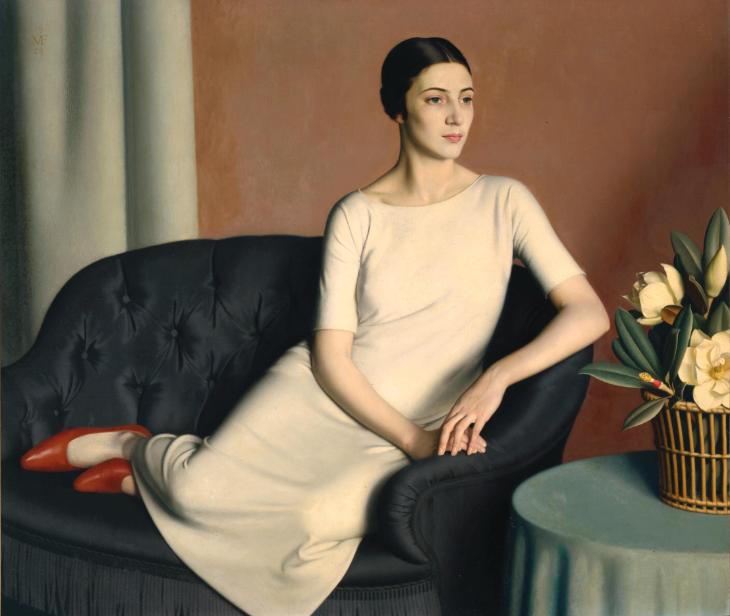
Meredith Frampton – Marguerite Kelsey (1928)

Meredith Frampton 1894-1984 Presented by the Friends of the Tate Gallery 1982 http://www.tate.org.uk/art/work/T03415
Marguerite Kelsey (1928), oil on canvas

Marguerite Kelsey, a professional artist’s model in the 1920s and 1930s, was renowned for her gracefulness and ability to hold poses for a long time. Her dress was made by the artist’s mother, and the shoes were chosen and purchased by Frampton for this portrait.

The simple, short-sleeved pale tunic dress worn with low-heeled shoes and her straight hair were all essential elements of the fashionable garçonne style created by the couturiers Coco Chanel and Jean Patou from the mid-1920s.

The subject’s pose is deliberately artificial, as is the rendering of the magnolias in the basket and indeed that of all the furnishings. Light was, as for most artists, absolutely crucial to Frampton, and according to Marguerite Kelsey several sittings for this portrait were abandoned when the light was poor.

In reality, what Frampton captures here is a moment of transition between classical elements and modernism and the overall effect, enhanced by the beautifully smooth brushwork, is vaguely surreal.

The model with her quizzical expression, appears almost to be floating on the sofa like a version of Botticelli’s Venus, the sofa substituting for the seashell. The balance provided by the colours of the drapes and the tablecloth make this an utterly satisfying composition.

Worth a trip to Tate Modern just to see this stunning work of art!


Meredith Frampton (1994-1984) was born in St John’s Wood and was the only child of the sculptor George Frampton and his wife, the painter Christabel Cockerell. Educated at Westminster School, Frampton eventually studied art at the Royal Academy Schools. During the First World War, he served in the British Army on the Western Front with a field survey unit and also worked on the interpretation of aerial photographs. After the war he established himself as one of the most highly regarded British painters during the period.


Carpet – Lubaina Himid


The African artist, Lubaina Himid was born in 1954 in Zanzibar, Tanzania. Her art focuses on themes of cultural history and reclaiming identities and she was one of the first artists involved in the Black Art movement in the 1980s.

Himid Carpet
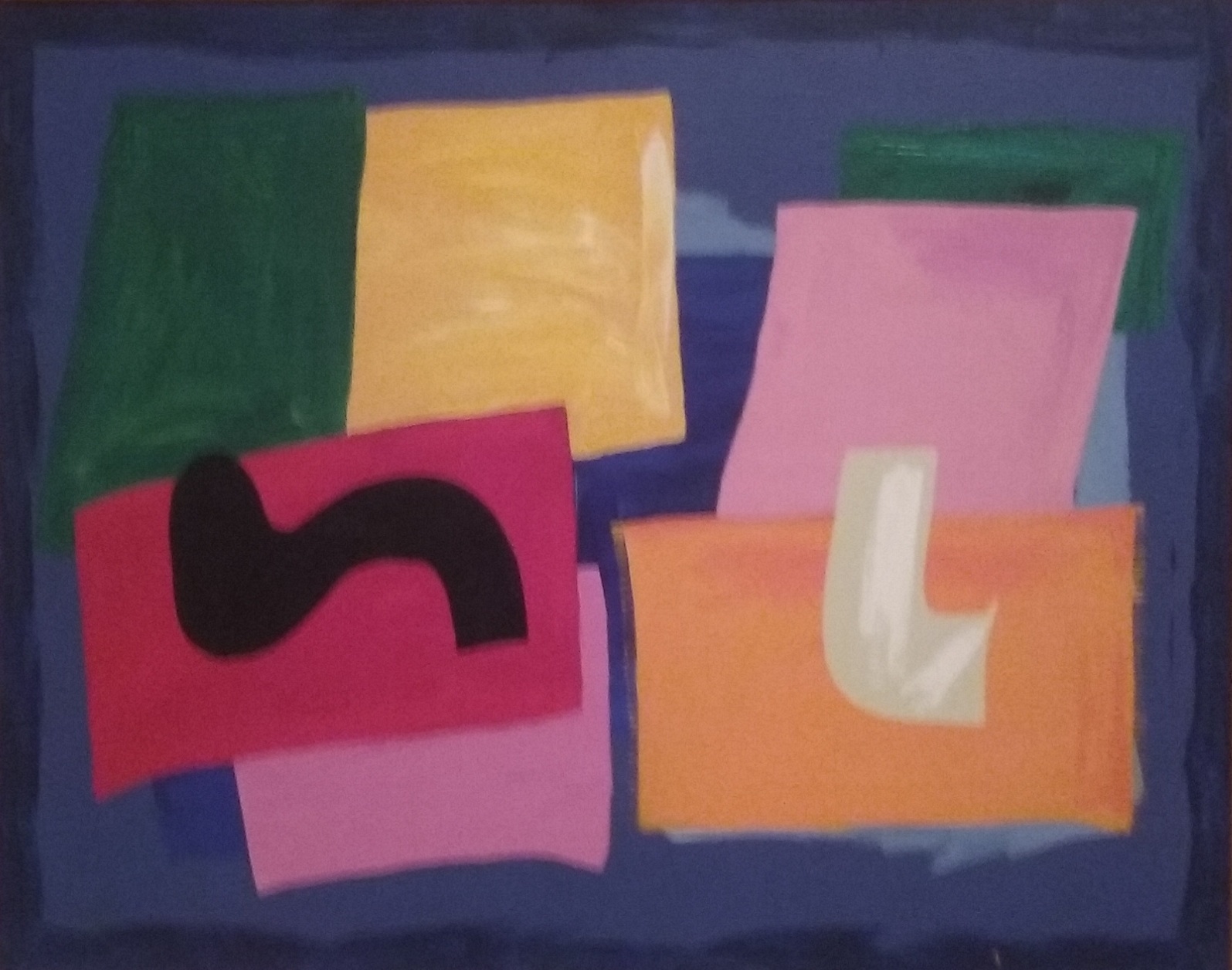
Lubaina Himid, Carpet, (1992, acrylic on canvas)

Her own description of her 1992 painting, Carpet, draws out the composition’s allusion to patchwork and cloth, and the idea that cloth can bear the traces of the activities for which it is used:

Patterns, colours, cloth flapping, beating in the wind. Robes wrapped against the sun and the cold of the night. Fabric highly coloured, woven, sewn together. Umbrellas tents canopies flags banners. The patterns on the cloths hold the clues to events.

To me these words give it away. I have never been to African, but the African presence in many countries in Central and South America is unmistakable. Travelling on buses through those regions, one of the most common and striking sights was to see brightly coloured washing hung on lines or fences or even bushes to dry. What to the European eye would seem to be rather brash colours, in African cultures is simply a statement of the vitality and beauty of life. Africa is, after all, the bedrock of European culture and its influence on painting and music is too obvious and too fundamental to be ignored.

Think of Carpet as a statement of life and appreciate how the blocks are not symmetrical nor posed symmetrically on the canvas upon which the letters appear to dance, and you get the idea of a buzzing dance floor capturing thus the vibrant energy of African culture. Another way to look at it would be to see the canvas as shorthand representation of our DNA code. Homo sapiens, emerged from Africa, as we all know, and these are the genes represented on the canvas, the genes too of all the wonderful creativity that has spread throughout the world.

Don’t believe me? Well get down to Tate Britain and see for yourself.