Number measure weight the mathematics of poetry How many feet until Odysseus makes it home to Ithaca? We learn that the gods are not always kind but neither are we simple mortals : love is a battleground One heart lays siege to another Love too is labour that is sometimes lost The metaphors are endless and they get us nowhere Ships sink in the storm and magic plays its tricks when the lights are lowered and there is silence in the auditoriumThe empty page is our workface and seams of gold are rare but they are to be found if we persistWhen her eyes met mine I took her hand and delivered a kiss to her soft lips and thought I would die
John Lyons
J’ai cru que j’allais mourir
Mesure, poids, nombre — les maths de la poésie. Combien de lieues Ulysse doit-il encore parcourir pour regagner Ithaque ? Nous apprenons que les dieux ne sont pas toujours bienveillants, mais nous, simples mortels, ne le sommes pas davantage : l’amour est un champ de bataille, un cœur assiège un autre cœur. L’amour est aussi un labeur, parfois vain. Les métaphores sont infinies, et pourtant elles ne mènent nulle part. Les navires sombrent dans la tempête, et la magie joue ses tours lorsque les lumières s’éteignent et que le silence s’installe dans la salle. La page blanche est notre terrain de travail ; les filons d’or y sont rares, mais on peut les découvrir si l’on persévère. Quand nos regards se sont croisés, j’ai pris sa main, j’ai déposé un baiser sur ses lèvres douces et j’ai cru que j’allais mourir.
How many spheres contained within a marble sphere the gift of sculpture that sees forms within forms the blind poet from the Argentine so aware of the infinity of infinities in time and space and how every human gesture is necessarily humbled by the algebras of history how the rose rises above the archetype and how heroism is an act not of the sword but of the imagination the poet who conjures with words to create a parallel universe in which Odysseus is forever at sea and Penelope an unattainable promise
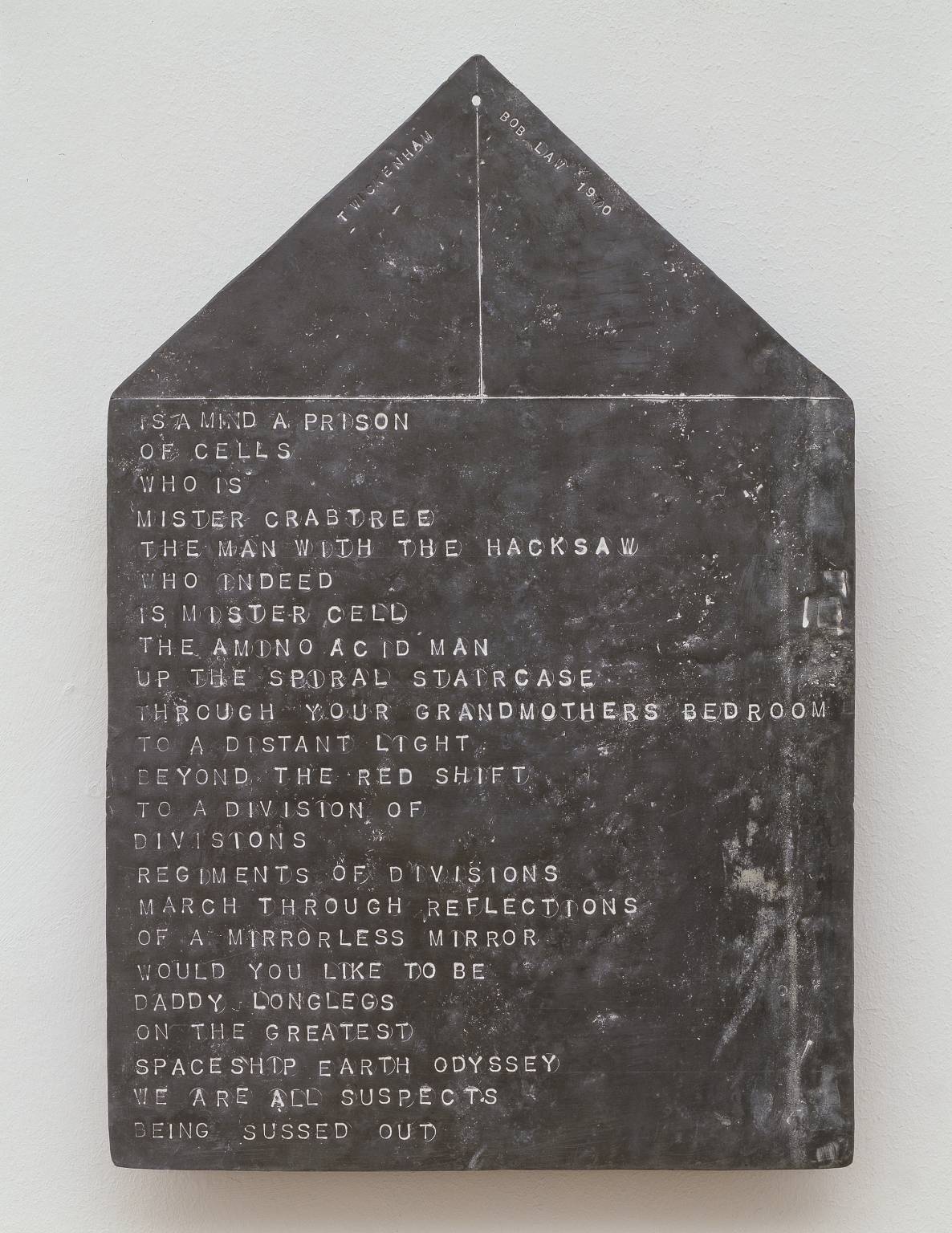
One of the most curious artworks on display at Tate Britain, is a two-dimensional sculpture by Bob Law (1934–2004) entitled “Is a mind a prison”. This piece is an obelisk-shaped tablet of lead, upon which some seemingly incoherent lines of poetry have been etched. The title of the work is a question, which in itself is unusual in the world of art: despite the fact that one of the fundamental aspects of art is the asking of questions, most paintings and sculptures have simple affirmative titles. Bob Law’s obelisk is also simple in form: it could represent a chapel, or perhaps even a spaceship, one of the notions clearly indicated in the poetic text. If we examine the geometrical shape of the lead tablet it is basically a rectangle topped by two equilateral triangles which suggest a roof structure. The words on the tablet are imprisoned within the space, just as the words in our minds are locked in. Cell within cell.
We are all on a journey, all travelling through space aboard planet earth, and in the course of our journey we will all be confronted with a series of adventures, highs and lows, as though the gods have taken offence and set out to make our homecoming as difficult as possible, just as they did for Odysseus in Homer’s poem.
Bob Law’s reference to redshift is to the cosmological effect caused by the expansion of the universe whereby light sources moving away from the observer are red in contrast to light sources that approach the observer which are blue. Expansion is process. Expansion within the space of our minds within cosmic space. Would you like to be the daddy longlegs, the kingpin, the big daddy on this trip at the end of which we will all be judged for our actions? And so on. . . .
Bob Law was known as one of the founding fathers of minimalism. However, this piece demonstrates that a minimalist technique can be highly expressive. Minimum of resources for maximum effect, Samuel Beckett might have written. Here the combination of sculpture and poetry challenges the observer to stop and to think about structures, about cells contained within cells and questions contained within questions, one art form contained within another.
On the afternoon that this piece caught my eye as I strolled through the beautiful, spacious, well-lit galleries of Tate Britain, and perhaps because of its location by a doorway, it reminded me very much of one of the Stations of the Cross that can be seen in so many churches. This in turn made me think that art galleries do, in fact, have a strong spiritual dimension, not so much because their spaces can replicate churches, but rather that underpinning the work of all the artists on display is the common link of spirituality, albeit manifest in disparate forms. Their work makes contemplatives of us, urging us to meditate on the nature of the human condition. What is it to be human, what is beauty, what in the world around us is worthy of note, what values best define the essence of human goodness, what content and what colours and shapes should be used to celebrate life even as we question its purpose?
All of which explains why the appreciation of art is so liberating and uplifting and why it is so important to incorporate it in the educational process for our young children. But it also has to be appreciated, where possible, in situ. So get down to Tate Britain in Pimlico as soon as you can and when you’re there, take your time, it’s all you have.