The social life

The social life

The serrated edge
         of gruff fox voices
chattering
         late into the night
celebrating
         partying
under a lacklustre
         moon

Occasionally
         the tone rises
as though
         tempers have flared
teeth bared
         but it’s probably
just high spirits
         foxes shooting the breeze
after a hard day’s graft
         letting it all hang out
—and who could begrudge them
         that moment in time ?

John Lyons

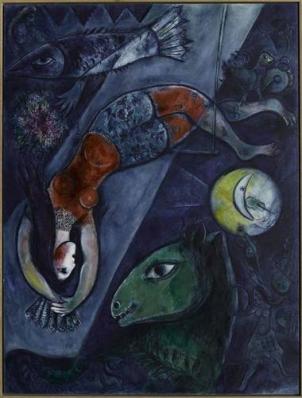
Chagall – early impression

chagall

Chagall – early impression

Chagall’s blue
         sea of aching origin
transmigration
         of genes
across Europe
         across continents
flight of all things
         in constant flux

Swirl of blue vortex
         earthwomb
from which all life
         emerges
fiery cadmium placenta
         a canvas dripping
with minerals
          Mother and child
in the hills above Nice
          a brush with destiny
instrumental colour
         the hands from which
melody flows
         Pegasus dashing
across the seasky
          repeated layers of love
tenderly applied
         the groomed bride
floating within her sex
          circles of satisfaction
zones of curved comfort
         joy inviolate
against the terror
         of time’s crude cross

John Lyons


Parallelogram

Parallelogram

Hushed beauty of the red rose
and yet she gasps in awe

breathes in the scent
and sighs deeply

soft petals that will be revealed
to unborn generations

that will be fed into fresh narratives
of love and tenderness

A rose carried from place to place
a gesture of the hand and of the heart

Love being that warm condensation
that repairs the shattered hours

that soothes the haunted imagination
A bloom unblemished amid the settling dust

At first light a silhouette a shade
in the receding shadows of the night

the blush of passion faded on their flesh
content they lie entwined at last at rest

John Lyons

Noises, by Juan Gelman

Juan Gelman
Juan Gelman

The poet Juan Gelman was born in Buenos Aires in 1930. The third son of Ukrainian immigrants, his father, José Gelman, had been a social revolutionary who participated in the 1905 revolution in Russia before finally settling in Argentina.

Gelman himself was an ardent political activist and in 1975 briefly became involved with the Montoneros, later distancing himself from the group. Following the 1976 military coup, Gelman was forced into exile. In 1976, his son Marcelo and his pregnant daughter-in-law, Maria Claudia, aged 20 and 19, were kidnapped from their home. They became two of the 30,000 disappeared, the people who vanished during the period of the military junta and the so-called Dirty War.

In 1990 Gelman was taken to identify his son’s remains (he had been executed and buried in a barrel filled with sand and cement). Later still, in 2000, Gelman managed to trace his granddaughter, who was born in a clandestine hospital before Maria Claudia was murdered. The baby had been adopted by a family that supported the military government. Maria Claudia’s remains have not been recovered. The poem below was published in 1991. In 2007 Gelman was awarded the prestigious Miguel de Cervantes Spanish language prize. He died in 2014.  


Noises

those footsteps are they looking for him ?
that car is it stopping at his door ?
those men in the street are they lying in wait ?
there are all sorts of noises at night

in the midst of those noises day breaks
nobody can stop the sun
nobody can stop the cock crowing
nobody can stop the day

there’ll be nights and days he might not see
nobody can stop the revolution
nothing can stop the revolution
there are all sorts of noises at night

those footsteps are they looking for him ?
that car is it stopping at his door ?
those men in the street are they lying in wait ?
there are all sorts of noises at night

in the midst of those noises day breaks
nobody can stop the day
nobody can stop the sun
nobody can stop the cock crowing

Juan Gelman

(translation by John Lyons)

Say what you like

Say what you like

Say what you like
         about infinities
about endless eternities
         in your heart you know
that this day
         will never return

The black tide of time
         is in our nature
the soft petals
         on the plucked rose
will soon fall to dust

To say that nothing lasts
         is not to despair
it is to admit the majesty
         of the moment
of the kiss bestowed
         of the love made
of the deed done
         once and for all

John Lyons

THE ODYSSEY OF HOMER

THE ODYSSEY OF HOMER translated by Alexander Pope

BOOK I

ARGUMENT.

MINERVA'S DESCENT TO ITHACA.

The poem opens within forty eight days of the arrival of Ulysses
in his dominions. He had now remained seven years in the Island of
Calypso, when the gods assembled in council, proposed the method
of his departure from thence and his return to his native country.
For this purpose it is concluded to send Mercury to Calypso, and
Pallas immediately descends to Ithaca. She holds a conference with
Telemachus, in the shape of Mantes, king of Taphians; in which she
advises him to take a journey in quest of his father Ulysses, to
Pylos and Sparta, where Nestor and Menelaus yet reigned; then,
after having visibly displayed her divinity, disappears. The
suitors of Penelope make great entertainments, and riot in her
palace till night. Phemius sings to them the return of the
Grecians, till Penelope puts a stop to the song. Some words arise
between the suitors and Telemachus, who summons the council to
meet the day following.

The man for wisdom’s various arts renown’d,
Long exercised in woes, O Muse! resound;
Who, when his arms had wrought the destined fall
Of sacred Troy, and razed her heaven-built wall,
Wandering from clime to clime, observant stray’d,
Their manners noted, and their states survey’d,
On stormy seas unnumber’d toils he bore,
Safe with his friends to gain his natal shore:
Vain toils! their impious folly dared to prey
On herds devoted to the god of day;
The god vindictive doom’d them never more
(Ah, men unbless’d!) to touch that natal shore.
Oh, snatch some portion of these acts from fate,
Celestial Muse! and to our world relate.

Now at their native realms the Greeks arrived;
All who the wars of ten long years survived;
And ‘scaped the perils of the gulfy main.
Ulysses, sole of all the victor train,
An exile from his dear paternal coast,
Deplored his absent queen and empire lost.
Calypso in her caves constrain’d his stay,
With sweet, reluctant, amorous delay;
In vain-for now the circling years disclose
The day predestined to reward his woes.
At length his Ithaca is given by fate,
Where yet new labours his arrival wait;
At length their rage the hostile powers restrain,
All but the ruthless monarch of the main.
But now the god, remote, a heavenly guest,
In AEthiopia graced the genial feast
(A race divided, whom with sloping rays
The rising and descending sun surveys);
There on the world’s extremest verge revered
With hecatombs and prayer in pomp preferr’d,
Distant he lay: while in the bright abodes
Of high Olympus, Jove convened the gods:
The assembly thus the sire supreme address’d,
AEgysthus’ fate revolving in his breast,
Whom young Orestes to the dreary coast
Of Pluto sent, a blood-polluted ghost.

“Perverse mankind! whose wills, created free,
Charge all their woes on absolute degree;
All to the dooming gods their guilt translate,
And follies are miscall’d the crimes of fate.
When to his lust AEgysthus gave the rein,
Did fate, or we, the adulterous act constrain?
Did fate, or we, when great Atrides died,
Urge the bold traitor to the regicide?
Hermes I sent, while yet his soul remain’d
Sincere from royal blood, and faith profaned;
To warn the wretch, that young Orestes, grown
To manly years, should re-assert the throne.
Yet, impotent of mind, and uncontroll’d,
He plunged into the gulf which Heaven foretold.”


For the full text see http://www.gutenberg.org/cache/epub/3160/pg3160.html.
What is Popular Poetry, by W B Yeats

From What is Popular Poetry, by W B Yeats

There is only one kind of good poetry, for the poetry of the coteries, which presupposes the written tradition, does not differ in kind from the true poetry of the people, which presupposes the unwritten tradition. Both are alike strange and obscure, and unreal to all who have not understanding, and both, instead of that manifest logic, that clear rhetoric of the ‘popular poetry,’ glimmer with thoughts and images whose ‘ancestors were stout and wise,’ ‘anigh to Paradise’ ‘ere yet men knew the gift of corn.’ It may be that we know as little of their descent as men knew of ‘the man born to be a king’ when they found him in that cradle marked with the red lion crest, and yet we know somewhere in the heart that they have been sung in temples, in ladies’ chambers, and our nerves quiver with a recognition they were shaped to by a thousand emotions. If men did not remember or half remember impossible things, and, it may be, if the worship of sun and moon had not left a faint reverence behind it, what Aran fisher-girl would sing :


It is late last night the dog was speaking of you; the snipe was speaking of you in her deep marsh. It is you are the lonely bird throughout the woods; and that you may be without a mate until you find me.

You promised me and you said a lie to me, that you would be before me where the sheep are flocked. I gave a whistle and three hundred cries to you; and I found nothing there but a bleating lamb.

You promised me a thing that was hard for you, a ship of gold under a silver mast; twelve towns and a market in all of them, and a fine white court by the side of the sea.

You promised me a thing that is not possible; that you would give me gloves of the skin of a fish; that you would give me shoes of the skin of a bird, and a suit of the dearest silk in Ireland.

My mother said to me not to be talking with you, to-day or to-morrow or on Sunday. It was a bad time she took for telling me that, it was shutting the door after the house was robbed….

You have taken the east from me, you have taken the west from me, you have taken what is before me and what is behind me; you have taken the moon, you have taken the sun from me, and my fear is great you have taken God from me.

The great unrest of which we are part

The great unrest of which we are part

As I sat today in solitude
         by the rolling river
my thoughts went floating
         on vast and mystic currents

What is Nature but change
         in all its visible and still more
its invisible processes ?
         Or what is humanity – in its faith
in its love its heroism its poetry
         even in its morals –
but emotion ?

Fifty thousand years ago
         the constellation of the Great Bear
or Dipper was a starry cross
         a hundred thousand years hence
the imaginary Dipper will be upside down
         and the stars
which form the bowl and handle
         will have changed places

The misty nebulae are moving
         and besides are whirling around
in great spirals
         some one way some another
Every molecule of matter
         in the whole universe
is swinging to and fro
         every particle of ether
which fills space
         is in jelly-like vibration
Light is one kind of motion
         heat another
electricity another
         magnetism another
sound another

Every human sense
         is the result of motion
every perception every thought
         is but motion of the molecules
of the brain translated by
         that incomprehensible thing
we call mind
         The processes of growth
of existence and of decay
         whether in worlds
or in the minutest organisms
         are but motion

Adapted from Walt Whitman

Adam’s advice to his offspring

Adam’s advice to his offspring

Build a garden of wonder
         with the person you love
and over the years
         fill it with all manner
of flowers and trees

Feed on the fruit
         of apple and cherry
and in summer months
         make the most of the berries

In the hedgerows
         plant hawthorn
that blossoms thickly
         in spring

But give pride of place
         to the subtle wild rose
admire its heavenly beauty
         yet respect its sharp thorns

John Lyons

Whistable reworked

These poems which I post most mornings are not intended as final drafts. They are part of a long work in progress, and this explains why the same themes and images return time and time again. In some cases I have drawn heavily on the work of other poets, but more often than not, my early morning poems are improvisations, some of which work much better than others. My aim is to accumulate material for the larger project, and this material will be edited down, and I suspect that much of it will not make it into the final work. All I can say is that while some people go to the gym for an early morning workout, I prefer to use the exercise of writing a short piece of poetry before I start my day. I do appreciate, however, that the two activities are not mutually exclusive. Occasionally, I find time to take a second look at an earlier post and rework it: this happens particularly when I am not happy with an early draft. Such is the case today!

John Lyons