Having commenced this daily blog towards the end of July, and given the response of readers on a day-by-day basis, I have come to one conclusion, (there will be others), namely, that the poetry posts are far and away more popular than anything else, and certainly far more popular than the short stories. I believe that there is a very simple explanation for this. Readers respond to poetry because it touches them in a way that very little prose can match.
Prose tends to be rational, often following a clear thread or narrative and in some cases so much is signposted that the reader just has to sit back and absorb the story almost on automatic pilot. Poetry touches different strings, it intimates and invites the reader to participate actively in the event, and by that I mean participate in the moment at which the mind meets the emotions encapsulated in the text. Poetry stirs the soul as music does, and certain words in a poetic context have the power of big piano chords. Think of the simplicity of striking a low G on the piano, listen to it resonating: the energies of poetry can stimulate a similar effect, creating, with the listener’s or reader’s collaboration, a meaningful emotion. This is further evidenced, I believe, by the often perfect marriage of words and music in song. Emotion above meaning!
October
October comes wrapped in mellow dreams and morning mists gulls coast on the horizon gardens are stripped back to their essentials and all human endeavours are humbled by the force of nature The contrivances of love will get us nowhere nor reckless ambition Who would be the moon’s best lover will soon enough know the taste of dust as their lease on life expires Our flesh recalls the schooled innocence of children who skip their early days away the taut tango of magpie and crow the scavenging of squirrel and the aimless amble of foxes that parade their shadows through our darkness From each their fruits : we are conscripts called to serve a higher law we who were once a mound of undelivered life must nurture the time of those around us slay the dragons of need and abandonment In the early hours I have touched her flesh of moans heard the soft murmur of breath on her lips the shapeless words that struggle to rise up from sleep folded her in the warm cocoon of my arms shared seed and song and pierced her heart beyond pain
José Lezama Lima (1910–1976) was a Cuban writer and poet considered to be one of the most influential figures in Latin American Literature. The son of a military officer, Lezama lived through some of the most turbulent times of Cuba’s history, fighting against the Machado dictatorship. His literary output includes the semi-autobiographical, baroque novel Paradiso (1966), the story of a young man and his struggles with his mysterious illness, the death of his father, and his developing sensuality and poetic sensibility.
Although he only left Cuba twice (trips to Mexico in 1949 and 1950), Lezama’s poetry, essays and two novels draw images and ideas from nearly all of the world’s cultures and from every historical periods. His baroque style creates stunning constellations of unusual images which can make some of his poetry extremely challenging.
In addition to poetry, Lezama wrote many essays on figures of world literature such as Stéphane Mallarmé, Paul Valéry, Góngora and Rimbaud.
WOMEN AND THE HOME
You were boiling milk and adhered to the customs of aromatic coffee. You tiptoed around the house with thriftily measured steps. Every little detail a sacrament, like an offering to the night’s weight. Your every hour is justified traipsing from room to room, where portraits hang that enjoy your comments. You lay down the law for every day and the Sunday bird half-opens with the colours of fire and froth in the pot. When a glass is broken, it tinkles with your laughter. The centre of the house flies like the point on the line. In your nightmares it rains incessantly upon the collection of miniature plants and the subterranean flame tree. Were you to lose your cool the broken skies would come crashing down on us in shards of marble.
*
O, HOW YOU ESCAPE
O, how you escape in the moment in which you’d already achieved your best definition. O, dear girl, how you refuse to believe the questions of that freshly cut star, that soaks its tips in another enemy star. O, if only it could be true that at bath time, when in the same discursive water the still landscape and the finest animals bathe: antelopes, serpents with staggered, evaporating steps appear amid dreams, without a craving to lift the longest head of hair and the most remembered water. O, dear girl, if in the pure marble of farewells you’d abandoned the statue that could accompany us, well the wind, the funny old wind, stretches like a cat allowing itself to be defined.
*
ON AN ENGRAVING OF CHINESE ALCHEMY
Beneath the table you spy three doors to small ovens, where you can see stones and bars burning, where the dwarf peeks out chewing on sleep-inducing seeds. On the table you see three blue and gray cushions on two of which lie sort of geometric figures made from unbreakable eggs. Beside it an unadorned jug. Lumps of firewood on the floor. A man hunched over a scale weighs a basket of almonds. The ebony rod immediately reaches the pointer. The man who’s selling fears the three small ovens hiding beneath the table. That’s where the expected figures should emerge when the man doing the weighing manages to balance the basket To his right the abstracted observer of the man weighing, plays with some birds
A gentle cascade of thoughts and words to fill a Sunday morning in which the world is struggling to awake from its deep sleep. The sound of traffic in the distance but otherwise little movement. Silence almost complete. A perfect dream-state. A time to make love and little else.
White echoes
How many lush green fields and slender silver streams how many gold-rimmed sunsets how many spiralling kites will fit into this endless silence ? Who heard our footsteps as we walked through the park who saw us climb the hill as squirrels jumped from tree to tree as children filled their lives with play ? Dreams and hope and desire grew within us and time offered us its pledges which we did not dare to believe Who saw as the curtains were drawn as you laid down beside me laid in my arms laid in my heart ? The wind was still through the night as spiders wove and the roses took their rest Today birds will swoop and feast on the berries the chestnuts will swell on the branches and leaves will form a carpet to take us into winter and to a landscape sketched by frost modelled by snow and draped in silence Where will love be then and hope and dreams ? Where will our shadows lie what scenes will be staged within the theatre of our blind ecstasies what life will be left to be led by our bartered blood ?
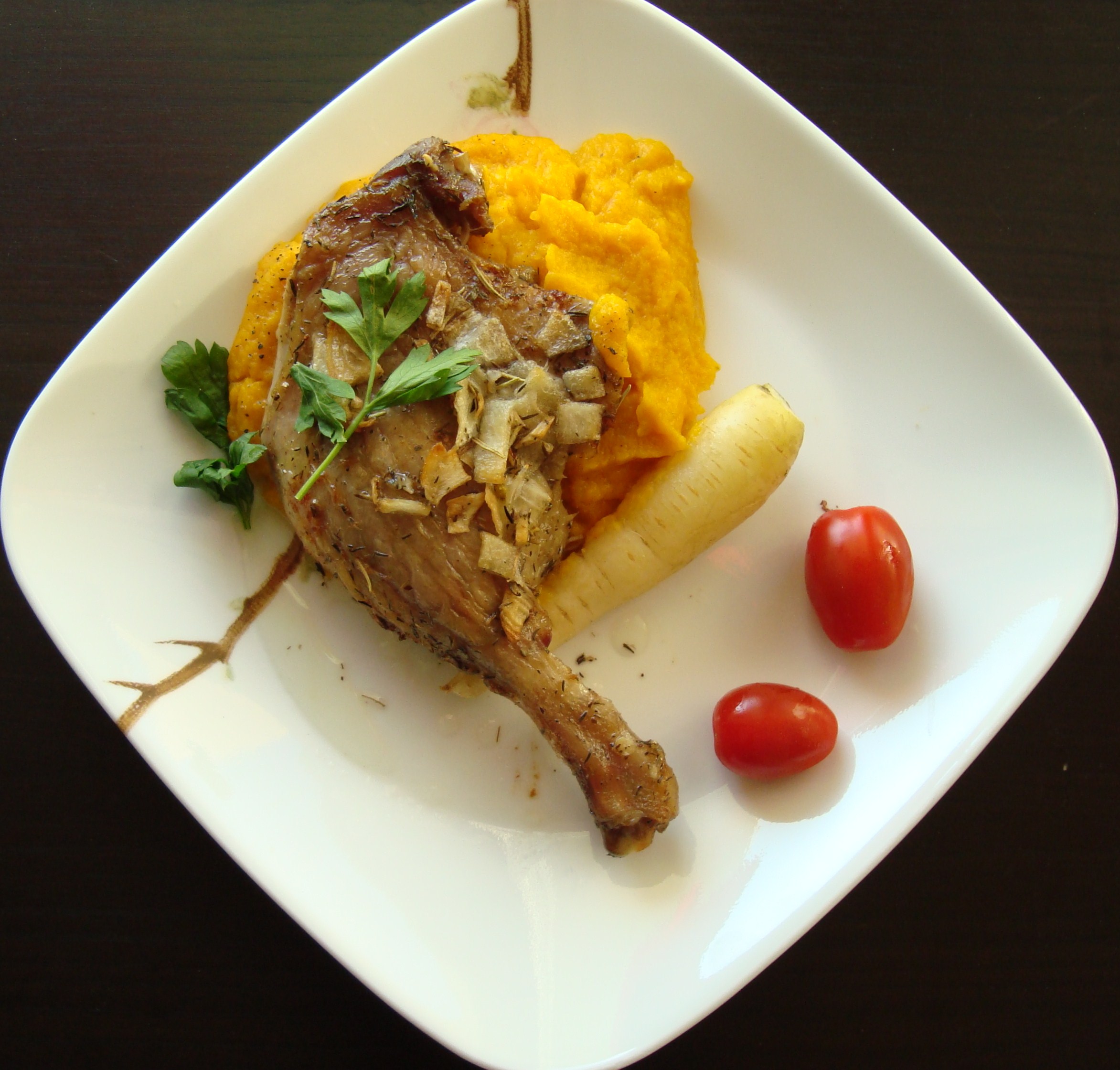
3 x 2 duck legs vacuum sealed ready to be immersed in the sous-vide water oven
Sous-vide cooking used to be the preserve of up-market restaurants. Why? Because the technology behind this method of cooking gives chefs complete control over the outcome of certain recipes. The principle is simple: foods are placed in a vacuum-sealed pouch and immersed in a water bath at a controlled temperature for a controlled period. All things being equal, the results from this method of cooking are identical which in scientific terms amounts to repeatability. Same ingredients, cooked for the same time at the same temperature, taste the same at the end of the process. Excellent for batch cooking. And because foods are cooked in vacuum sealed pouches, foods remain moist and none of the flavour is lost.
The initial cost of the equipment required may deter some people. You need a water oven (which can still be quite expensive) and a vacuum sealer (much less expensive). But making that investment will enable you to produce restaurant-quality dishes at home. Sous-vide cooking is especially effective when preparing tough cuts of meat, brisket, for example, which can remain in the water bath for up to three days and will emerge tender and succulent. Tough brisket, pork shoulder, pigs or ox cheeks all melt in the mouth after cooking sous-vide.
Say no more! You can search online for more details on the benefits of this type of cooking. Meanwhile here’s my own recipe for confit duck legs prepared in the sous-vide water bath:
Duck or goose confit is one of the most luxurious of foods in French cuisine. Gently cured duck legs bathed in their own fat and slowly cooked to falling-off-the-bone perfection. The preparation of this dish in the traditional way can be time-consuming. However, using a sous-vide water oven, nothing could be easier. The first stage of this recipe involves brining the duck legs in a dry cure of 50/50 salt and sugar.
Equipment
A temperature-controlled water bath
A food vacuum sealer
Method for two duck legs
To brine the duck legs, apply a dry cure (15 g sea salt and 15 g sugar, ) to two duck legs.
Store the legs in a glass or strong plastic container in the fridge overnight or for up to 24 hours.
Gently rinse the duck legs and pat dry.
Vacuum seal the legs together with a tablespoon of duck fat, a few juniper berries, some freshly crushed black peppercorns, and whatever additional seasoning you want in a food-grade plastic pouch.
Immerse the pouch in the water bath with the temperature set at 80 ˚C and leave for 8-10 hours.
Remove from the water bath and drain the liquid into a bowl. [Reserve this liquid in the fridge. When cooled you can separate the fat from the stock. Use the stock in soups and store the fat for use when roasting vegetables or when preparing more duck confit.]
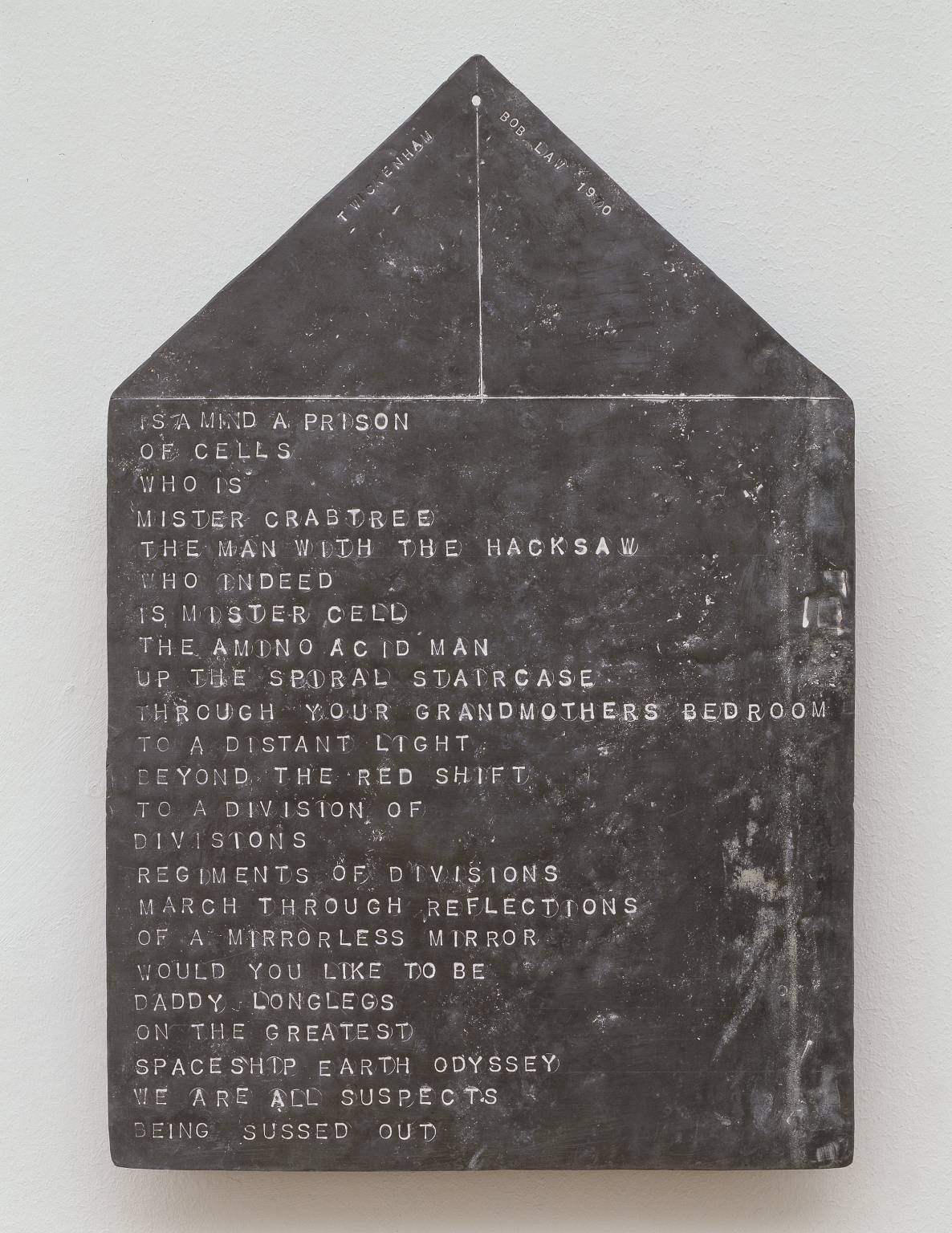
One of the most curious artworks on display at Tate Britain, is a two-dimensional sculpture by Bob Law (1934–2004) entitled “Is a mind a prison”. This piece is an obelisk-shaped tablet of lead, upon which some seemingly incoherent lines of poetry have been etched. The title of the work is a question, which in itself is unusual in the world of art: despite the fact that one of the fundamental aspects of art is the asking of questions, most paintings and sculptures have simple affirmative titles. Bob Law’s obelisk is also simple in form: it could represent a chapel, or perhaps even a spaceship, one of the notions clearly indicated in the poetic text. If we examine the geometrical shape of the lead tablet it is basically a rectangle topped by two equilateral triangles which suggest a roof structure. The words on the tablet are imprisoned within the space, just as the words in our minds are locked in. Cell within cell.
We are all on a journey, all travelling through space aboard planet earth, and in the course of our journey we will all be confronted with a series of adventures, highs and lows, as though the gods have taken offence and set out to make our homecoming as difficult as possible, just as they did for Odysseus in Homer’s poem.
Bob Law’s reference to redshift is to the cosmological effect caused by the expansion of the universe whereby light sources moving away from the observer are red in contrast to light sources that approach the observer which are blue. Expansion is process. Expansion within the space of our minds within cosmic space. Would you like to be the daddy longlegs, the kingpin, the big daddy on this trip at the end of which we will all be judged for our actions? And so on. . . .
Bob Law was known as one of the founding fathers of minimalism. However, this piece demonstrates that a minimalist technique can be highly expressive. Minimum of resources for maximum effect, Samuel Beckett might have written. Here the combination of sculpture and poetry challenges the observer to stop and to think about structures, about cells contained within cells and questions contained within questions, one art form contained within another.
On the afternoon that this piece caught my eye as I strolled through the beautiful, spacious, well-lit galleries of Tate Britain, and perhaps because of its location by a doorway, it reminded me very much of one of the Stations of the Cross that can be seen in so many churches. This in turn made me think that art galleries do, in fact, have a strong spiritual dimension, not so much because their spaces can replicate churches, but rather that underpinning the work of all the artists on display is the common link of spirituality, albeit manifest in disparate forms. Their work makes contemplatives of us, urging us to meditate on the nature of the human condition. What is it to be human, what is beauty, what in the world around us is worthy of note, what values best define the essence of human goodness, what content and what colours and shapes should be used to celebrate life even as we question its purpose?
All of which explains why the appreciation of art is so liberating and uplifting and why it is so important to incorporate it in the educational process for our young children. But it also has to be appreciated, where possible, in situ. So get down to Tate Britain in Pimlico as soon as you can and when you’re there, take your time, it’s all you have.
Everything passes in time: the theme of so much poetry because that is the abiding sensation in life. We learnt the Latin tag as children: carpe diem, live for today. And as we get older, the truth of that statement becomes ever more evident. Poetry and song take us out of the moment briefly and they celebrate the fact that we can turn the passage of time into something beautiful, into something dynamic. Hence the frequency with which the rose appears in poetry, as a metaphor for beauty and fragility, the intensity of the beauty heightened by its ephemeral nature. Nothing lasts for ever, but life is a seemingly endless sequence of things or activities which do not last forever. Poetry records the moment and the feelings of the moment and it savours the moment paradoxically forever.
After my father died, it was quite a surprise to discover a very large trove of poems he had written over a number of years. I knew that he occasionally wrote poetry, and from time to time he would share some of his poems with me, particularly if they were on topical subjects, such as the 1968 invasion of Czechoslovakia.
Of the three poems below, the nature poems speak for themselves. In addition to being an accomplished musician and artist, my father’s other great passion was gardening and he took it very seriously. We had a very large, sloping garden attached to the house where we grew up and my father was constantly modifying its features, adding a water course and a pond, relocating flower beds, setting aside a small area which he used as an allotment to grow vegetables, trimming the box hedge that ran alongside the lower lawn so that it resembled a steam engine. He had a rich imagination and he could turn it to anything.
The third poem, is about his marriage to my mother and the risk she took by agreeing to share her life with him; and he recognizes the trust that her decision involved. It was, in the end, a marriage that lasted a lifetime, and only death eventually separated them. And it was a marriage that made them, that defined their adults lives. And it was the absolute cornerstone of their emotional lives. They were both schoolteachers, my father a graduate and my mother virtually self-educated. But in their day, people perceived them as a couple, as an inseparable, loving couple. The union was strong, the family unit was strong and every other aspect of life appeared to be subordinate to the love that had brought them together.
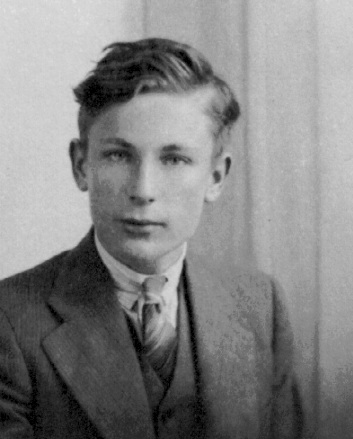
It has to be said that my father was a dreamer, and in the photo accompanying this piece, taken when he was still at St Joseph’s Academy in Blackheath, I believe it is possible to see the dream in his eyes. Nothing wrong with being a dreamer or a poet! My father’s dream was realized in his marriage to my mother and in the six children they had. All his other endeavours, professionally or artistically, were a celebration of the love he gave and the love he received.
Hesperides
Late autumn sunset Humped copper-coloured cloud, like billowing canvas Ponderously sailing over tree tops towards the dark, Attended by a fleet of widely scattered skiffs. Sun-tinted filmy sails against a sea-blue sky. Scarcely a movement of twig or leaf below Save a rustle in the high top elms And saffron fronds of silver birch Draped around its pianola-music bole Standing on uncut emerald grass Green-spiked like springing wheat. Caught by the western glow Two apples hang upon a topmost branch Unplundered reassure of Hesperides.
*
This river
I stood upon a river bank Whose current carried tumbling leaves. The water moved but I was still. It passed, to merge into the sea. Travelling in rippling rapid speed Over rocks it foamed its urgent pace, Then slackened, scything cuts at bends, Its path confined to journey’s end.
And then I knew it carried me: For as I gazed upon its flow Time had gone upon its stream, Seconds, like bubbles, here, then gone – A paradox of life itself. For while, at times, we are quite still Or feel increase in our life’s motion The seconds ever bear us on To lose ourselves within the ocean.
*
Till death do us part
When first they met the sea was calm He told her tales of wonder and delight That lay beyond the harbour walls She longed to put to sea : they two alone, Sailing among enchanted isles. It was a prospect that entranced Intoxicated and allured. And yet she feared the deep. He was no master mariner, But once before had lost a ship (And, near his skin, so bronzed and muscled)
What if it should . . .
She looked into his eyes And cast aside her fears. She knew that she would go.
They only took what each would need He told her what; they jettisoned the rest. And so they sailed into the deep water: Where they had berthed the currents swirled, Carrying to and fro, among the eddies, The flotsam, so lately and so lightly tossed away, Drifting till it was cast up stranded on the beach – Brief witness where a ship was tied; Up-anchored, they sailed, and left it all behind.
I must have been fourteen when I started working as a Saturday delivery boy for a butcher in the medieval village of Old Bexley. I can still remember the day I first entered the shop, the pungent smell of raw animal flesh, the bloodied clumps of sawdust over the floor, and the three butchers with their traditional blue and white striped aprons, wielding their knives, carving and chopping meat as they chattered amongst themselves.
I’d been taken there by Peter Murphy, who was the son of my godfather, Jimmy Murphy. Our fathers had been friends since their childhoods and both had attended the same secondary school, St Joseph’s Academy, in Blackheath. Jimmy Murphy was originally from Arklow in Ireland, where my paternal grandmother was born. As with my own family, there were three boys and three girls in the Murphy family, and I was closest to Peter, the eldest of the boys, who was probably five or six years older than me. Peter attended St Mary’s Grammar School in Sidcup, and when I started there in September 1961, my parents had asked him to take me to and from school. So each morning he would call for me on his way and we would walk down to the Black Prince pub where we would catch the bus. Similarly, he would wait for me at the end of the school day.
Always a jovial character, it was not difficult to get on with Peter, but the age difference was significant, and after a couple of months, we both tired of the arrangement. At the end of the day I’d give Peter the slip and go off with my friends to play football in the park across the road from the school. This was undoubtedly a great relief to him.
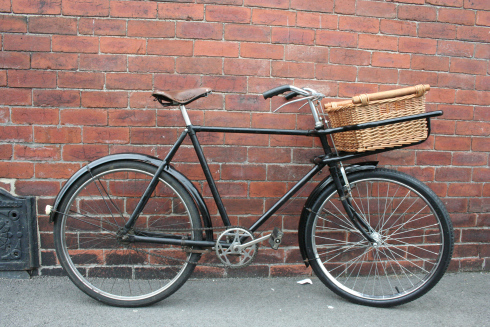
My memory of all the circumstances is a bit hazy, but I assume Peter had been working for the Bexley butchers for some time; so when he decided to move on to better things, he asked me if I was interested in replacing him, which of course, I was. I was a scrawny looking lad in those days and as I walked into the shop beside Peter, the manager eyed me up as a rather unpromising piece of meat before reluctantly agreeing to give me a trial. That first Saturday, Peter showed me the ropes. The delivery bicycle was one of those old-fashioned affairs with a very large basket at the front. It was extremely heavy, even before the basket was loaded, and quite high, so that even when the saddle was adjusted to its lowest height it was still so high I could barely touch the ground with the tips of my toes. “And watch the brakes,” Peter warned me. “They’re very poor and you need to slow down well in advance if you want to stop.” “Couldn’t you ask them to do some maintenance on it,” I asked. Some questions in life can be answered silently, with just an appropriate facial expression: that was one of those occasions. Notwithstanding, we eventually left the shop and loaded the basket. I had my own set of wheels with me, a cycle which I’d cobbled together over months from parts I’d found abandoned in the street at different times. Peter led the way on the delivery bike and we spent most of the morning distributing quality cuts of beef and lamb and a few boxes of eggs to some of Old Bexley’s finest. There were a couple of very steep hills on the round, one in particular on Parkhill Road which ran down to the Blue Anchor pub. “This one is treacherous,” Peter warned. “Remember, with the weight of the bike and a loaded basket, the brakes are useless, might as well not have any. So you need to be especially careful.” I nodded, but felt sure I could handle anything. “And,” he added. “If you need to turn the bike around be sure to make as wide a turn as possible or the handlebars will lock and the bike will slide from under you. Next thing you know, you’ll be lying in the road with your meat and eggs scattered all over the ground.” On a later occasion I had cause to wish I’d paid more attention to all the sound advice he had given me: but such is the folly of youth, full of confidence until the cropper comes!
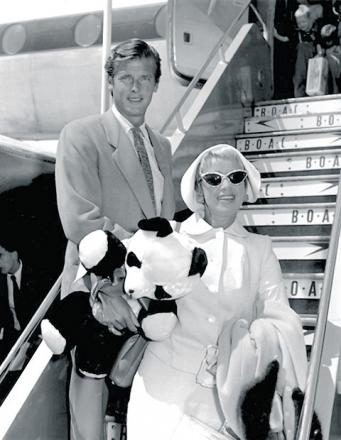
Dorothy Squires and Roger Moore
But this piece is not about the cropper. The incident I wish to describe took place after I’d had several uneventful Saturdays working for the butcher’s, and it concerns the second wife of the actor, Sir Roger Moore, the former Saint and seven-times James Bond who is currently doing the rounds promoting his one-man show in London. At the time of this story, he was living in Bexley, having just married the popular Welsh singer, Dorothy Squires: not that I knew this when I saw the name of Dorothy Squires on the list the butcher handed to me a few Saturday mornings into the job. Dorothy lived at The Mount, a large detached house in Wansunt Road just off Vicarage Road, the continuation of which led to Dartford Heath. The house was actually the last of the addresses on my round that day, and by the time I reached the front door I was feeling rather pleased with myself. No accidents on the bike, not an egg broken, no sweat. It was a beautiful summer’s day, the air was full of honeysuckle and lavender, birds were singing and I would soon have a little money in my pocket once I returned the delivery bike to the butcher’s. I remember a long gravel path curved down to the house which to me looked more like a palatial mansion. I leant the bike against the wall and took out the package of meat. Then I rang the bell. I waited for an answer. And I waited. One minute, two minutes passed. But nobody came to open the door. Beginning to feel a little impatient, I rang the bell again, twice. Suddenly I heard the clump of footsteps, then the sound of a chain being loosened, the sound of a key turning in a lock, twice. The door opened just enough to see a blonde lady in a flimsy nightdress and dressing gown. It was Dorothy, I’d seen her on TV. She scowled at me when she noticed the package I had thrust towards her. She didn’t take it. “Don’t you know,” she said in a lilting, rather posh Welsh accent, “that there’s a tradesmen’s entrance at the side of the house, boy? You’re not supposed to ring here.” I looked down at the ground and shook my head, and felt my freckled cheeks flush with embarrassment. “No,” I muttered. “I’m sorry. I didn’t know.” “Well you do know now,” she said. “So remember next time!” And with that she snatched the meat from my hands and slammed the door in my contrite face.
Years later I read a description of a similar occurrence, in William Faulkner’s 1936 novel, Absalom Absalom, in which the doomed hero, Thomas Sutpen, suffers humiliation, as a fourteen year old, when a black butler refuses to allow him to enter the mansion of the planter Pettibone by the front door. The young Sutpen vows after that incident that one day he will be the owner of a similar mansion, set in a similar plantation with blacks working for him. And it is the psychological damage caused by this childhood snub that motivates Sutpen to achieve immense material success and leads ultimately to tragedy. Happily, the rebuff I received from Dorothy Squires failed to leave such a pyschological scar!
In the extract below from Absalom Absalom, by William Faulkner, the use of an ethnic term which has now become offensive is retained:
And now he stood there before that white door with the monkey nigger barring it and looking down at him in his patched made-over jeans clothes and no shoes and I dont reckon he had even ever experimented with a comb because that would be one of the things that his sisters would keep hidden good-who had never thought about his own hair or clothes or anybody else’s hair or clothes until he saw that monkey nigger, who through no doing of his own happened to have had the felicity of being housebred in Richmond maybe, looking-” (“Or maybe even in Charleston,” Shreve breathed.) “-at them and he never even remembered what the nigger said, how it was the nigger told him, even before he had had time to say what he came for, never to come to that front door again but to go around to the back. “He didn’t even remember leaving. All of a sudden he found himself running and already some distance from the house, and not toward home. He was not crying, he said. He wasn’t even mad. He just had to think, so he was going to where he could be quiet and think, and he knew where that place was. He went into the woods. He says he did not tell himself where to go: that his body, his feet, just went there-a place where a game trail entered a cane brake and an oak tree had fallen across it and made a kind of cave where he kept an iron griddle that he would cook small game on sometimes. He said he crawled back into the cave and sat with his back against the uptorn roots, and thought. Because he couldn’t get it straight yet. He couldn’t even realise yet that his trouble, his impediment, was innocence because he would not be able to realise that until he got it straight. So he was seeking among what little he had to call experience for something to measure it by, and he couldn’t find anything. He had been told to go around to the back door even before he could state his errand, who had sprung from a people whose houses didn’t have back doors but only windows and anyone entering or leaving by a window would be either hiding or escaping, neither of which he was doing. In fact, he had actually come on business, in the good faith of business which he had believed that all men accepted. Of course he had not expected to be invited in to eat a meal since time, the distance from one cooking pot to the next, did not need to be measured in hours or days; perhaps he had not expected to be asked into the house at all.
Charles Baudelaire (1821-1867) was a French poet, translator, and literary and art critic whose reputation rests primarily on Les Fleurs du mal [The Flowers of Evil], published in 1857, which was undoubtedly the most important and influential poetry collection to appear in Europe in the 19th century. When it was first printed, the book was prosecuted for alleged obscenity.
Addicted to sex and drugs, Baudelaire eventually succumbed to syphilis, but in his famous preface to Les Fleurs du mal entitled “Au lecteur” [To the reader] he listed all manner of vice and accused his contemporary society of monstrous hypocrisy, stating in effect ‘none of you are any better than me, my brothers.’. A number of versions of this scathing text can be read at: http://fleursdumal.org/poem/099, but here are the first two verses in a translation by the American poet, Robert Lowell:
To the Reader
Folly and error, sin and avarice, Labor our minds and bodies in their course, Blithely we nourish pleasurable remorse As beggars feed their parasitic lice.
Our sins are stubborn, our repentance faint, We sell our weak confessions at high price, Returning gaily to the bogs of vice, Thinking base tears can cleanse our every taint.
The prose poem I have translated below is taken from the posthumously published Petits poèmes en prose (1869): the most successful and innovative early experiment in prose poetry of the time. Here the mood is that of world-weariness, ennui, or spleen and the title is borrowed from a poem by the English poet, Thomas Hood.
Anywhere Out of the World
This life’s a hospital in which every patient is possessed with the desire to change beds; one would like to suffer in front of the stove, and another believes he’d recover his health by the window.
It always seems to me that I’d feel well wherever I am not, and this question of displacement is one I’m forever discussing with my soul.
« Tell me, my soul, my poor frozen soul, what do you think of going to live in Lisbon? Must be warm there, and there you’d liven up like a lizard. That city’s on the coast; they say that it’s built of marble and that the people there so hate vegetation that they tear down all the trees. There you have a landscape to your taste! a landscape made of light and mineral, and liquid to reflect them! »
My soul says nothing.
« Since you’re so fond of taking it easy, while observing the bustle, would you like to live in Holland, that beatifying country? Maybe you’d have some fun in that land the image of which you’ve so often admired in the art galleries. What do you think of Rotterdam, you who love forests of masts, and ships moored at the foot of houses? »
My soul remains silent.
« Perhaps Batavia would appeal more? There, of course, we’d find the spirit of Europe married to tropical beauty. »
Not a word. « Could my soul be dead ? »
« Have you reached such a degree of lethargy that you’re only content to be ill? If so, let’s flee to those countries that are analogues of Death. I know what we need, my poor soul! We’ll pack our trunks for Tornio. Let’s go farther still to the far end of the Baltic; or farther still from life, if that’s possible; let’s settle at the Pole. There the sun only grazes the earth obliquely, and the slow alternation of light and darkness suppresses variety and increases monotony, that semi-nothingness. There we’ll be able to take long baths of darkness, while to amuse us, the aurora borealis will from time to time send us its pink sprays, like a display of fireworks from Hell! »
Finally, my soul blows it top, and wisely cries out to me: « Anywhere! anywhere! as long as it’s out of the world! »
In March 1977 I arrived in Caracas and was immediately contracted by the Venezuelan Ministry of Culture to select and translate an anthology of modern Venezuelan poetry. Among the poets I chose to include was Eugenio Montejo (1938-2008) whom I met shortly after starting the project. I met many poets in the course of the next three months, but none more gentle and unassuming than Eugenio.
Years later Eugenio was to become famous when Sean Penn spoke some of the words from a poem he had written in the film 21 Grams, directed by the Mexican, Alejandro González Iñárritu.
The earth turned to bring us closer it turned on itself and within us until it finally brought us together in this dream as written in the Symposium.
I completed my work in Caracas in May 1977. Since that time I have not looked at the translations below, nor have I revised them. At the time I had shown my versions to Eugenio and he had been pleased with them and that was enough for me. Outwardly, Eugenio was the stereotypical professor of literature: yet his poetic voice was the most original of his generation.
Earthness
To be here, for years, on the earth, with the clouds that arrive, with the birds, suspended in fragile hours. On board, almost adrift, closer to Saturn, more distant, while the sun goes round and pulls us and the blood runs on in its ephemeral universe more sacred than all the stars.
To be here on the earth: no further than a tree, no more unexplainable, lithe in autumn, bloated in summer, with what we are or are not, with the shadow, the memory, the desire, till the end (if there is an end) voice to voice house after house, whether who gains the earth, if they gain it, or who hopes for it, if they wait for it, sharing at each table the bread between two, between three, between four, without forgetting the leftovers of the ant that always travels from remote stars to be present at the hour of our supper although the crumbs are always bitter.
*
The table
What can a table do by itself against the roundness of the earth? It already has enough to do allowing nothing to tumble, allowing the chairs to converse softly and in turn to come together on time.
If time blunts the knives, dismisses and brings diners, varies the topics, the words, what can the pain of its wood do?
What can it do about the cost of things, about the atheism of the supper, of the last supper?
If the wine is spilt, if bread is wanting and people grow absent, what can it do but remain motionless, rooted between hunger and the hours, with what intervenes though it should wish?
*
The stones
The stones intact in the river absorbed in the bank, sitting alone, in conversation. The stones deeper than childhood and of more solid scenery. When they see us they lift their faces now cracked and they do not recognise us, you have to speak to them so loudly!
They have no notion of masks and journeys, they perceive time through touch, they believe that our image in the water was erased in the sands downriver.
In the afternoons the shadow of an aeroplane passes over them and they are unaware that they go in the suitcases on board, that they are our only luggage, so tightly have they shut their eyelids.
 Having commenced this daily blog towards the end of July, and given the response of readers on a day-by-day basis, I have come to one conclusion, (there will be others), namely, that the poetry posts are far and away more popular than anything else, and certainly far more popular than the short stories. I believe that there is a very simple explanation for this. Readers respond to poetry because it touches them in a way that very little prose can match.



 johnjosephlyons