Tear-feeding moths and butterflies in Africa and Asia and South America feed on large placid animals deer antelope crocodiles which cannot readily brush them away
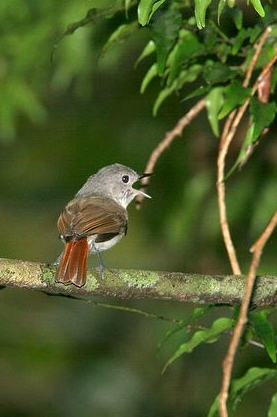
In Madagascar there are no such large animals Birds can fly away but not when sleeping The Madagascan moths can be seen on the necks of sleeping magpie robins and red-tailed newtonia the tip of their proboscis inserted under the bird’s eyelid avidly supping for the sodium in the tears
As the birds have two eyelids both closed instead of the soft straw-like mouthpart found on tear-drinking moths elsewhere the Madagascan moth has a harpoon-shaped proboscis with hooks and barbs which it inserts and secures under the bird’s eyelids without disturbing the bird
The Madagascan tear-drinkers all male derive most of their nutrition from tears : take from this observation what you will
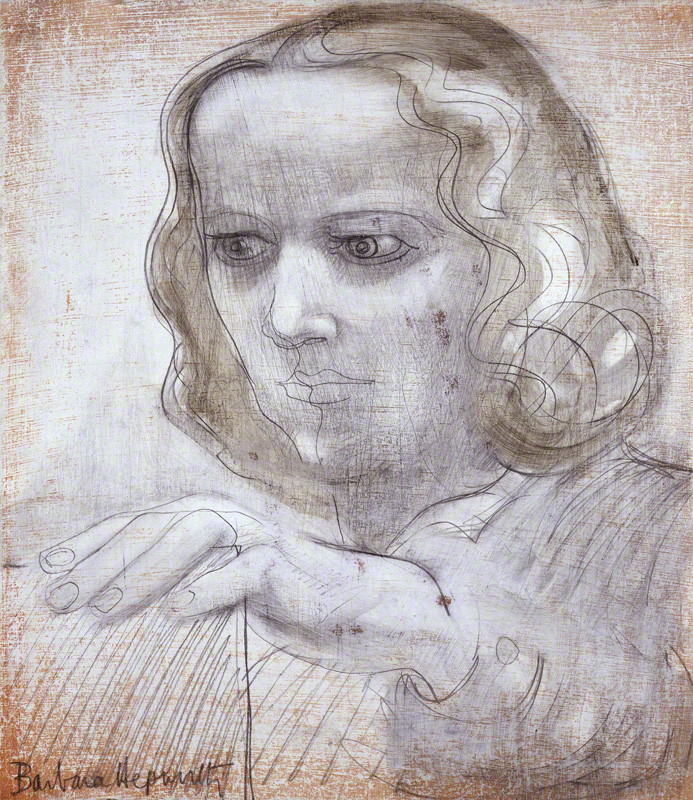
Barbara Hepworth, Self-portrait, 1950 (oil and pencil on board)
For those who enjoyed the recent Dame Barbara Hepworth retrospective at Tate Britain, here is a self-portrait which she produced in 1950, done in oil and pencil on board.
The beauty of this portrait lies in its simplicity. In what is little more than an elaborate sketch, Hepworth has rendered a representation of herself as sculptor, her eye focused on her hand which is resting on a block of material, possibly of marble, and she has such an intense gaze that we can imagine that she is trying to discover the shape which is hidden within the material, or perhaps trying to decide whether the idea or shape she has in her mind will find its form within the medium she is touching. Touch to her was paramount, as she stated:
“I think every sculpture must be touched, it’s part of the way you make it and it’s really our first sensibility, it is the sense of feeling, it is first one we have when we’re born. I think every person looking at a sculpture should use his own body. You can’t look at a sculpture if you are going to stand stiff as a ram rod and stare at it, with a sculpture you must walk around it, bend toward it, touch it and walk away from it.”
The sketch itself can be seen as a preliminary study for a sculpture, the theme of which, is not so much the individual person but the art itself, the vocation of sculptor. The form is stripped down to the essentials as it would or could be if rendered in stone or bronze.
It is not an abstract but it does demonstrate how the great abstracts were produced through a process of reduction, of paring away of unnecessary detail to maximize the impact of the essential shape, which is to say, the essential space that the sculpture displaces. The portrait captures the texture and smoothness of stone and at the same time proposes an eventual transfer of energy, of breath from one medium to another, a process which lies at the heart of all artistic activity.
Barbara Hepworth was born in Wakefield, Yorkshire in 1903. She was a leading modernist figure in the international art scene throughout a career spanning five decades until her death in 1975. The self-portrait can be seen at the National Portrait Galley off Charing Cross Road.
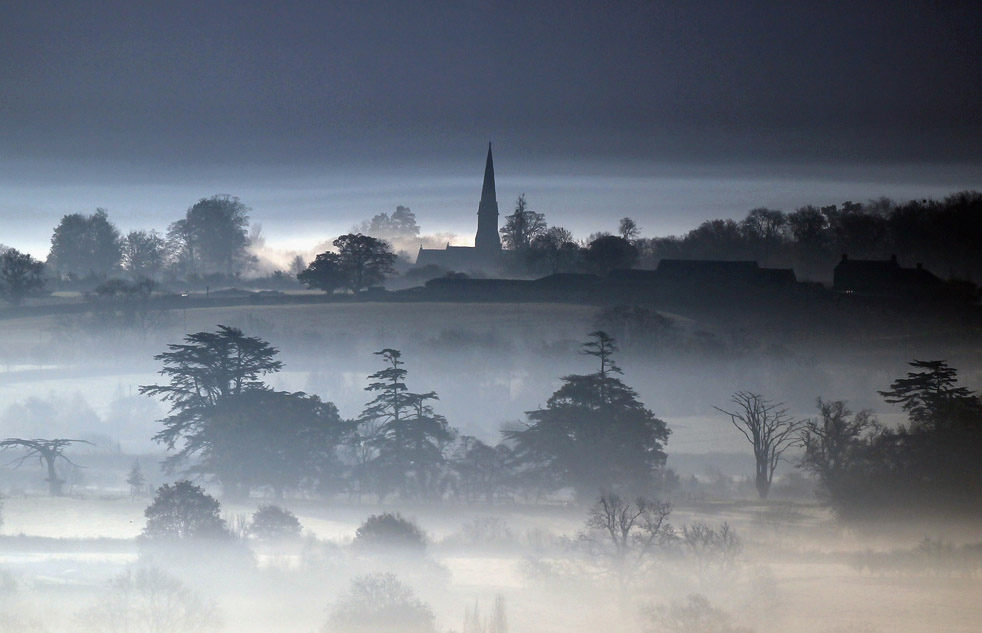
The mist has reduced the distant the streets to dark silhouettes I hear a crow cawing but can see nothing : the world for a moment has lost its sense of direction some of the garden bushes have yet to be stripped of their bright orange berries pigeons have been gorging on them all week mist-coloured pigeons now busy mating under the camouflage This Sunday rises late from its bed but the voices of children with plans and schemes are heard urging their parents to action Under the shroud of mist lovers lie loving in their beds and the silence turns operatic there is so much to do in the world and so little time and yet they lie loving as though there is no tomorrow but there is no tomorrow Cars thread through the mist even as airports close passengers held in suspension circling the metropolis wondering whether they will ever touch land again hovering above their lives but unable to lift a finger to change a thing Sunday has become lost in this mist and plans have been revised curtailed or postponed as life enters the hesitance mode and everyone is suddenly unsure of themselves and looking for guidance aching for leadership and for an answer to several mundanities For some the bed is the resolution when all else fails the bed is a blanket like the mist one on top of the other lovingly like lovers Excuses for inaction are there at the window or dripping from trees that peer from the greyness gaunt shadows of their former selves For the moment for this precise moment this Sunday is going nowhere fast this November first in other words is fast becoming a month of Sundays For the time being in these hyperactive times in which we live the message for the time being is to do nothing
We are so they say the stuff of stars and in the warmth of our bodies there is a remembrance in our eyes a glow and in our hearts an ambition that we may once again travel a galactic distance
We are so they say the stuff of love not the music of it but the dance the perpetual movement see how we cover the floor space how we invest in our intimate choreographies how we twist and turn but always guided by the beam of light that comes from our lover’s eye
We are so they say language words that fuel our journey that send signals to and from mission control words that hone our actions and winnow our thoughts words that ferry our feelings from one soul to the other hopelessly romantic first drafts longing to be shaped into final texts
We are so they say the elaboration of solar energy driven here on the crest of cosmic waves bound in a code of complex simplicities time passing through the mesh of time adventurers of the heart and mind
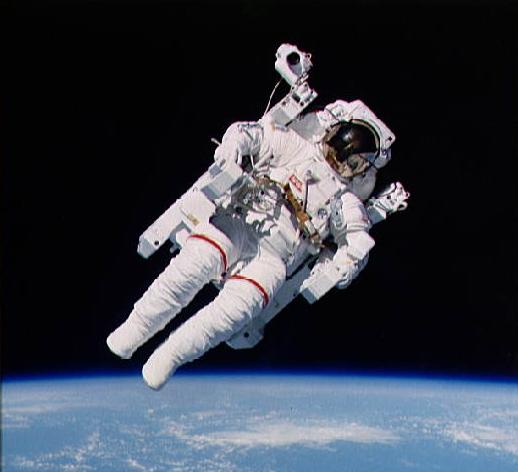
We are so they say astronauts on a mission to discover a path to find our way to rediscover ourselves in our own dark night
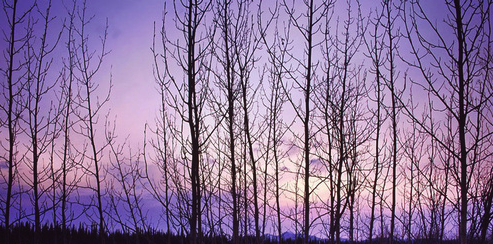
What it is to introduce a new text into the world free from the fret of fear and hate I have seen the sycamore the beech and silver birch stripped to their boughs as a wind blew in from the East and a flurry of tiny birds caught in a sudden gust before their final departure
This is autumnal abandonment the first shivers of the year end plumes of smoke rising above the houses as every step hastens one would hope homeward to a smile and a warm supper
In the woodlands the last chromatic burst has been neutralized and expectation now rests on the buried seed that will rise to pierce the transparent air in spring
And yet the withered rose it would seem has outstayed its welcome as nature reinvents itself in the guise of the poor of the dispossessed of those by force of circumstance obliged to live colourless thankless lives
What currency rules this bitter world of inequalities ? What canker lies at the heart of communities that disown their own ? And where are we to find the necessary angels of the earth those not stiffened by the pangs of greed those with uncurdled hearts who believe in the reality of harsh realities ?
Nature is the great leveller and months of austerity will yield in time to the bliss of abundance the speech of truth will thrive and the peace of intelligence will dismount the stars and share the fruits of their energy among one and all and nothing will be lost
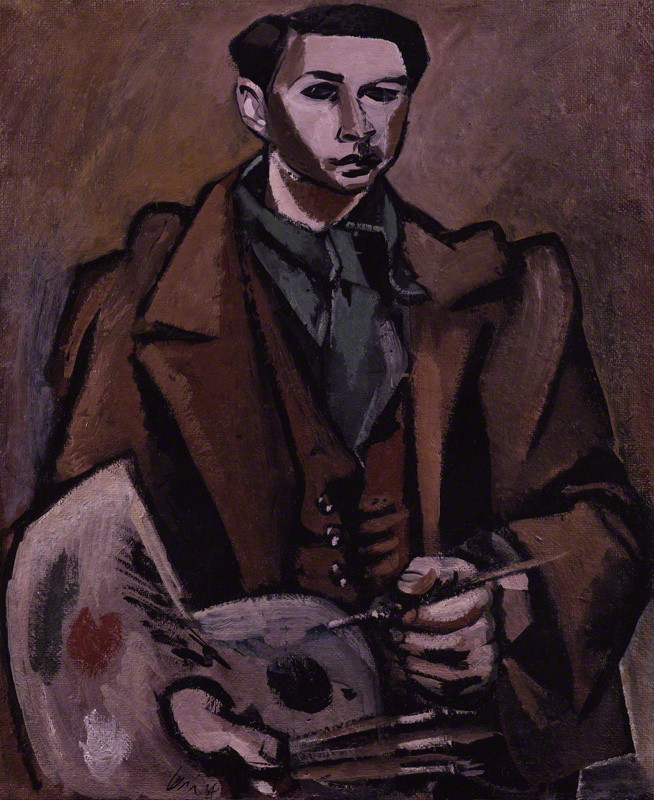
Ceri Richards, Self-portrait (oil on composition board) 1934
Ceri Richards (1903-1971) was born in a small village near Swansea. He and his younger brother and sister were brought up in a highly cultured, working-class environment. His mother came from a family of craftsmen; and his father, who worked in a tinplate foundry, was active in the local church, wrote poetry in Welsh and English, and for many years conducted the Dunvant Excelsior Male Voice Choir. The children were all taught to play the piano, and became familiar with the works of Bach and Handel. In later years music would be an important stimulus to Richards’s painting – as would his youthful sensitivity to the landscapes of Gower and the cycles of nature. Richards trained initially at the Swansea School of Art before completing his studies at the Royal College of Art, (where in later years he became a teacher).
In this beautiful self-portrait from 1934, the influence of the surrealists is quite apparent, particularly that of Picasso. Nevertheless, the portrait remains very much rooted in Richards’s Welsh background, with the dark earthiness of the colours capturing the tone of the valleys where the artist grew up. It is very much the ‘portrait of the artist as a young artist,’ but an artist emerging from a very specific landscape, which the rugged shapes and the simplicity of the composition evoke so well. It is an action painting in the sense that the subject is proudly presenting the tools of his trade, the palette and brushes which he carries as emblems. The thick black lines enhance the notion that the artist is an accumulation of elements, yet the eye is drawn to the bright complexion and the affirmative expression which underline the pride Richards took in his work and his vocation. This self-portrait is quite simply his coat of arms.
Richards wrote: “One can generally say that all artists — poets, musicians, painters, are creating in their own idioms, metaphors for the nature of existence, for the secrets of our time. We are all moved by the beauty and revelation in their utterances — we notice the direction and beauty of the paths they indicate for us, and move towards them”.
The beauty to which Richards refers is intrinsic in every detail of this self-portrait which so clearly and affectionately references his roots in the Welsh valleys —which he appears to be wearing about his shoulders— and his belief in the rugged powers of art. Former pupils have described Richards as a cheerful, boisterous teacher, and these traits come through in this marvellous celebratory painting which is there to be admired any day of the week in the National Portrait Gallery on Charing Cross Road.
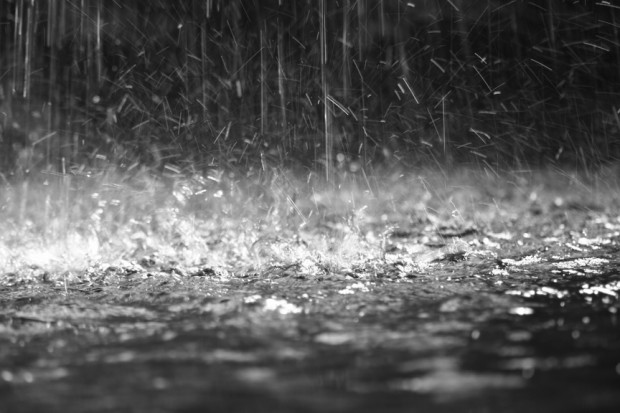
Across the whole of England rain is falling falling upon the towns and the fields falling upon the highways and the byeways falling upon the rich and the poor
falling upon young and old alike falling upon the fit and the infirm upon our schools and hospitals Across the whole of England
the sky is dark and rain is falling falling upon those who love and upon those whose lives are consumed with sorrow or hatred
or bitterness or disappointment falling upon those who will struggle to survive and upon those who retain a spring in their step the rain is falling
on buses and cars and trains and planes through the polluted city air across the whole of England the rain is falling everywhere upon the present and the past and upon
the dreams we hope will last the rain rains down on the living and the dead
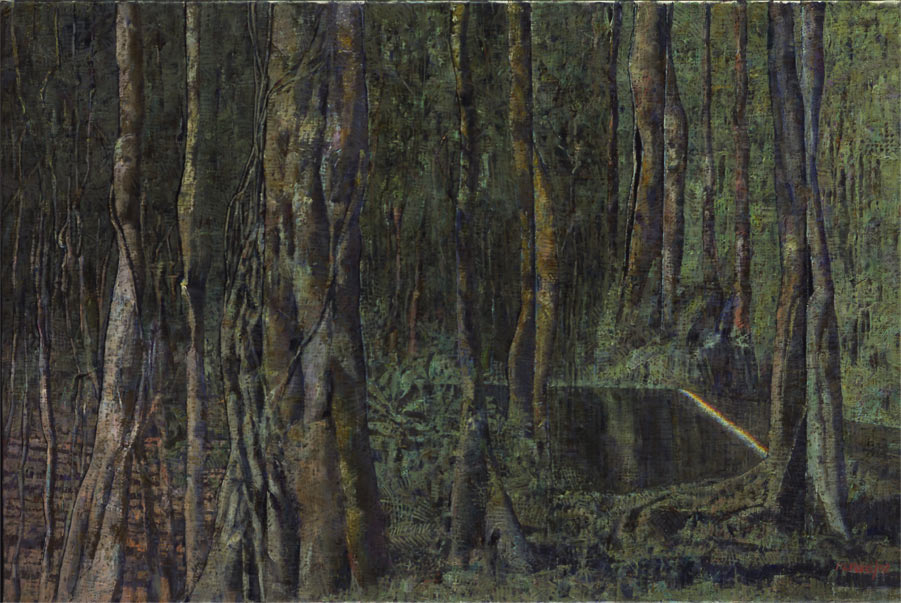
Armando Morales (1927–2011) was an internationally renowned Nicaraguan artist, a contemporary and friend of the poets, Ernesto Cardenal and Carlos Martínez Rivas.
Morales was famous for his voluptuous still lives, in particular, sensual studies of apples and pears that evoked the softness of human skin. He later moved on to the painting of the female form, and in 1971, at the Galeria Bonino in New York, he showed a series of stunning nudes in which the fine detail of every muscle, of every inch of skin, reveals an unsurpassed sensuality.
I visited Armando at his studio in Vauxhall many years ago during a brief period he spent in London. On that day he was preparing a huge canvas, and in the course of our conversation many times he climbed a ladder to access the top of the canvas. In one hand he held a magnifying glass and in the other a razor blade, poring over the surface in search of the most minute imperfections, meticulous to a fault.
I have chosen his beautiful woodland study to illustrate the poem below, the title of which is based on the opening line of Dante’s Inferno.
In the midst of a great forest
What treasures I have amassed are immune to fire and theft though I have indeed known loss loss of the body and loss of the soul and live now in a quiet space catching the drift of birdsong of the splenetic spider that plays upon its frosty web I can resist all things better than my own changeability I breathe the air but do not breathe it all I am not proud and know my place : the moth and the fish-eggs are in their place too so too the bright suns and the wide golden moon that shone last night so too the phantom dawn that creeps through the mist to smother dreams What is palpable is in its place What is impalpable is in its place Whether we fall by ambition blood or lust like diamonds we are cut with our own dust I seek the grail of laughter a life that will turn upon the axle of devotion a kiss not singed by the eventual flame
These are the lanes of death where our footfall falls Here love is a moment and pain another and our mutual friends are ash and dust moth and termite here time runs amok wields a thirsty blade cuts to the very bone
Flying by day this spineless boneless innately venomous creature is a paragon of brash invertebrate beauty but beauty comes at such a price Native only to Madagascar it flits from bloom to bloom its long proboscis supping by preference on the nectar of white flowers More choosy still are the larvae that that feed only on plants from the toxic Omphalea family They hatch from eggs laid on the underside of the leaves of these plants The white or pale yellow larvae with bright red feet will once they emerge mercilessly devour the entire plant leaf flower stems and all before moving on to decimate another of the same family From tip to tip their wings span a good three inches and boast shades of black and blue and red and yellow and emerald green Patterns of kaleidoscopic effect are produced by the wings’ curved scales creating optical interference as light is reflected at sharply different angles Toxicity is their defence for though the caterpillars eat the poisonous plants the toxins are not digested : these remain in their bodies through pupation into adulthood To most predators a most noxious foul-tasting moth— the iridescence of their wings a salutary warning
It’s that time of the year again. Clocks have gone back, the temperature is beginning to drop and we are all bracing ourselves for winter. The landscape is unrecognisable from the bright summer days, yet every season has its magic and its mood. Autumn, a sensitive time for nostalgia, for poring over memories by an open fire, for meditation; a season which John Keats has indelibly marked forever as a time for poetry. And so we are pleased today to present a new poem by our dear friend, Molly Rosenberg.
Autumn Thoughts
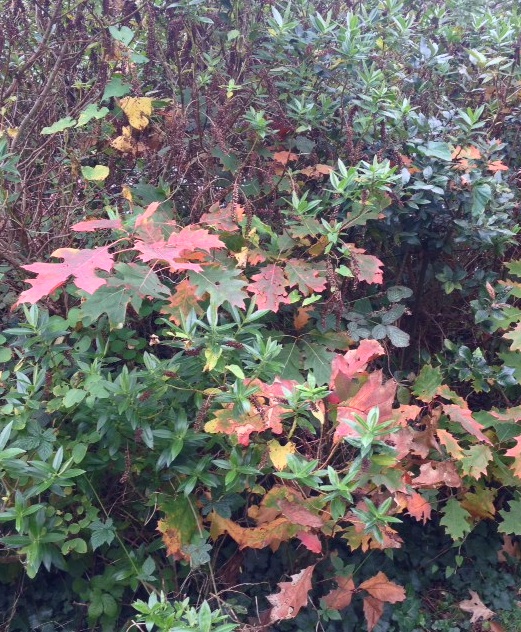
Through gold Through ruby red Burnt orange Amber glow
Like us the magnificence of beauty reaches its crescendo, as the array of colours overwhelms the Ravensbourne Valley. It takes my breath away. So short a time like our youth so fleeting.
Fluttering Drifting Crunching underfoot
Beauty turned to nuisance now like us when our purpose is served, all will be swept away.
The sharpness of the air pricks my cheeks. I wrap myself in the softness of cashmere. Relish the feeling of summer feet now clad in suede as I tread lightly through these golden autumn days.