Sophie grown old

Sophie grown old

Like a new invention, Sophie
      you were ushered into the world;
given all the care and attention
      of the new-found; trained
for perfection, till all
      stepped back and admired
the beauty, the goodness
      the gifts.

You lived a little,
      saw much suffering
brought peace where you could,
      hardly noticing the changing
colour of your hair
      the yellowing skin,
life spreading its surreptitious
      disease.

You loved a lot
      were for a while loved back
and forth
      but with a merchant love capable
only of despair, and then
      you were left alone.
But though your life ceased
      you continued to grow old,
with a mind that swayed
      to a weakly magnetic north.

Now,
      if that exists for you,
you have been placed in a drawer
      along with other uncrossed oceans
which have outgrown their usefulness,
      lost all novelty.

You rarely stir the dust about you
      nor do many come to inspect
you in your hidden place,
      to take you by the hand
and press a little warmth
      into your cold, lost world.
We all grow out of fashion
      but never outgrow love.

John Lyons


Unless the seed. . .

Unless the seed. . .

On one side
            the long neatly trimmed box hedge
                        a fragility of shimmering bronze
            in the fast fading half-light
                        of this misbegotten winter’s day

On the other
            by the lap-panelled fence
                        an apple tree – perhaps a Bramley –
            from which all but two crisp leaves have fallen
                        but to which twenty or more

apples
            still cling on for their dear fruitless lives
                        roundly reluctant to detach
            to tumble gravely to the ground
                        to take their chances in the damp

fertile soil
            Soon it will be dark : soon
                        the endless agony of the long night
            will grip those prone to despair while
                        ravenous couples gorge on scraps

of unrequited love
            Outside the unkempt lawn is marked
                        with narrow trails blazed by frisky cats
            and foxes that gently indent the lush green grass
                        as they ply their necessary trade

John Lyons


Pilgrim’s Progress


Pilgrim’s Progress

Why not state the obvious for a change
           that we are all solar powered
for example
           or that we are all astronauts
launched into orbit at the hour of our birth
           that there is no such thing as outer space
that even the inner space of consciousness
           is hurtling through the solar system
at an unthinkable speed ?

Bride and groom honeymooning
           on the beach
starry eyed as they gaze up
           at their ancestors embroidered
into the night’s rich tapestry
           and thankful for a marriage
literally made in the heavens

Who taught the galaxies to sing
           who taught the stars to cry out at birth
or to die with a whimper
           who put poetry into the mouths of babes
and beauty into the eye of the beholder ?

Cryptic messages wherever we look
           the restaurant in the Miami Airways motel
shortly after Hurricane Andrew
           ‘Food to go’
as we are all here to go
           consumed on the hoof
pilgrims bound for an unknown shrine
           a pause in our journey to tell tales
to sing songs
           to while away the hours
until we reach our final destination

Thirteen ways of observing
           four and twenty blackbirds
baked in a pie
           wasn’t that a dainty dish !

John Lyons

The kitchen – a preliminary sketch

The poem below was written in Spanish many years ago and it was partly inspired by a reading of several works by Gertrude Stein, in particular her stories, Three Lives, and her long prose-poem dedicated to the home, Tender Buttons. Having been written in Spanish it benefited from the sounds and rhythms of that language, some of which have been lost in the English translation. 


The kitchen – a preliminary sketch

The kitchen is the household’s nest and home’s soul
it is the homely heart of hearts and so much so that
we must admit that without a kitchen there is no home
       just as without a heart there is no body
new paragraph

And it doesn’t matter whether it has a gas or electric
or even a wood stove the kitchen is always
the great engine the main driver that powers a home
it is the turbine the dynamo and the source and origin
       of all domestic and experiential energy

In the kitchen the plants and flowers and wood all feel at home
       cold cast iron and tender marble at home too
       at home cork and wickerwork
       surrounded by glass and ceramics
and everything just as natural as can be in the kitchen with only plastic
and polyurethane and anything at all synthetic feeling a little out of place
       surrounded by so much vegetable
       mineral
       and human nature

Here technology counts for little
in the role the kitchen plays in home life
because every technological device has a single purpose
to fulfil an ancient task in the newest
and most efficient manner nothing more
so that while not exactly redundant
technology is indeed par excellence expendable
and so much more so
than the cry of a cockerel or a lark
       at the crack of dawn

A kitchen has its own rhythm and its own music and in that
it resembles a poem a poem perhaps hanging on a kitchen wall
amid photos of grandparents and great grandparents as though a recipe
for the preparation of some stuffed eggplants
because in reality poems too are stuffed in so many different ways
with so many different sauces to give them a particular flavour and
likewise certain recipes too are followed to carry them off
so that poetry and cooking
       -in practice and in situ-
       are two quite similar things
although on the other hand
       totally different and no comparison

In a kitchen to come up behind someone who’s peeling potatoes
or rinsing vegetables under cold water running
over the sink can be a real treat because the person
with their hands full cannot defend themselves and one can
hug that person from behind or give them a peck on the neck
or do both simultaneously and there’s nothing
the poor person can do with busy wet hands
but let out a scream and laugh and try to turn around or dodge
but most of the time it’s in vain because from a kiss
which by the stars is bound to be bestowed
there’s no escape because it’s fate
and no one escapes their fate as we all too well know
although rarely do we know what exactly fate is
especially our own random luck
our destiny or that of those we most love
       because that’s life
       with a destiny but unpredictable
       as though there were no destiny
       at all

And notice that a kitchen occupied by one person barely counts
as a kitchen because the nature of the kitchen requires the minimal presence
of two so as to classify as a real kitchen
and the reason for this is that the kitchen is a place of sharing
and by definition solitude’s not something to be shared
so it fails to qualify as a kitchen but rather undermines it authority
or at least removes authenticity and I’d go as far as to say takes away the taste
from the food served in that room that I daren’t
even call a kitchen given that it’s occupied nothing more
than by one person alone and that’s not sharing
and by failing to comply with the rules of the kitchen
       is hopelessly disqualified

And a rhetorical question would be
where else can one find such an intimate and innocent
formal and informal promiscuity in a house than in the kitchen
and that is largely due to the fact that a main ingredient of a main kitchen
is miscegenation
or rather the confluence
of a huge variety of ingredients in a single dish
because to tell the truth when the culinary art
is practised seriously very rarely does the kitchen not assume something
of the atmosphere of the General Assembly of the United Nations
when a host of products from various flags around the world congregate
all of which are destined in accordance with the talent
of the person in charge of the cuisine to melt into
a unique combination into a single unified taste though there might
persist a plethora of minor or secondary flavours
       underlying the unicity of the dominant flavour
       and that’s why all prejudices have to remain
       out of the kitchen so as not to impede the peace process
which is cooking within the confines of that space
that is indeed a kind of sanctuary
for all human rights and values
of respect and democracy and friendship and affection
       and quite simply love

Moreover as if this weren’t enough the kitchen is a place
where many alien things are always mislaid
and where other equally alien things are always found
a phenomenon that is repeated so often
that it gives the impression that the kitchen is a magical space
with frankly surprising powers of attraction
and it’s impossible to hear the question
where’re the keys or the newspaper
without thinking with an almost pathological automatism
of the probability that the blessed newspaper quite certainly
is in the kitchen not far from the cup and glasses
and perhaps beneath the keys to the car
       or to the house itself

And that’s why friends prefer to be in the kitchen instead
of anywhere else even after the meal they’ve just
ingested because the host or hostess will constantly
have experienced the following and that is that after filling
their stomachs friends want to fill their soul with delicacies
no less nutritious than an oven roast or a fried fish
or a plate of rice with shrimp or chorizo
since it’s true that the human species
       cannot live on bread alone
       but on daily conversation and dialogue
       and the exchange of ideas and impressions
       and tastes and sometimes even mild or strong
       disagreements and opposing politics and it seems
that being surrounded by utensils and pots and heavy porcelain
lends to some if not to most people
an unparalleled sense of security so that rarely do they
accept the suggestion to file out into the living room
while the leftovers are put away and the dishes washed
and the stove is cleaned and the coffee has been filtered
because they fear that they’ll lose that frank and warm
human quality that is
       the necessary environment
       of a fine inexhaustible kitchen
       whether here
       or in Timbuktu
       and in saying all this
       I feel I’ve said so very little
       and that I’m really
       just getting going

John Lyons

© 1990, 2015


Erith

A few words for a cold Sunday morning. Poetry is in the rhythm as it is in the wind, in the coalescence or energies that keep the world warm and alive on this frosty morning. The silence of meditation, the white canvas across the land. On days such as these we search for warmth. We wrap up well in our coats or lie longer in bed under the covers. But whether at home or out and about, what we seek is human warmth, a smile, a hand held, a kiss, the clench of love, anything to remind us that this too will pass, that the cold season will shift into spring and on into summer and that patience will get us through these challenging times.

Poetry is in the steps that words take, how they move through the mind at a trot, or flow smoothly like a river or rush over a wintry weir, driven always by the passion for life and by the sustaining energies that come directly from the sun. November. The month of remembrance and of memory, of those who are in the cold cold ground, of those who move warmly above it. Memory, the living gallery of moments and places and feelings and faces and sensations and hopes and dreams and love. 


Erith

From Holly Hill to the river’s edge
           a chill November day
with an icy wind
           soughing among the alders
and the damp chrysanthemum petals
           blown about the garden-ways
beneath a low grey sky

Lassitude
           languor,
                      a sluggish tide
slapping the charred beams
           of the abandoned jetty
           the air thick with decay
                      and obsolescence

The future too has its backwaters
           where light will gather in
dark pools of neglect
           who bathes in these waters
may be lost
                      lost forever


La Recoleta – tomb of Evita Perón

evita_tomb

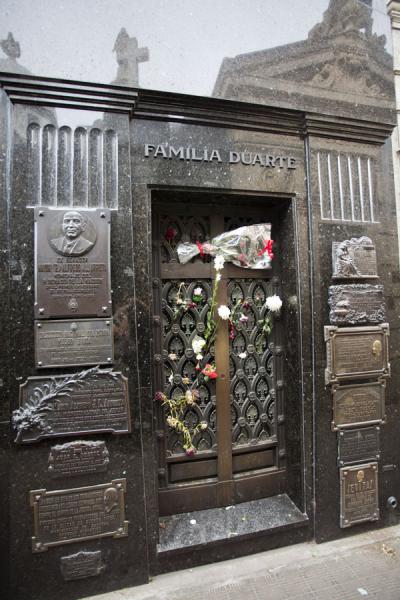
On one of my many visits to Buenos Aires, I visited the famous La Recoleta cemetery, final resting place of so many of that country’s great and good.

When Evita Perón died in 1952, her husband, Argentine President Juan Domingo Perón, ordered her body to be embalmed and exhibited to the nation in a glass case. Three years later, when Perón fell from power, Evita’s corpse became a heavy burden for the subsequent regime that wished to prevent her place of burial in La Recoleta from becoming a cult place of pilgrimage.

Kidnapped by the Army Intelligence Service, for weeks the body was secretly driven around the streets of Buenos Aires, and was later hidden for months in the back room of a cinema. At one stage the body was allegedly subjected to all sorts of passions when it was stored at the home of a captain who had lost his mind. The true location of Evita’s body became the subject of much speculation following the publication in 1995 of a best-selling novel, Santa Evita, by Tomás Eloy Martínez, which propounded many new stories and myths about the posthumous escapades of Evita’s body.


La Recoleta

Here lies
           the body of Eva Perón
                      or so they say, in a low key grave
           that lacks the pomp and circumstance
                      of her new neighbours, some of whom

are determined
           to sit our their time until the day
                      of judgment, in ornate mausoleums
           lined with grey granite slabs; some with
                      tiny windows looking out on the streets

below
           at the frenzied sweep of doomed human traffic;
                      some with en suite bathrooms
           from which dull rusty piss seeps, endlessly.
                      Wealth and illustrious military power

are buried
           here, the owners of a past Buenos Aires
                      and a long gone Argentina. In this dusty
           city of death, laid out in monotonously meti-
                      culous streets and avenues, tourists

anxiously
           stroll through a gaping emptiness that awaits
                      us all; and with a shudder they quicken
           their pace as they exit once more through
                      the huge entrance gates, taking large gulps

of life.
           And on the white external wall an unknown wit
                      has scrawled in huge red letters
           DULCE ETERNIDAD (sweet eternity)
                      and whatever we believe, we are

never
           to know, whether in hope or in despair
                      whether in faith or simply fatigue.
           Here lies the body of Eva Perón, though some
                      say not. Here lies the truth, or a lie.

John Lyons

2 August 2005


Notes Towards a Garden of Eden


Notes towards a Garden of Eden

In poetry we find
             an age of innocence
a return to the garden
             and to the first idea
when all was simple
             and honest and good
Belief in the immaculate
             beginning is restored
and wood-doves sing of peace

Poetry is before the fall
             and it speaks with the power
of tameless waves
             driven by the endless
shunt from ventricle
             to ventricle :
poetry is blood language
             in which the unabashed rose
may blossom with impunity

Poetry perhaps
             from the remnants of stars
from fatigued energies
             revitalized on the breath
quickens a new birth

Poetry feeds on the ashes of existence
             it resurrects dead thoughts
it drives them over the universe
             spreads fire
from its unextinguished hearth :
             among mankind it scatters
words from undead lips
             incantatory
it trumpets its prophecies

There are no withered leaves
             no shrivelled buds on the branch
nor will the stars be overshrouded
             by despair
Life is irrepressible
             so too is love and charity
and faith and hope
             and peace comes dropping
and poetry is the pulse

John Lyons


Starlings

Starlings

The cold earth at dawn
     darkness still
and a restless mind
     Motion lives in space
and in our thoughts
     and poetry must resist
the pull of intelligence

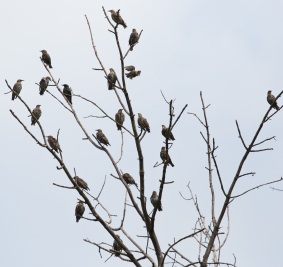
Yesterday in the car park
     a singing tree
a young leafless sapling
     to be precise
and a horde of fledged starlings
     thirty or more
perched on the branches
     singing in unison
a real piece of choral music
     that startled me
with the beauty
     of the melody

As I closed the car door
     a gust of wind caught it
and so it slammed shut
     but the birds did not flinch
nor did they miss a note

A magical singing tree
     such as you might read of
in The Arabian Nights
     each bird
a particle of a single song
    each bird dressed
for the occasion
    looking straight ahead
facing symmetrically south :
     and I admired the complexity
of their harmonies
     their resolution
admired the iridescent

     metallic sheen
of their plumage
     and above all
their all-for-one
     one-for-all attitude

Song lives in space
     and is orchestrated in the mind
At night a canopy embroidered
     with sparkling beads
by day the baton
                         is never still

John Lyons


Circus

Below is a poem written in 1968, while I was still at school. I’m using this today due to problems with the WordPress site which is preventing me from uploading images at present. The post intended for today was a brief commentary on Patrick Heron’s portrait of the poet, T.S. Eliot.

Circus

A thousand ostriches stare at the ceiling
A guest Jamaican spider hangs from his net
Woven at a height to top all heights
The cackling dies down and only the sound
Of crunched sugar corn nibbles at the silence
The pat of the drum breaks into a gallop
The ants below in the sawdust hold hands
The little flies forget their grievances
And pray crossing their wings anxiously

The spotlight spins wildly and drags the beam
Up to where the nonchalant performer
Spits into six of his legs and then waves
To a group of relatives sitting way below
As he now begins the eight-legged hop
People faint at liberty throughout the enclosure
He slowly swings from one leg to another
One two three four he stops smiles
Scratches his back five six he slips
And tumbles down like a feather into the arena
Some scream some cry and some just marvel
At the grace and control as he fell earthwards

The rusty tinkle of coins is heard
As clean hankies are pulled from pockets
To soak up the tears
                                     A doctor arrives
The spider is dead go home that’s all today

Back with more thrills next week says the ringmaster

No one remembers our Jamaican friend any more
And his black widow just spins and spins
Day in day out slip one

John Lyons

Discrepant age

It’s not easy to maintain a daily blog, but I have no complaints. Over a lifetime of reading and wide experience, I have a lot of cultural material at my disposal; and the supply of such stimuli is endless, living, as I do, in a city such as London where there is so much going on and so many events and galleries and museums and places of interest to visit, not to mention people to observe.

The fact that the main focus of this blog in on poetry is a further advantage. In his preface to the Selected Poems of Ezra Pound, T. S. Eliot wrote that a poet should write every day, that the poet should in fact write for the sake of writing and not be overly concerned about the quality of the verse. The discipline of writing every day Eliot compared to the fireman keeping his engine in good working order by polishing it daily. True inspiration, as every poet knows, is rare and cannnot be summoned, and it can come and go in a flash. Shelley wrote of the same phenomenon in his Defence of Poetry (see my earlier post including an extract from that essay).  

So most days I rise and I write, just as I did this morning. I have notebooks at my disposal should I want for ideas, and in these notes there are many quotations from other sources: writing is, after all, re-writing. Today, for example, a couple of lines from Robert Herrick seemed appropriate and I have consciously slipped them into my own poem, other references are unconscious.

The vocation is sacred, nothing else!


Discrepant age

How brightly the flame of beauty
      burns in the mind’s eye
and how jealously the memory
      guards the precious memory
They may replace my hips
      or my knees or my teeth
or my hair as I slip
      into that other state
that other country
      that is still not quite the end
With scalpel they may sculpt
      a fresh smile
or tighten the failing skin
      across my pale cheeks
They may in so many ways
      breathe new life into old
but how brightly burns
      the flame of memory
in the mind that never flags
      that never tires of recalling
the silk of her flesh
      the soft impress of her lips
nor the sweetness of her voice
      the ruby niplet of her breast
the love that struck me
      with such gentle cruelty

Peddlers of time beware
      of passions that do dislodge
the hourglass from its pedestal
      that smash the unholy bulbs
            to smithereens

John Lyons