Nothing changes from generation to generation but the thing seen and that makes composition
writing and painting are like that in that what is observed whether internally or externally provides the material necessary to live as an outlaw in defiance of rules and totally open to the unexpected that is why lovers are always ahead of their time because they create something entirely new
a bond composed of myriads of affinities alongside refreshing disparities— love like that is always beginning is never ending is a fount of constant innovation and harmonious consolidation art poetry and love are the natural trinity in which beauty and truth are enshrined
And so to Deptford to St Paul’s where death lies buried in the empty grounds where fresh-blown roses are washed in the dew petals gone in a final gasp to dust
In the broken darkness the birds fly silently from oak to ash to sycamore and strands of light filter through the dying leaves
Here we remember her silken hair her rosy lips the shape of her smile the taste of her kiss her gentleness of voice
What lies here under the earth is love and beauty held on a threshold by the edge of the creek the ash of stardust awaiting resurrection
Here lie the remains of sweet young lovers laid bone to bone in everlasting embrace in the darkness
while all around them the swirl of autumn light the frail dust of day-to-day debris piled high in the gutters and — long forgotten the ghost of silenced voices never to be heard again
John Lyons
St Paul’s in Deptford is a Grade 1 Listed Building designed by the architect Thomas Archer, dating from 1730. It is one of the places of worship built following the 1711 Act for building new churches in London and its suburbs. These are generally known as the Queen Anne churches. The poet, John Betjeman, described St Paul’s as “a pearl at the heart of Deptford”, and it is indeed a remarkable and important example of English Italianate Baroque.
Thomas Archer was specifically influenced by two churches in the Historic Centre of Rome: the interior, by Francesco Borromini’s restyling of S. Agnese in Agone, Piazza Navona using Corinthian pillars, 1653 onwards, and the portico by the semi-circular porch of S. Maria della Pace, (which is just off the Piazza Navona) by Pietro da Cortona, constructed 1656-1661.
A note on Deptford to place St Paul’s in its context: The deep ford which gave Deptford its name crossed the River Ravensbourne at what is now Deptford Bridge. It was on the ancient road from London to Canterbury and Dover, and Deptford is mentioned in Chaucer’s Canterbury Tales. One part of Deptford grew up here, beside the ford and the later bridge. The other part was the fishing village beside the Thames called Deptford Strand. There were fields between the two settlements until the nineteenth century.
In 1513 Henry VIII founded a dockyard at Deptford to build ships for the Royal Navy. In the eighteenth century a Victualling Yard was established alongside, where ships stores and provisions were assembled. The Dockyard closed in 1869.
After use as a cattle market and in other military and industrial capacities, the area is now being redeveloped for housing. The Victualling Yard remained until 1961. Its site is now occupied by the Pepys Estate. Samuel Pepys often visited the Dockyard when he was Clerk to the Navy Board, and his friend and fellow-diarist John Evelyn lived here, in the manor house called Sayes Court.
In this big house that nobody knows With its façade, its walls caught Between stone and human existence, With the air that envelops it and always about to pulsate With its secret life that makes a window rattle Or rather showers it with tears, In this big house a lamp shines day and night It shines for no one As though the Earth were uninhabited Or as though hope had already withdrawn from the world. And when I attempt to dash to catch the light My legs go awry beneath me And for an instant my heart glimpses glacial eternity.
But perhaps one day the lamp Constrained to move as when ice melts Will spontaneously approach me to shine and reveal Its colour to my soul Its ardour to my spirit And their true shape.
Meanwhile I must live without glooming about such gloom. What’s called noise elsewhere Is nothing but silence here, What’s called movement Is a heart’s patience, What’s called truth A man chained to his body, And what we call tenderness Ah! what would you have it be?
Jules Supervielle (1884-1960) was born into a French-Basque family living in Uruguay. Aged ten, he was sent to Paris, where he completed his education at the Sorbonne. For the rest of his life, he divided his time between Uruguay and France. He was friends with André Gide, Paul Valéry and Jacques Rivière, and in 1923, he met the Austrian poet, Rainer Maria Rilke, a crucial influence on his later work.
The fish
Memory of fish in deep coves, What can I do here with your slow memories, I know nothing about you except a little foam and shade And that one day, like me, you’ll have to die.
So why do you come to question my dreams As if I could be of help to you? Go out to sea, leave me on my dry land, We weren’t made to share our days.
Jules Supervielle (translation by John Lyons)
Les poissons
Mémoire des poissons dans les criques profondes, Que puis-je faire ici de vos lents souvenirs, Je ne sais rien de vous qu’un peu d’écume et d’ombre Et qu’un jour, comme moi, il vous faudra mourir.
Alors que venez-vous interroger mes rêves Comme si je pouvais vous être de secours? Allez en mer, laissez-moi sur ma terre sèche, Nous ne sommes pas faits pour mélanger nos jours.
Shifting Sands, John Lyons (65 x 50 cm, oil on canvas)
What burn below the horizon
What burns just below the horizon a palette of mixed feelings love in flames in its purity its sky-blue sky against an oxidised earth
where pristine rivers flow where untamed oceans beat against wild shores where green pastures stretch into long-ago years upon the mountain roads lined with gorse and golden heather that carry me down to Dingle Bay
Out of the earth this pine wood out of the earth these pigments out of the earth the oils used out of the earth the wooden brush and bristles the artist too
out of the earth from stardust to stardust this simple composition a smattering of light in the darkness out of the earth all life all love all art out of the earth
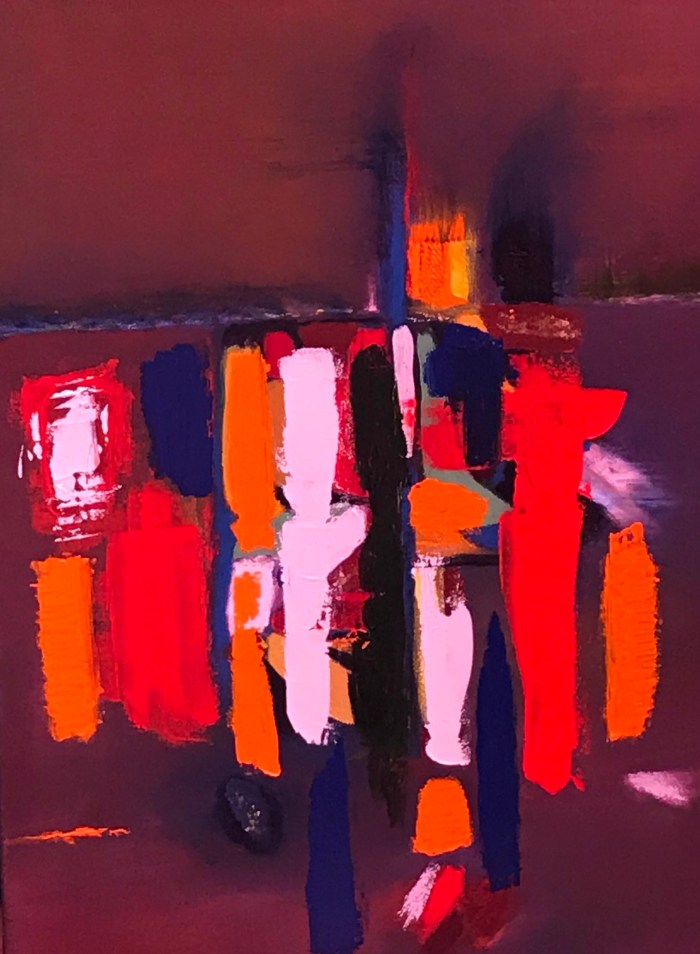
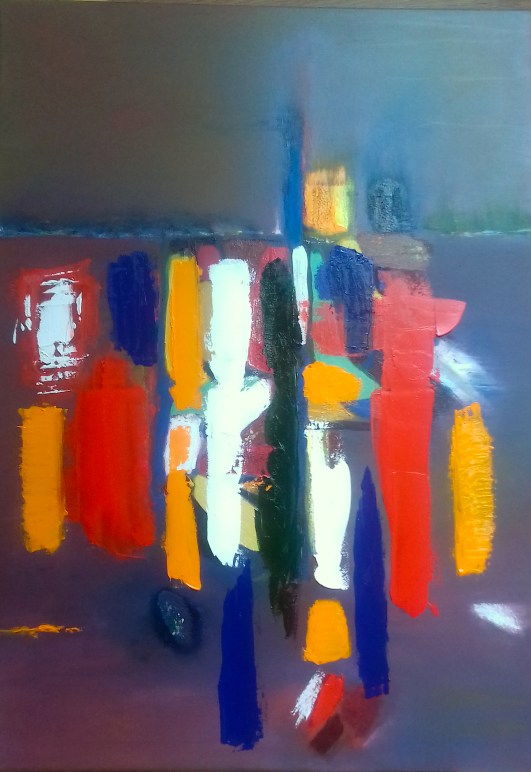
Dash of colour, John Lyons (70 x 50 cm, oil on canvas)
A quick dash of colour
A quick dash of colour to suggest dusty fields of wheat and barley green pastures where sheep and cattle graze the gentle hills and dales through which blue rivers run their course the red flourish of poppies in the wide meadows quivering on their slender stems
the colour of earth and blue skies and white clouds riding high : this is where life lives where hearts break and are mended and where energies are all but exhausted in the pursuit of love



 johnjosephlyons