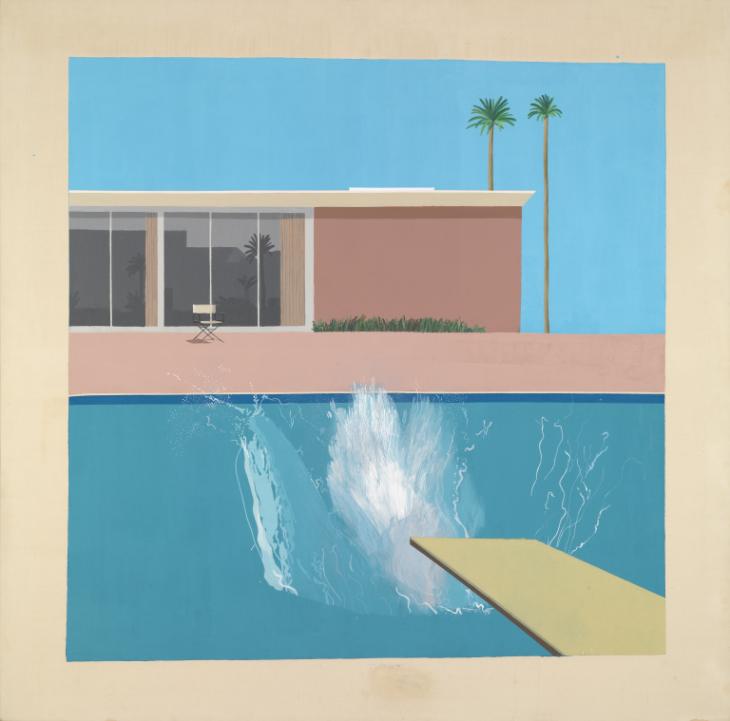
David Hockney, A Bigger Splash (1967), acrylic on canvas. Click to enlarge.
I have chosen David Hockney’s painting, A Bigger Splash (1967) from the Tate Britain collection, to accompany a new poem by Molly Rosenberg. The connection is perhaps rather tenuous, but both the poem and the painting deal with absence.
In Molly’s sensitive poem, a personal loss is registered and there is a tense equilibrium between the absence of one life and the presence of another. Hockney’s composition, however, captures the sad, dreary perfection of a Californian day by the pool. Here the pastel colours are deliberately drained of life, and the hard geometrical edges of the draughtsmanship are used to highlight the lifelessness of the scene. What is missing from this painting is the richness of life, there is no hint of a body anywhere. The splash that occurs is tantamount to an attack on the vapid soullessness of the scene, an act not of vandalism but of defiance and rebellion, a yearning for life.
Missing out
Glint of shining Aqua At times almost blinding. A boy figure stands At the edge of the pool. Elongated limbs that will stretch With the promise of years to come. The grandchild he so longed for, yet never saw. Impatient, he left before age could claim him.
Corn-coloured hair ruffled beneath the surface Drifts like weeds on the riverbed. Honeyed limbs, silky smooth Bejewelled with crystal drops. He’d have held your small soft hand in his. Delighted as you tightly clasped your arms around his neck.
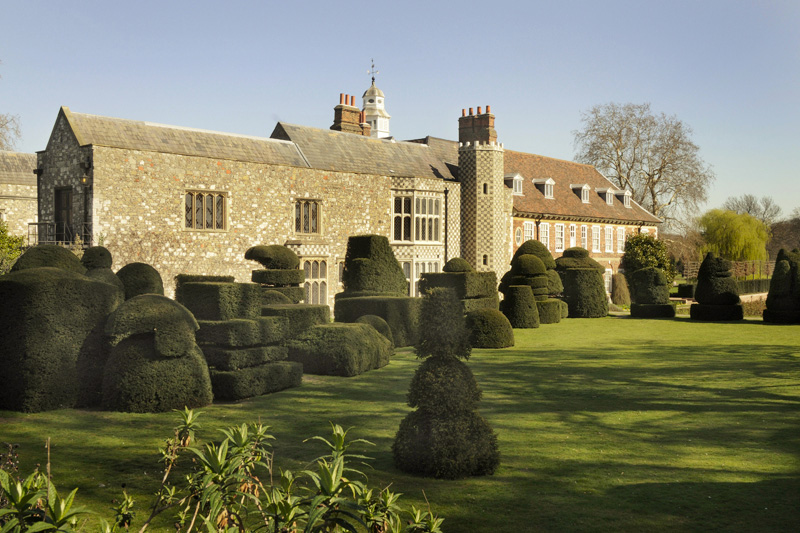
Mansion by the Cray 17th century red brick conjoined to Tudor checkerboard of flint and rubble A rectangular rose garden sweeps down to the river So many years of my life drained away here Across from the topiary a wide open pasture where families graze where lovers lie in the summer-long grass where the restless wander up to the rockery wormwood and wild garlic poinsettias and marigolds It’s a place to visit when life no longer crowds you out or weighs upon your shoulders its trees have known generations and sheltered them with kindly indifference from scorching summer suns from sudden seasonal downpours Ducks abound— one of the main attractions their ugly offspring reminding us that quite possibly we may with age improve Only the majestically sumptuous swans keep their distance aristocratic to the core their blood never mingling never consorting with lesser species
Over the weir the waters rush creating a stream of brilliant white foam the suds of which gradually subside into a mirror-smooth surface These waters once held her reflection her short dark hair that barely touched her shoulders held our reflection as we kissed : into these waters
we poured such innocent love perhaps our dreams and as evening fell home we tramped hand-in-hand across the narrow gravel pathway back into the abrasive bustling world in which so little stands still for long in which next to nothing not even love lasts forever
This blog is primarily dedicated to the writing and the translation of poetry, although during the so-called ‘silly season’ of the summer, I have strayed and wished to experiment with other types of writing, not excluding some stretches of straightforward nonsense which I have categorised as drivel. Some of this drivel, the story of Jonah and Anna-Belle, for example, has served its purpose as a sort of catharsis.
Furthermore, (and perhaps there is no need to state the obvious) I am no art critic, and it may have seemed a little presumptuous on my part to offer my views on a handful of paintings. Nevertheless, I have dared to write about those paintings that did catch my eye during visits to London galleries, in the knowledge that although I might be completely misguided in my interpretations, at least I have expressed my belief in the fundamental value of art. It has been a valuable exercise for me at least.
Writing is central to my life, and it is the activity most capable of lifting my spirits if I ever feel dejected. The moment I begin to write, the world around me disappears and I remain totally focused on the lines in front of me. That does not mean to say that whatever I write is necessarily of any value to anyone other than myself. The lines below were written this evening.
This road
This road takes me back into myself back into my country into my intimate landscape along paths where wheat and barley grew where oak was planted where elm and chestnut offered me shade and where love was once possible
This road takes me past a home I once occupied beside ditches and warrens and streams that meandered carelessly into the future a home where I was content and where one road led naturally to another to where a friend once lived or to where I first kissed a girl her body pressed tightly against mine so that I felt the purity of the energy that coursed through her veins that made her skin glow and I savoured the tenderness of her lips as I looked into her eyes on a day that I wished would never end
In a sense it never did
This road took me to Paris to Madrid and later to destinies far beyond to climates I never imagined and to challenges I never knew that I would face But this road remained always a path that led back to the home I loved and to those I loved with all my heart
All my life I have been a voracious reader and I will read anything anywhere, whether it’s words on a passing T-shirt, graffiti on buildings, anything: as soon as my eyes light on text, I’ll read it. As a youngster, one of the great joys of Christmas was the knowledge that I would receive five or six new books as presents, particularly from the parents of family friends. Coral Island by R. M. Ballantyne was one of my favourites: I loved the descriptions of the tropics and the exotic names of the different fruits and vegetables, yams, breadfruit, papayas, and so forth. Published in 1857, it was a text that William Golding drew on quite heavily when writing The Lord of the Flies.
Naturally these Christmas books did not last forever: they were soon devoured and I would be off in search of more. So I have always been a big fan and a great user of the public library system in this country. I grew up visiting the libraries, particularly in Bexley Village, and I got to know all the librarians immediately, or should I say, they got to know me as I pestered them week after week for new books.
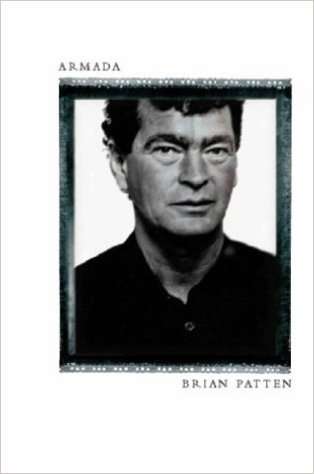
Brian Patten, Armada (1996)
Anyway, a couple of weeks ago, while others were off sunning themselves in foreign climes and enjoying the local vintages, I found myself with time on my hands in the mediaeval town of Dartford. The sun was out and the beautiful displays of flowers in the park were in full bloom, so I sat there and topped up my tan for about thirty minutes. But being a busy busy busy sort of person, I couldn’t sit there all afternoon, so I decided to enter the pubic library which is adjacent to the park. I love to peruse the shelves in these libraries to see what sort of selection they have, whether any of my favourite authors are included or excluded. Dartford is, after all, a funny old town: there you can cross paths with a Chinese man with long straggly dreadlocks wearing a Nirvana T-shirt and take it completely in your stride.
Anyway, into the library I go and I run my eyes across several shelves until I come across a book of poetry, Armada, by Brian Patten, not a poet I usually have had much time for in the past. Truth is, in the early days of the famed Liverpool poets, I went to hear him read in a small venue in Oxford, and he was so shy that after reading one poem he stood up and stumbled out (he’d clearly had one or two pints) leaving his audience mystified and disappointed. Poor man! I’m more sympathetic these days but back then, I thought it was the end. Still, always prepared to give him another chance, I take the slim volume to a desk and sit down and start to read the poems. Five minutes into the process, a man comes up to me and leans on the desk so I get the full benefit of his 40 per cent breath (this is 3.30 in the afternoon). He tells me he’s a local historian and is going to give a lecture on the history of the area on the following afternoon, would I like to go. There was, of course, only one answer to that.
Back to the poetry. Not a fan of the jokey Liverpool stuff, I am pleasantly surprised by what I am reading and I plough on and I’m genuinely moved by the unsentimental nostalgia that Patten evokes for the vanished neighbourhood where he grew up. With my loyal readers in mind, I jotted down a couple of quotations from the text to give a taste, but I would highly recommend the book to anyone who spots it in their local library.
By the time I got to where I had no intention of going
Half a lifetime had been passed.
I’d sleepwalked so long. While I dozed
Houses outside which gas-lamps had spluttered
were pulled down and replaced,
And my background was wiped from the face of the earth.
from “Betrayal”
*
One by one the souls of these houses and their tenants
have been undone by the fingers of bankers.
Among the debris where the religion lady wept
now only a sprinkler weeps.
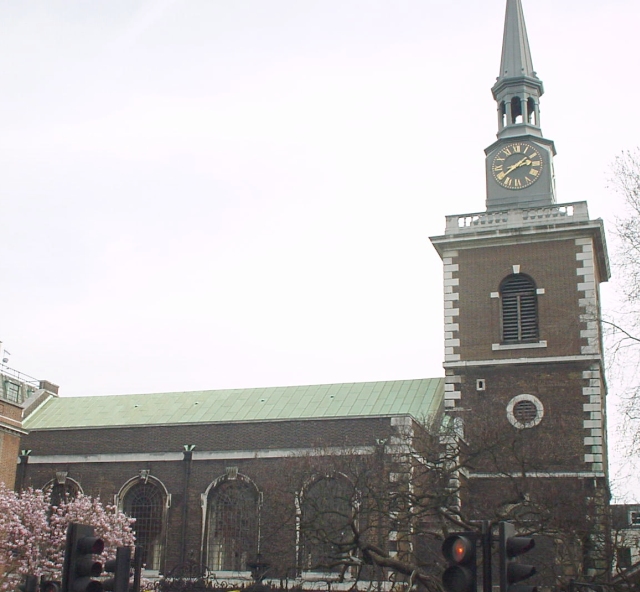
Off to St James Church, in Piccadilly, to see the font where the poet William Blake was christened. Had other plans but the torrential rain put a stop to that. Rain proof jacket proved not to be rain proof, so soaked through. Decided I’d better prepare for the Bank Holiday monsoon by stocking up on a few DVDs, so traipsed up to FOPP in Shaftesbury Avenue. Truffaut’s Les 400 coups, Godard’s Vivre sa vie, and Vittorio de Sica’s Bicycle Thieves. Should keep me from being too busy busy busy!
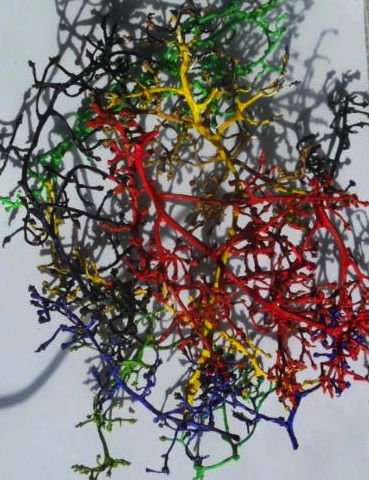
Came home dripping wet! Painted a few grape stems, had dinner and called it a day. Win some, lose some. C’est la vie!
Poor man’s Pollock
Unquiet soul
We are unquiet souls, born
not to silence, but to rhythm,
to the steady beat of life
first heard in our mother’s womb,
the rush of her blood, the rise
and fall of her heart rate
as she agonises over her ecstasies;
we are born to sound that plays
upon the drum that travels
through bone to our very hearts;
the voice of the wind
in the chimney, or the crash
of waves on the pebbled shore,
the call of owls or the far cry
of the cockerel speak to the core
of our being since we are cousins
to the world. That birds speak
in song should be a lesson to us,
pure music to our ears, and all life
imitates life, the synchronicity
of tempers and temperaments,
and though we may dance
to the tune of silicon, it is of scant
importance, the dance is the thing,
movement, the thrust of one leg
forward, then another, the rejection
of stasis. Beauty that is movement,
the orchid that blooms unseen
in the forest, unseen by whom?
The blush of beauty that stirs the heart,
the hush of lovers’ confidences,
their thrusting tongues and limbs,
hands that respond to liquid language
poured into the lobe from lovelorn lungs.
We are born to bear fruit, to divide
and conquer, to join forces, to respond,
unquiet souls until the grave.
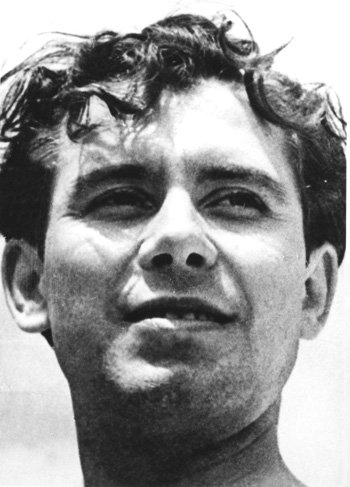
I was in Mexico in 1976, en route to the rainforests of the Yucatan to visit the ruins of Mayan cities as part of my doctoral research before travelling on down to Nicaragua. In Mexico City I stayed for a few days in a house in the magical neighbourhood of Coyoacan. It was in this part of the city that artists Diego Rivera and Frida Kahlo lived, and where Trotsky set up home in exile and where eventually he was assassinated. Their homes were now museums and within walking distance of the beautiful house where I was staying. That house had once been home to the Spanish poet Manuel Altolaguirre (1905–1959) who had come there in exile in 1939, at the end of the Civil War in Spain. Altolaguirre had been active on the Republican side of the war and was friends with many of the leading poets of the day, including the Chilean poet, Pablo Neruda and Spain’s leading poet and dramatist, Federico García Lorca. Lorca had been murdered by members of the Nationalist militia in 1936, a few weeks into the war.
For many years after, I would look in bookshops for editions of the poetry of Altolaguirre but everything seemed to be out of print. Then one day in 2002, I walked into the Livraria Cultura, the largest and best bookshop in São Paulo, and there sitting on the shelves in the Spanish language section, as though it had been waiting for me, was a copy of Altolaguirre’s poetry. Five of those poems I have translated today, and I have appended the Spanish originals for those who may care to consult them.
The light and I
The light and I invent you, city, as now in the breaking day of fantasy and sun you are born into the world; city still hazy, with blood, light and dreams on your white facades.
I don’t know what dawn I cast on buildings, nor what morning sun illuminates the valley, the sea, the streets, within me. The world and I have exchanged lights.
*
Outside myself
Today to me my body seems a recollection of me. It’s not my memory that lives in my forehead, but my whole body which is huddled within it, among the clouds, waiting for the death of oblivion. I’m now more than me. I shaped my surroundings, wrapped my soul around me, abandoned the life of men. I want to forget my body, would like it to sleep within me. Its external dreams will flood my spirit. Foreign populations, new gods, different elements, surround it. I’m dictating words to the one I was in the world, who believes he detains me under his watchful eye, the one I’m bossing about, overshadowing, the one who writes this story.
*
Kiss
How lonely you were inside! When I peered through your lips a crimson tunnel of blood, dark and sad, plunged deep down to the ends of your soul.
When my kiss penetrated, its warmth and its light sent tremors and shocks through your stunned flesh.
Since then the pathways that lead to your soul you want never to be deserted.
How many arrows, fish, birds, how many caresses and kisses!
*
The Elm is reborn
If I can no longer see myself, if only my roots survive, if birds look in vain for where their nests were amid the sad absence of my arms, do not cry for this.
In a Spring silence, verdant shoots of life will emerge from the earth like tears.
I will be that horde of adolescents, that laurel wreath that encircles the trunk sundered by the axe.
Life multiplied brings death. Multiple are the rays of dawn.
*
Elegy for Federico García Lorca
I forget to live if I remember you, I recognize that I am dust of the earth and I incorporate you, as does that part closest to your grave, insensitive land that usurps the zealous love of your friends.
With your life over, its outline is forever fully drawn: there’s no door to take you into the future.
The tree of your name has blossomed into an incalculable Spring. Death is perfection, a rounding off. Only the dead can be named. We who live are nameless.
The mythical makers of fame catapult the chants of your name world-wide and life’s lake opens its eyes with endless eyelids of glass: There is no mountain, no sky, no plain, that does not concentrically enhance the echo of your illustrious name.
It’s not a brother’s grief, not human pain, my suffering is part of the sentiment that turns the pensive stars into flowers embroidered on the night that shrouds you. I write these words separately from the daily pattern of my sleep, from a distant planet where I suffer your irreparable loss in tears.
Translations by John Lyons
YO Y LA LUZ
Yo y la luz te inventamos,
ciudad que ahora en un alba
de fantasía y de sol
naces al mundo;
ciudad aún imprecisa,
con sangre, luz y ensueño
en tus blancas fachadas.
No sé qué madrugada
sobre los edificios voy dejando,
ni qué sol mañanero
ilumina la vega, el mar,
las calles, interiores de mí.
Hemos cambiado mundo
y yo nuestras luces.
FUERA DE MÍ
Mi cuerpo hoy me parece
un recuerdo de mí.
No es mi memoria
la que vive en mi frente,
sino mi cuerpo entero
el que está arrinconado
en ella, entre las nubes,
esperando la muerte del olvido.
Yo ya soy más que yo.
Formé mi ambiente,
me envolví con mi alma,
abandoné la vida de los hombres.
Quiero olvidar mi cuerpo,
dormirlo en mí quisiera.
Sus sueños exteriores
inundarán mi espíritu.
Poblaciones extrañas,
dioses nuevos,
elementos distintos,
lo rodeen.
Voy dictando palabras
al que yo fui en el mundo,
al que cree contenerme
debajo de sus ojos,
al que estoy dominando,
ensombreciendo,
al que escribe esta historia.
BESO
¡Qué sola estabas por dentro!
Cuando me asomé a tus labios
un rojo túnel de sangre,
oscuro y triste, se hundía
hasta el final de tu alma.
Cuando penetró mi beso,
su calor y su luz daban
temblores y sobresaltos
a tu carne sorprendida.
Desde entonces los caminos
que conducen a tu alma
no quieres que estén desiertos.
¡Cuántas flechas, peces, pájaros,
cuántas caricias y besos!
EL OLMO RENACE
Si ya no puedo verme,
si de mí quedan sólo las raíces,
si los pájaros buscan vanamente
el lugar de sus nidos
en las tristes ausencias de mis brazos,
no hay que llorar por eso.
Con el silencio de una primavera,
brotarán de la tierra como llanto
insinuaciones de verdor y vida.
Seré esa multitud de adolescentes,
esa corona de laurel que ciñe
el tronco quebrantado por el hacha.
Multiplicada vida da la muerte.
Múltiples son los rayos de la aurora.
ELEGÍA A FEDERICO GARCÍA LORCA
Me olvido de vivir si te recuerdo,
me reconozco polvo de la tierra
y te incorporo a mí, como lo hace
la parte más cercana de tu tumba,
esa tierra insensible que suplanta
el amoroso afán de tus amigos.
Acabada tu vida, permanece
con su total contorno dibujado:
no hay puerta que te lleve a lo futuro.
El árbol de tu nombre ha florecido
en una incalculable primavera.
La muerte es perfección, acabamiento.
Sólo los muertos pueden ser nombrados.
Los que vivimos no tenemos nombre.
Los míticos honderos de la fama
tiran los cantos de tu nombre al mundo
y el lago de la vida abre sus ojos
con párpados de vidrio interminables:
No hay montaña, no hay cielo, no hay llanura,
que en círculos concéntricos no agrande
el eco de tu nombre esclarecido.
No es dolor fraternal, no es pena humana,
es parte, mi pesar, del sentimiento
que hace de las estrellas pensativas
flores sobre la noche que te cubre.
Te escribo estas palabras separado
del cotidiano sueño de mi vida,
desde un astro lejano en donde sufro
tu irreparable pérdida llorando.
Yesterday Eve Grubin was due to give a talk at the British Library entitled “The Poetics of Reticence: Emily Dickinson and Her Contemporaries”. Unfortunately, owing to circumstances beyond her control, this lecture was cancelled.
Ms Grubin is an excellent poet in her own right and we have decided to print two of her poems which are readily available on her own site which readers may consult for further material (http://www.evegrubin.com/close.php).
It is not difficult to see why Eve Grubin is drawn to the poetry of Emily Dickinson: her own poetry is spiritual and mysterious and driven by minute observations, reflecting the great sensitivity of a life lived intensely, passionately.
We hope that in the not too distant future she will be able to return to the British Library to deliver her talk on Emily Dickinson and in the meantime we send her our best wishes.
Eve Grubin was born and raised in New York City. She was the Programs Director at The Poetry Society of America for five years (2001-2006). She divides her time between London and New York.
When the Light Begins to Close
When the light begins to close, just before it closes,
I am looking out the window or walking beside buildings,
a wave of uncertainty—suffocating, numinous—rushes my throat,
quick, unmistakable.
Suddenly I am my name:
standing in the garden, the fruit eaten, seeds burning the dust.
Loneliness, slanted cold enters the air around my neck.
Eve looks at the wet eyes of the animals, once soft and brown. The rotation of the earth moves through her, me.
Holiness, a slanted cold
sifts the spaces between my fingers.
At end of day, light contracts: I stare into trees and lamps, the gray
sidewalk, shadows walking into shadows. What is it
about the transition between sun and dark, hope and gloaming,
that constricts, elates?
*
A Boat of Letters
arrives, and I lie down in its white wet,
ink prints on my cheek, feet, and dress.
Last night I dreamt my husband
held me like a forceful wind
as I strained forward to hear
a group of girls sing soft, unclear,
in our doorway.
I pushed towards them. They seemed far away.
He was strong, and I struggled against him.
Boat of letters, filled to the brim,
take us to your wild inky swamp
where leaves hang down like muted lamps,
where we can write and read; and with each broken seal,
let there be an answer, a surprise, something delightful!
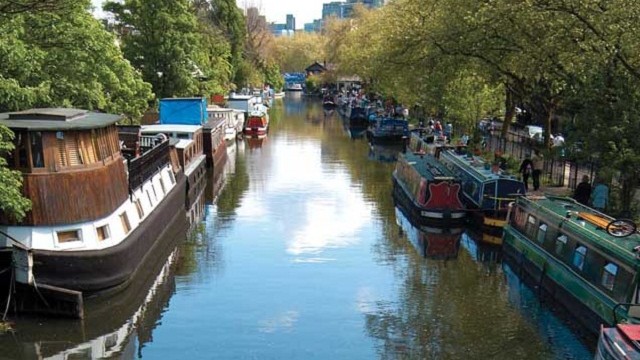
One of the joys of life, when I lived in North Kensington in the 1980s, was to be near the Grand Union Canal. I would usually join the path close to Kensal Green cemetery, and walk under the bridge by Portobello Dock and continue on down to Westbourne Park. Occasionally I would push on as far as Little Venice (pictured) in Paddington, where the waterway becomes the Regent Canal. For those who don’t know it, Little Venice is an utterly charming oasis of tranquility: here you will see all the prettiest, best-kept barges, many of them teeming with fresh flowers.
The heron mentioned in The Cross (the story posted earlier today) is the same bird that features in the poem below. I saw the heron sitting in the undergrowth on the north side of the canal, that is, the side opposite the towpath, close to the cemetery wall. What struck me most at the time was how rare it is to see ageing wildlife. I know that cats when they are about to die often run away or go into hiding so that they can end their days discreetly and in dignity. On the day in question, the sadness of this bird’s fate really touched me and I felt that the least I could do was to make a space for it in my poetry. In later years, I must confess, I have also worried that the heron might have been an omen. I hope not!
Heron
That heron I saw
on the canal bank
half-hidden in the bushes
standing in nettles,
all confidence gone
looking old and bedraggled,
it’s long slender legs
begrimed, its feathers
clogged with oil
doubtless released
from a careless barge.
And yet
you don’t expect
to see a heron
looking old
and defeated,
once vigorous wings
as though clipped.
It barely raised
its head
as I passed,
its opaque eyes
half-heartedly scanning
the opaque,
stagnant waters
for some
lithe living form
to devour.
A crestfallen heron
as though lost
as though displaced
as though homeless,
a heron fallen
on hard times
in old age,
a creature of
beauty trashed
by time and
circumstance.
None of these things
is to be expected
in a heron.
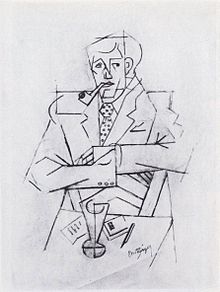
‘Le Pont Mirabeau,’ however, is a rather more traditional lament to the passing of time and the fading of love. The bitter-sweet, melancholy tone was inspired by the poet’s troubled and ultimately doomed relationship with Marie Laurencin.
In addition to writing poetry, Apollinaire was a journalist and an art critic and is credited with having invented the terms ‘surrealism’ and ‘cubism’ He was a very close friend of Picasso and also of Gertrude Stein.
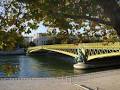
‘Le Pont Mirabeau’ has become one of the best-loved and most famous poems of French literature, and the first lines of the poem appear on a metal plaque on the Paris bridge in memory of this great poet.
The illustration is Étude pour le portrait de Guillaume Apollinaire, by Jean Metzinger, and it dates from 1911.
Under the Mirabeau Bridge
Under the Mirabeau Bridge flows the Seine Just like our loves Must I recall The joy that always followed pain
Night falls the bell tolls The days fade but here I remain
Hand in hand let’s stand face to face While beneath the bridge Of our arms the waves Of eternal longing flow languidly by
Night falls the bell tolls The days fade but here I remain
Love fades away like the water that flows Love fades away How slow is life And how aggressive is Hope
Night falls the bell tolls The days fade but here I remain
Days pass the weeks pass too Neither time gone by Nor our loves will return Under the Mirabeau Bridge flows the Seine
Night falls the bell tolls The days fade but here I remain
The Japanese haiku is a poem which replaces a few simple brushstrokes of the painter with a few simple words. It is a style of observational poetry built from short strokes of language.
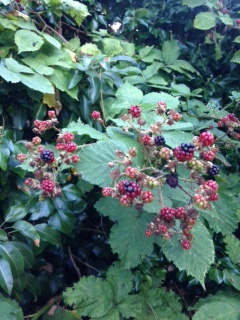
Art is about observation and consciousness and the transference of that consciousness into an expressive form to create an aesthetic object. Sounds complicated, but it can be as simple as the representation of a bison on a cave wall, or as a poem by Molly Rosenberg, inspired by the picking of seasonal fruit.
Blackberries
Tearing skin
on sharpest thorns,
spots of crimson
stained on white shorts.
Deep green leaves,
folded, curled,
hiding the treasure
embedded within.
A glint
of purple blackness,
first a single berry
then a cluster,
more and yet more
appear amid the cruelty
of the thorns
and the gentleness
of the leaves.
After the stabbing
and the pain
the sweetness
of the reward.



 johnjosephlyons
