With poetic licence – Adélia Prado

Adélia Prado

When I was born a slim angel,
the type that blows trumpets, announced:
she’ll carry the flag.
Very heavy load for a woman,
even today a downtrodden species.
I welcome the tricks that suit me,
without having to lie.
Not so ugly I can’t marry,
I think Rio de Janeiro’s beautiful and
do and don’t believe in painless childbirth.
But, what I feel I write. I’m true to my stars.
I inaugurate bloodlines, found realms
—pain is not bitterness.
My sadness has no pedigree,
but my longing for joy,
its roots go back a thousand years.
To limp through life is man’s fate.

Women are flexible. I am.

Adélia Prado

(translation by John Lyons)

Brazil’s greatest living poet, Adélia Prado was born in 1935 and lives in Divinópolis, Minas Gerais.


Com licença poética

Quando nasci um anjo esbelto,
desses que tocam trombeta, anunciou:
vai carregar bandeira.
Cargo muito pesado pra mulher,
esta espécie ainda envergonhada.
Aceito os subterfúgios que me cabem,
sem precisar mentir.
Não tão feia que não possa casar,
acho o Rio de Janeiro uma beleza e
ora sim, ora não, creio em parto sem dor.
Mas, o que sinto escrevo. Cumpro a sina.
Inauguro linhagens, fundo reinos
—dor não é amargura.
Minha tristeza não tem pedigree,
já a minha vontade de alegria,
sua raiz vai ao meu mil avô.
Vai ser coxo na vida, é maldição pra homem.

Mulher é desdobrável. Eu sou.
Eugenio Montejo – Caracas

2000_mall_caracas

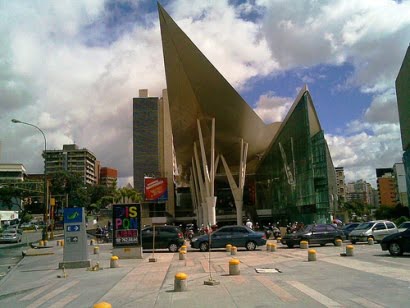
Caracas seen from the Milleniumm de Los Dos Caminos Mall

So tall are the buildings that
nothing of my childhood remains to be seen.
I’ve lost my back yard with its slow clouds
where the light dropped ibis feathers,
Egyptian clarities.
I’ve lost my name and the dream of my house.
Rigid walkways, tower upon tower,
now hide the mountain from us.
The din grows a thousand engines per ear,
a thousand cars per foot, all deathly.
Men chase after their voices
but the voices drift
behind the taxis.
More distant than Thebes, Troy, Nineveh
and the fragments of their dreams,
where was Caracas?
I’ve lost my shadow and the feel of its stones.
Nothing of my childhood remains to be seen.
I can grope my way through its streets now
increasingly lonely;
its space is real, unflinching, solid concrete.
only my history is false.

Eugenio Montejo
(translation by John Lyons)


See Eugenio Montejo 21 grams

Party time

Steel fireworks
How charming these illuminations
     Artificer’s artifice
Lends a little style to courage

Two air-burst shells
Pink explosion
Like two breasts set loose
Their nipples insolently pointing
WHAT A LOVER
                  What an epitaph

A poet in the forest
       His revolver half-cocked
Observes with indifference
Roses dying of hope

He thinks of Saadi’s roses
And suddenly his head slumps
When a rose reminds him
Of the soft curve of her hip

The air stinks with a terrible alcohol
Filtered by half-closed stars
The shells caress the soft
Night perfume where you rest
     Mortification of the roses

Guillaume Apollinaire
(translation by John Lyons)


Note: A later version of this poem appeared in the previous post

Warrior roses – Apollinaire

Celebration with steel lanterns
How charming these illuminations
Murderous fireworks
But with courage one has a good time

Two rockets pink explosion
Like two breasts that one releases
Insolently point their nipples
What a lover What an epitaph

A poet in the forest
Observes with indifference
His half-cocked revolver
The roses dying in silence

Roses from an abandoned park
And which he gathers at the fountain
At the end of the diverted path
Where each evening he strolls

He thinks of Sâdi’s roses
And suddenly his head slumps
When a rose reminds him
Of the soft curve of her hip

The air is filled with a terrible alcohol
Filtered by half-closed stars
The shells sob in their flight
The amorous death of roses

September 1915
Guillaume Apollinaire
(translation by John Lyons)


From Poèmes à Lou, a series of poems Apollinaire sent from the front line in letters addressed to his girlfriend at the time.

Schevchenko – Testament

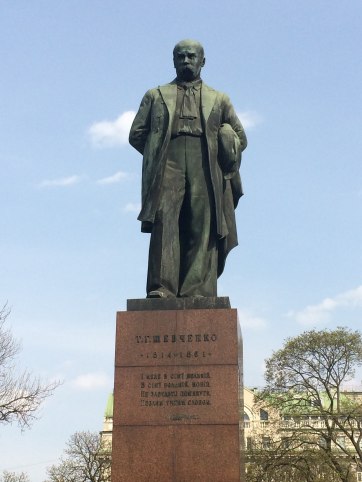
Schevchenko statue

When I die, make me a grave
High on an ancient hill
In my beloved Ukraine,
Out on the endless steppe:
Where one may see vast fields of wheat,
The steep banks of Dnipro
And hear the wild river’s
Turbulent roar.

Not until Ukraine’s forces
Have swept the enemy’s blood
Into the deep blue sea
Will I depart from these hills
And wheatlands forever :
Leave all behind, and ascend
To the throne of God
Where I’ll make my prayer.
But until that time
I’ll know nothing of God.

Make my grave there—rise up,
Throw off your shackles,
Bless your freedom with the blood
Of the enemy’s evil veins !
Then in that great family,
A new and free family,
Never forget, with kindness,
Speak of me fondly.

Taras Schevchenko

(version by John Lyons)


Taras Schevchenko (1814-1861), is Ukraine’s national poet and the personification of the Ukrainians’ thirst for liberty and independence. The statue stands in Taras Schevchenko Park opposite the National University in Kyiv. 

Flag

Schevchenko – Do not envy

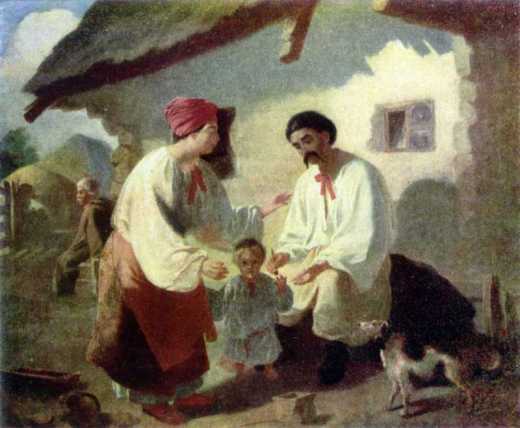
Schevchenko - a peasant family
         The peasant family, Taras Schevchenko (1843)

Do not envy the rich man,
He knows nothing ever
Of friendship nor of love—
For those he must pay.
Do not envy the powerful,
They are obliged to bully ;
Do not envy the famous
For they know well enough
It’s not they who are loved
But their bitter fame

Which in order to please gushes
From the blood and tears of bitter pain.
And to the young they meet,
All is quiet and blissful
As in paradise—but see :
Something is really wrong.

Therefore, envy, no one ;
Look around—and you will never
Find paradise on this earth,
Nor, indeed, in heaven above.

Taras Schevchenko

(version by John Lyons)


Taras Schevchenko, (1814-1861) is Ukraine’s national poet and the personification of the Ukrainians’ thirst for liberty and independence. Schevchenko was born into serfdom, but in 1838, a group of artist friends purchased his freedom with the proceeds from a sale of their paintings. Schevchenko was an accomplished painter of landscapes and historical canvases

.Flag

SUPPORT UKRAINE

Vasyl Stus – The world was hiding

Flag

stus

I knew: the world was hiding from me,
behind all things another thing hides
and snaps at my heels. All the while
it refuses to show me its true face,
because the trust and friendship between
man and the world have now been lost.
Not for no reason do the smallest birds
recoil from me, or fish scatter
the moment they recognise a human shape,
or with their fragile beauty do flowers wish
to save themselves from me (the final
shred of hope that human beings
are not entirely beyond redemption). After all,
I thought, the harmony of worlds
has not bypassed humanity, instead
a certain distance has been established:
you belong to the world only thus far.

Vasyl Stus

Version by John Lyons


Vasyl Stus (1938-1985), was a Ukrainian poet, translator, literary critic, journalist, and an active member of the Ukrainian dissident movement. For his political convictions, his works were banned by the Soviet regime and he spent 13 years in detention, until his death in a Soviet forced labor camp for political prisoners.

AROUND THE WORLD, EVERY CULTURAL VENUE AND SPACE CLOSING IT DOORS TO RUSSIAN PERFORMANCES SHOULD OFFER THEM TO UKRAINIAN CULTURE

Spain – Take this chalice from me

If Spain falls

Children,
sons of warriors, just for now,
hush your voices, since Spain’s energy at this very moment
is being parcelled out among the animal kingdom,
tiny flowers, comets and humankind.
Hush your voices, for she is
close to death, which is very grave, not knowing
where to turn, and there in her hand
the skull spouting words words words
the skull, the braided skull,
the skull, the skull of life!

Hush your voices, I beg you;
Hush your voices, the syllables of song, the weeping
of matter and the slightest murmur from the pyramids, and even
from those temples that walk with two stones!
Hush your breath, and if
your forearm droops,
if the vicious rulers ring out, if it is night,
if the heavens are squeezed between two terrestrial limbos,
if there’s noise in the sound of doors,
if I delay,
if you see no one, if you are afraid
of blunt pencils, if mother
Spain falls — you know, I’m just saying —
go out, children of the earth, go out and find her!


Above is a fragment from a poem by the great, antifascist Peruvian poet, César Vallejo (1892-1938), written during the Spanish Civil War (1936-39). The parallels with the violent Russian assault on Ukraine, which jeopardises the security of the whole of Europe, are all too clear. Translation by John Lyons.

Bolero – Julio Cortázar

workinprogress
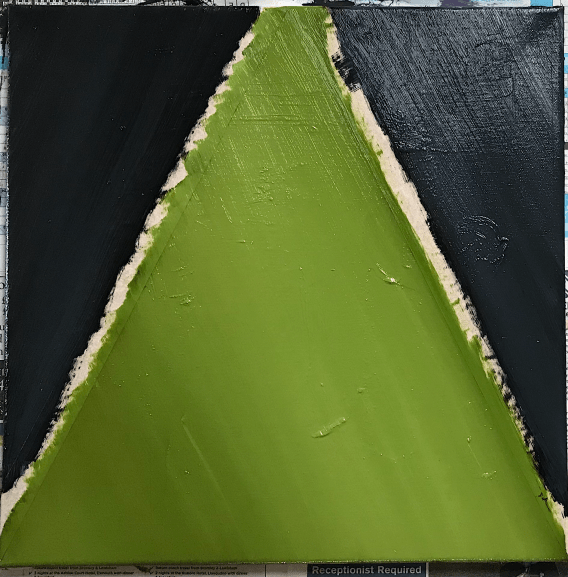
    Green mountain, John Lyons (40 x 40 cm, oil on canvas)

What vanity to imagine
I can give you everything, love and happiness,
itineraries, music, toys.
It’s true this is how it is:
all I have, I give to you, it’s true,
but all I have is not enough for you
just as it’s not enough for you to give me
all you have.

So we’ll never be
the perfect couple, the picture postcard,
if we’re unable to accept
that only in arithmetic
does one plus one make two.
 
Scribbled on a scrap of paper
that merely says:
You were always my mirror,
What I mean is, I had to look at you to see myself.

And this fragment:

The slow machine of disaffection
the gears of reflux
bodies that abandon the pillows,
the sheets the kisses 

and standing before the mirror each one
self-questioning
no longer facing each other
no longer naked for each other
I no longer love you,
my love.

Julio Cortázar

(translation by John Lyons)